
“The governor should finally reorient the state’s transportation policy around reducing vehicle miles traveled and giving all New Yorkers better, safer, more affordable options to get around and get ahead.”
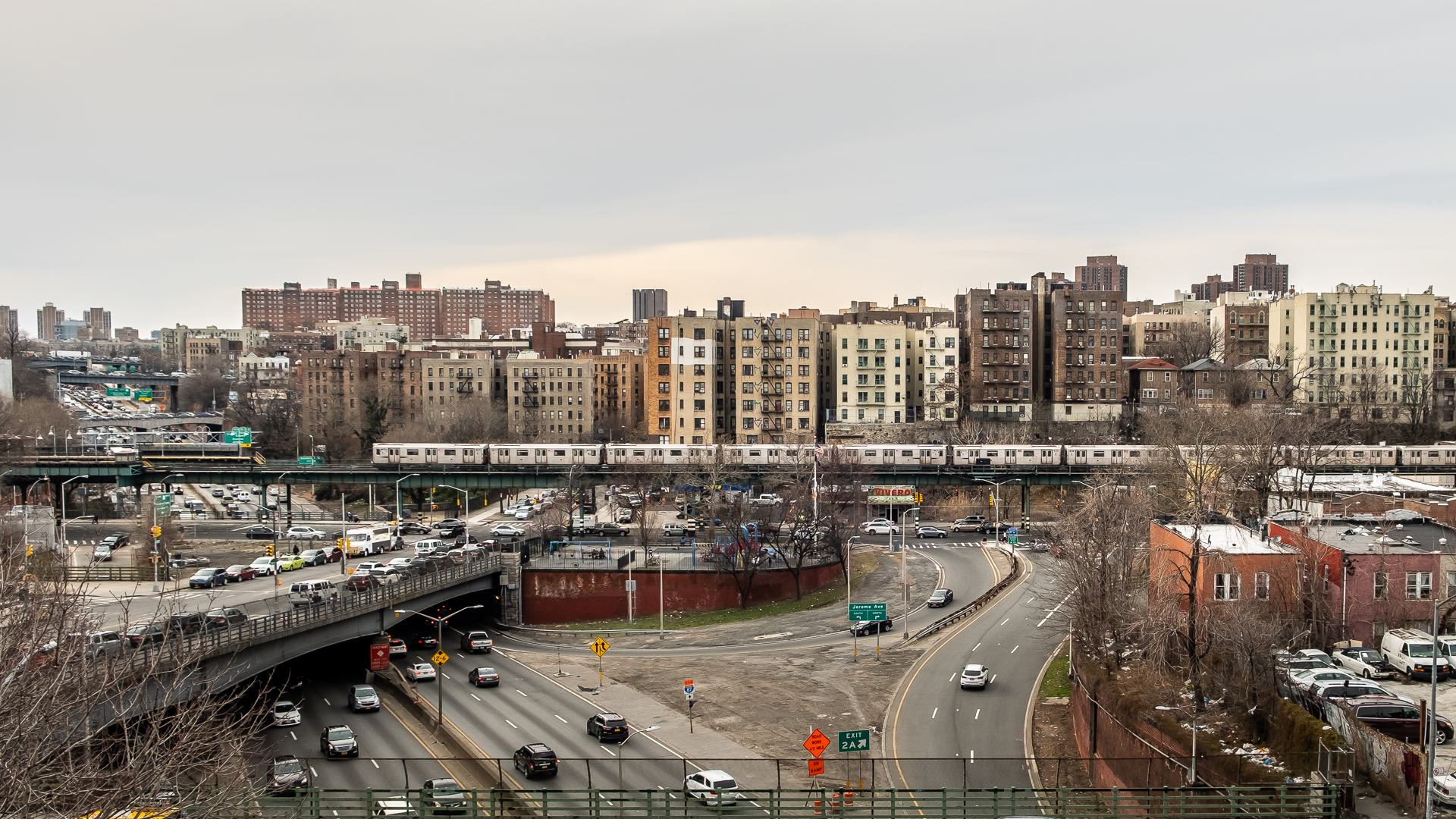 A view of Jerome Avenue with its elevated 4 train and the Cross Bronx Expressway from the Grand Concourse. (Adi Talwar)

Last century, Robert Moses rammed the Cross Bronx Expressway through East Tremont, destroying homes, dividing neighborhoods, and saddling the Bronx with some of the worst air pollution in the country. But Moses didn’t act alone. The expressway reflected a broader political consensus that treated Bronx communities as expendable in service of regional highway traffic.
Now, New York bureaucrats are preparing to repeat the same mistake. State transportation officials are preparing to widen America’s most notorious highway. What would be terrible transportation policy on its own is made worse by the simple fact that the Bronx, then as now, is overwhelmingly a community of public transit riders.
In the west Bronx, barely one-third of households have cars. As a whole, the Bronx depends more on bus service than any other borough, in a city with the nation’s largest bus ridership and slowest service. The subways run south to Manhattan; traveling east and west requires boarding a slow, unreliable bus to climb hills and cross rivers. The need for better transit could not be clearer.
Yet instead of fixing buses or improving transit connections, the state Department of Transportation plans to double down on highways.
Now that the state DOT has completed its inadequate study ahead of planned construction later this year, it’s up to Gov. Kathy Hochul to rescue Bronx communities and transit riders by sending this project back to the drawing board and reforming the agency that sent it to her desk.
Expanding the Cross Bronx would bring it even closer to public housing tenants at the Bronx River Houses, stuck in place by rising rents, who already suffer poor health outcomes from exposure to the toxic pollution out their windows. It would cast an even wider shadow over a borough sliced and diced by highways carrying traffic from elsewhere to somewhere else.
For decades, state engineers have schemed to widen five bridges over the Bronx River and nearby roadways. With congestion often at a standstill, the result would not be smoother travel but a larger parking lot for diesel trucks idling between Maine and Florida. Even the project’s supposedly modest additions, like new shoulders, would invite more traffic and deepen the harm..
The same engineers have similar plans for other segments of the Cross Bronx but they analyzed this one in a vacuum, making their review legally dubious as well as noxious. Their study excludes such obvious alternatives as altering the number of lanes or redesignating Interstate 95 onto another highway segment to the north or south. In effect, the outcome was predetermined. They cooked the books.
This approach is not new. Under Gov. Andrew Cuomo, the same DOT widened the Van Wyck Expressway through Queens to add more cars on the road to JFK Airport, despite the existence of bus and rail service and efforts to encourage people to ride public transportation to and from their flights.
There’s more: In Orange and Sullivan Counties, DOT proposes spending $1.4 billion to widen NY-17/Interstate 86 over 30 miles to save drivers, at best, six minutes. Meanwhile, New York also manages to lead the nation in highway demolition, reconnecting long divided communities in Rochester, Syracuse and soon likely Albany and Buffalo.
The contradiction is glaring. In some parts of the state, New York is dismantling the highways that once tore communities apart. In others, it is preparing to build them bigger. Leaders denounce the legacy of Robert Moses, but without a clear and coherent policy from the top, the same highway-first logic continues under a different name.
Governor Hochul has the authority and responsibility to steer a transportation bureaucracy that has drifted out of step with the needs of New Yorkers, if it ever really was in step with those needs. The Brookings Institution ranked our DOT 49th in the nation, barely ahead of last place Alabama.
Other states are charting a different course. Colorado and Minnesota are canceling highway expansions and investing instead in transportation systems that help residents get around urban, suburban and rural communities without regard to age, income or ability.
New York City already anchors the nation’s largest public transportation network, but most New Yorkers live far from a subway line. They depend on buses, regional rail, and safe streets to get where they need to go.
Whether through the budget or legislation like Assemblymember Karen McMahon’s and Senator Andrew Gounardes’s “Get Around New York Act,” the governor should finally reorient the state’s transportation policy around reducing vehicle miles traveled and giving all New Yorkers better, safer, more affordable options to get around and get ahead.
The Cross-Bronx Expressway stands as one of the clearest symbols of the damage highway-first planning inflicted on New York communities. We should not widen that mistake.
Betsy Plum is the executive director of Riders Alliance.