
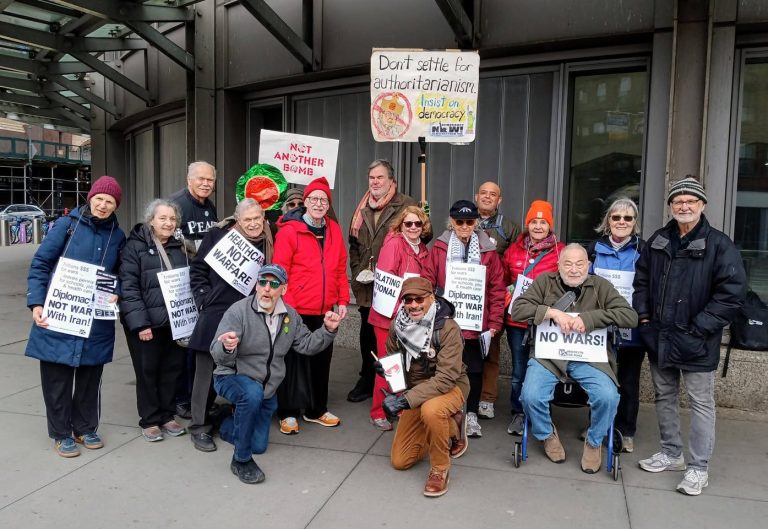
On Saturday, March 14, members of the anti-war group Brooklyn for Peace (BFP) gathered outside Atlantic Terminal at 2 p.m. for their weekly vigil to oppose the U.S. war with Iran.
For several months, demonstrators have held signs calling for diplomacy over military action, handing out flyers and urging passersby to put pressure on their senators and representatives to oppose President Trump’s military escalation both at home and abroad.
“Unfortunately we’ve had to change the leaflet almost every week, because it gets worse,” said BFP co-vice chair Bruce Altschuler.
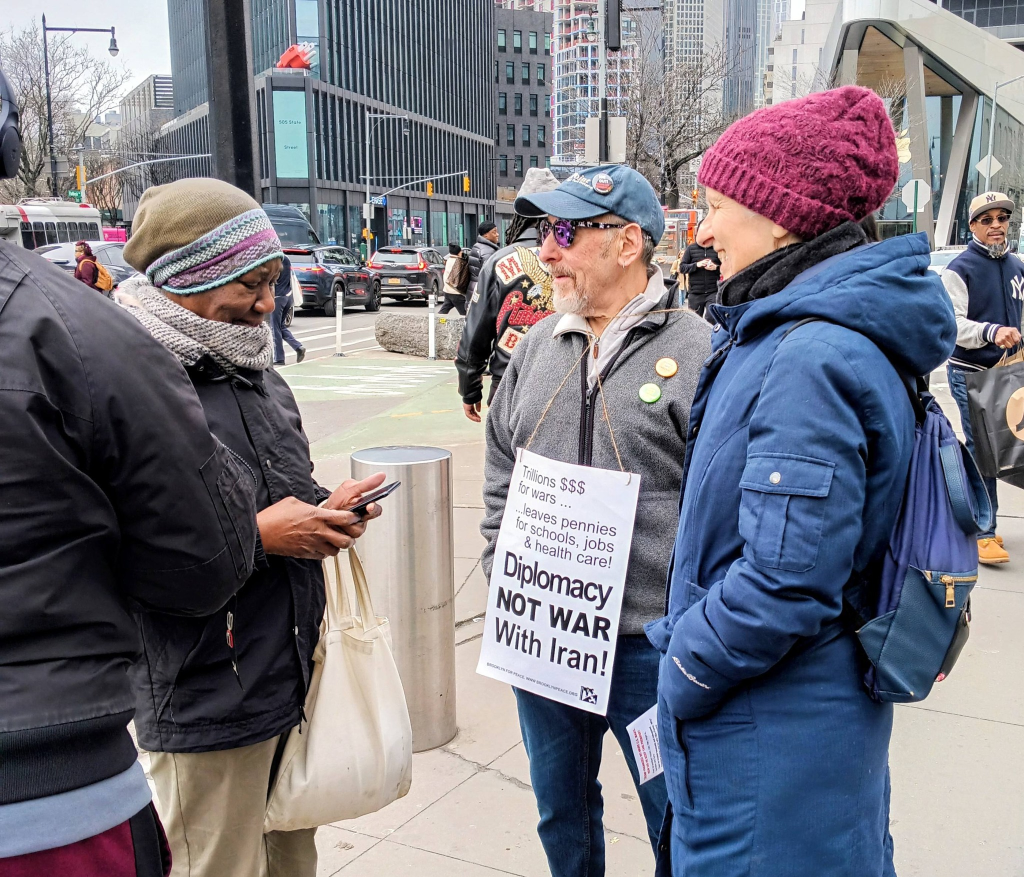 (Photo courtesy of Brooklyn for Peace).
According to Carolyn “Rusti” Eisenberg, BFP’s co-vice chair and legislative coordinator, the response from Brooklynites has largely been positive. At the crowded Atlantic Terminal plaza, weekend shoppers often stop to take photos of the signs or ask demonstrators what they can do to help.
“Every time that we’ve been here, people have come over and said they want to be involved,” Eisenberg said.
Support from elected officials, however, has been far harder to secure.
“There’s a huge gap between what ordinary people feel about this war and what we are seeing from local lawmakers, including my representative, Dan Goldman,” said Etan Mabourakh, organizing manager at The National Iranian American Council (NIAC) and a BFP board member.
Altschuler echoed Mabourakh’s frustration: “Congress has not been overly responsive,” he said, also singling out Representative Dan Goldman of New York’s 10th District, whom organizers say has been difficult to reach. Eisenberg described BFP’s relationship with Goldman as “nonexistent.”
“Our members of Congress and our senator [Chuck Schumer], who lives in Brooklyn, need to take a stand against [the war] and be firm about it. They are very far from that right now,” said Eisenberg, who is also a professor of American Foreign Policy at Hofstra University. “That’s what our work is.”
Eisenberg did, however, point to a recent victory: a meeting two weeks ago held by NIAC representatives and Wyndee Parker, policy adviser to Representative Hakeem Jeffries (NY-08), which she felt was mildly successful.
“I thought it was a real conversation. She asked intelligent questions,” Eisenberg Said. “I think one result might have been that Jeffries came out very, very strongly for the War Powers Act. So possibly that meeting made a difference.”
Eisenberg did stress that supporting the War Powers Resolution—which restricts the president’s military actions without approval from Congress—is not the same as outright opposing the war. The act failed in the House on March 5.
“It’s an irresponsible war,” Eisenberg said. “But are the Democrats going to push back in an effective way?”
The Indypendent is a New York City-based newspaper, website and weekly radio show. All of our work is made possible by readers like you. During this holiday season, please consider making a recurring or one-time donation today or subscribe to our monthly print edition and get every copy sent straight to your home.