
The majority of NFL free agency is in the books, and the New York Jets’ roster looks quite different from what it did last month.
All together, the team’s free agency approach certainly impacted how they will approach April’s NFL draft.
Here is a seven-round post-free-agency mock draft…
Round 1, Pick 2: Arvell Reese, EDGE, Ohio State
Admittedly, at first, I was a fan of Gang Green selecting Miami’s Rueben Bain Jr. in this spot. However, after his measurements at the NFL Scouting Combine, he should not even be considered at No. 2, and Arvell Reese is the clear pick.
Not only would the Jets be betting on him to be a historic outlier as a successful EDGE with very small arms at 30 3/4, but his measurements in the height and weight category were underwhelming.
Ahead of the combine, he was listed at 6-foot-4 and 263 pounds, but he measured 6-foot-2 and 277 pounds in Indianapolis, a significant difference.
On the other hand, Reese plays with unmatched strength and physicality with a tremendous amount of upside. Not only is he a great scheme fit for Aaron Glenn and the Jets’ defense, but at just 20-years-old, he also has a ton of room for growth.
Round 1, Pick 16: Kenyon Sadiq, TE, Oregon
Kenyon Sadiq should be evaluated less as a traditional tight end and more as a pure pass catcher, which is an important distinction for the Jets, who are still searching for a consistent second option behind Garrett Wilson in the passing game.
As I detailed in a recent column, the Jets must prioritize the best available pass-catcher at No. 16, and Sadiq very well could fit that description.
Unlike Bain, Sadiq’s stock soared thanks to his performance at the combine.
His 4.39-second 40-yard dash is the fastest ever recorded by a tight end since 1982. The Oregon product paired that with a 43.5-inch vertical, the second-best in combine history among tight ends, and an 11-foot, 1-inch broad jump, the third best all-time among TEs, putting together one of the most explosive testing profiles we have ever seen from a tight end.
Even after selecting Mason Taylor in the top 45 of last year’s draft and seeing encouraging flashes from him as a rookie, the Jets should not let that prevent them from selecting Sadiq.
Beyond his astonishing athleticism, Sadiq’s production backs up the hype. In 2025, he totaled 560 receiving yards on 51 catches and led all FBS tight ends in touchdowns with eight.
At 6-foot-3 and 241 pounds, he projects much more as a big-bodied pass-catcher rather than an in-line tight end, profiling similarly to Harold Fannin Jr., who was a third-round pick in last year’s draft, who thrived during his rookie season, finishing the season with 731 receiving yards, the second most among all first-year tight ends.
With Jordyn Tyson, Carnell Tate, and Makai Lemon all off the board in this simulation, Sadiq was the best pass-catcher available on my board.
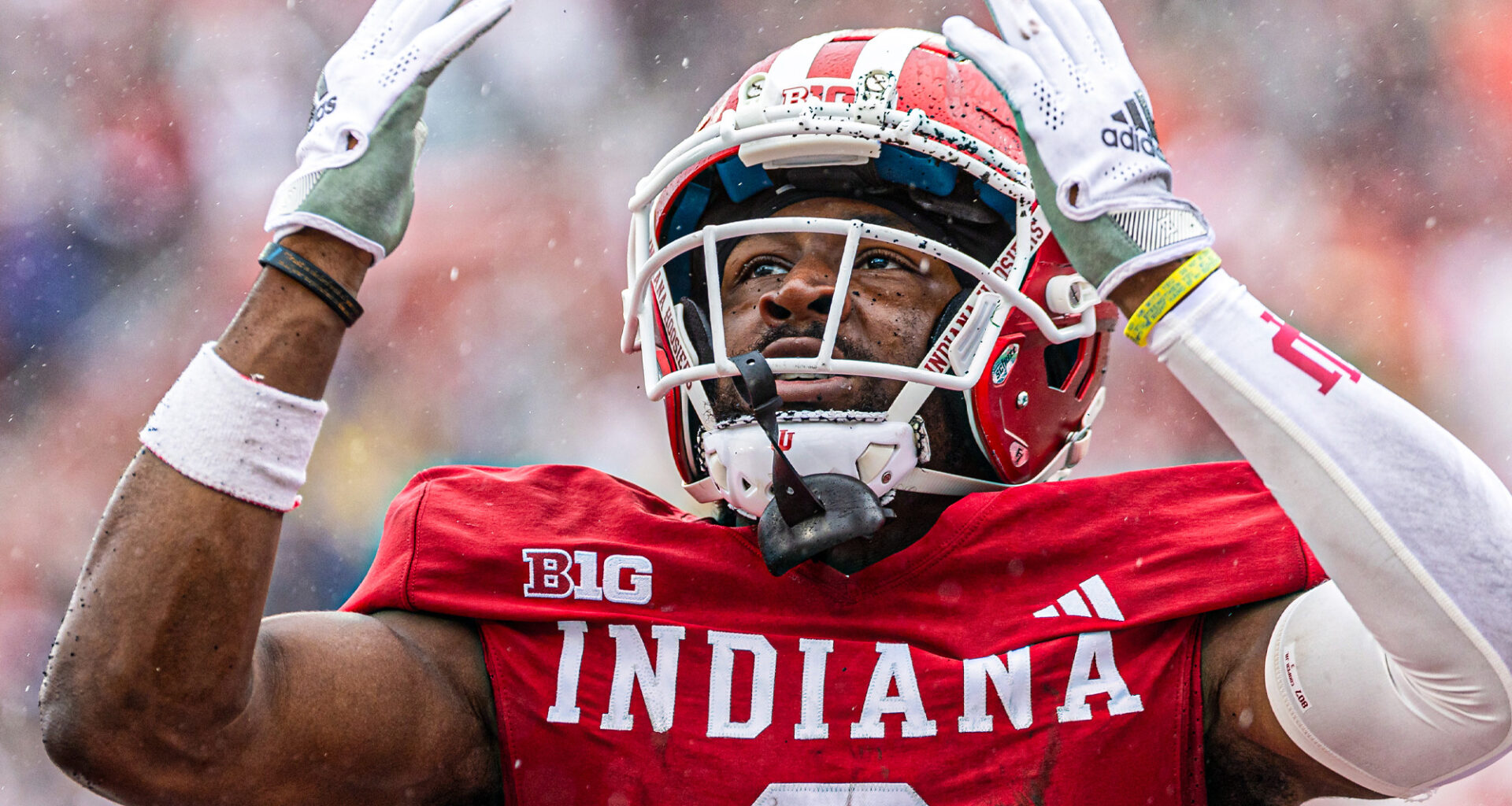
Round 1, Pick 20 (via Dallas): Omar Cooper Jr., WR, Indiana
We have a trade.
The Jets strike a deal with the Dallas Cowboys to move back into the top 20, securing a third selection in that range while adding valuable mid-round capital.
In this exchange, New York acquired picks No. 92 (third round) and No. 112 (fourth round) from Dallas, while sending Nos. 33 and 44 overall to the Cowboys.
By traditional trade value chart standards, the deal comes out nearly even, with just a 12-point edge towards the Jets.
With the pick, New York doubles up at pass catcher in the draft and secures their WR2 behind Garrett Wilson in Omar Cooper Jr.
Over three seasons at Indiana, Cooper Jr. hauled in 115 receptions for 1,798 yards and 22 touchdowns. In 2025, he posted 937 yards and 13 touchdowns across 69 receptions.
During the 2024 season, he flashed his upside as a deep threat, totaling 594 receiving yards on just 28 receptions, averaging 21.2 yards per catch. In 2025, though, he transitioned towards a heavier slot role, and his consistency stood out.
The 22-year-old logged an outstanding 143.2 passer rating when targeted, while his 27 missed tackles forced were tied for the fourth most among FBS wide receivers.
He has strong hands and the ability to finish through contact; his YAC ability stands out, and Cooper Jr. offers explosiveness both underneath and vertically.
After a trade up, the Jets exit Round 1 with Arvell Reese, Kenyon Sadiq, and Omar Cooper Jr.
Round 3, Pick 92 (via Dallas): Jake Slaughter, C, Florida
Looking to further improve their offense, the Jets go offense for the third straight pick after selecting Reese at No. 2.
One of the few bright spots for the Jets during their atrocious 3-14 year was the promise shown by their starting offensive line. The outlook ahead of the 2026 season, though, is a little different.
Olu Fashanu and Armand Membou continue to anchor the Jets at tackle, and Joe Tippmann is expected to remain at right guard after a stellar first year in that role. The only shift as of now comes at left guard, where Dylan Parham takes over for John Simpson.
What the Jets do at center is unknown.
While Josh Myers was serviceable for the team last season, the squad could certainly upgrade at the position to beef up the starting five. Overall, Myers profiles as a perfect primary backup for a top starting offensive line—not a starter.
So at No. 92, the Jets land their starting center in Jake Slaughter while pushing Myers to the bench.
While Slaughter doesn’t particularly have the best frame for a starting center at 6-foot-5 and 303 pounds, his strength and technique make up for it.
In 2025, the Florida Gator earned a stellar 79.3 overall grade from Pro Football Focus, the best among 307 qualified FBS centers. His run-blocking grade of 80.2 ranked 3rd, while his pass-blocking grade of 84.1 ranked 18th.
Overall, selecting Salughter would further catapult one of the Jets’ most promising units.
Round 4, Pick 103: Drew Allar, QB, Penn State
This appears to be the perfect position for Gang Green to take a flier on at quarterback.
In this exercise, the team takes their dart throw on Penn State’s Drew Allar. Allar fits the mold of what the Jets’ offensive coordinator covets in his quarterbacks: above-average size, a strong arm, and the ability to play well under center.
The Penn State product undoubtedly poses the most upside among any other QB the Jets would be interested in at this juncture of the draft.
After a breakout 2024 campaign, Allar entered the draft conversation as a projected first-round pick.
He helped lead the Nittany Lions to the College Football Playoff semifinals, finishing seventh among qualified FBS passers in completion percentage (66.5%) and sixth in yards per attempt (8.4) on a minimum of 450 dropbacks.
Rather than declare, Allar returned to Happy Valley, a decision that he most likely regrets.
He struggled to find consistency early in the following season before suffering a season-ending left ankle injury, halting any chance to rebuild momentum and causing his draft stock to fall drastically.
Despite that, Allar has worked to rebuild his outlook in the pre-draft process. He delivered an impressive showing at both the NFL Scouting Combine and his pro day, while showcasing his athleticism and arm strength.
Sure, the odds of Allar or any developmental option in this range becoming the Jets’ long-term QB solution are slim, but given the team’s outlook at the position for 2026, it is certainly worth a flier.
Round 4, Pick 112 (via Dallas): Michael Taaffe, S, Texas
While the Jets added much-needed beef to their safety from free agency, acquiring star Minkah Fitzpatrick and signing Dane Belton, the team could still look to add one on Day 3 of the draft.
Taaffe, 23, spent four years at Texas while moving all over the Longhorns’ secondary. While he primarily played free safety, the 23-year-old also logged reps in the box, slot cornerback, and boundary CB.
In 2025, he was also very stingy in coverage, posting a stellar 89.4 coverage grade, per PFF, the 13th best among 914 qualified FBS safeties.
Remaining Picks
Round 5, Pick 175: Kaelon Black, RB, Indiana
Round 5, Pick 178: Zane Durant, DT, Penn State
Round 6, Pick 181: Hezekiah Masses, CB, California
Round 7, Pick 219: Jimmy Rolder, LB, Michigan
Round 7, Pick 242: Joshua Braun, G, Kentucky
With the Jets’ final five selections, the organization should be looking to capitalize on upside and value.
It is always wise to select a running back on Day 3 of the draft, especially this year for the Jets. Braelon Allen is still recovering from a season-ending MCL injury, while Isaiah Davis was largely unimpressive down the stretch last year.
With their first fifth-round pick, the Jets take Indiana running back Kaelon Black, who had a top 30 visit with the team. Across 126 carries with the Hoosiers last season, he tallied 724 rushing yards and seven touchdowns while averaging 5.7 yards per carry.
Zane Durant offers upside as a pass-rushing defensive tackle, while Hezekiah Masses logged five interceptions last season.
Jimmy Rolder serves as a depth option in the team’s linebacker room with the ability to play special teams, and Joshua Braun is another body for the Jets’ IOL depth.