
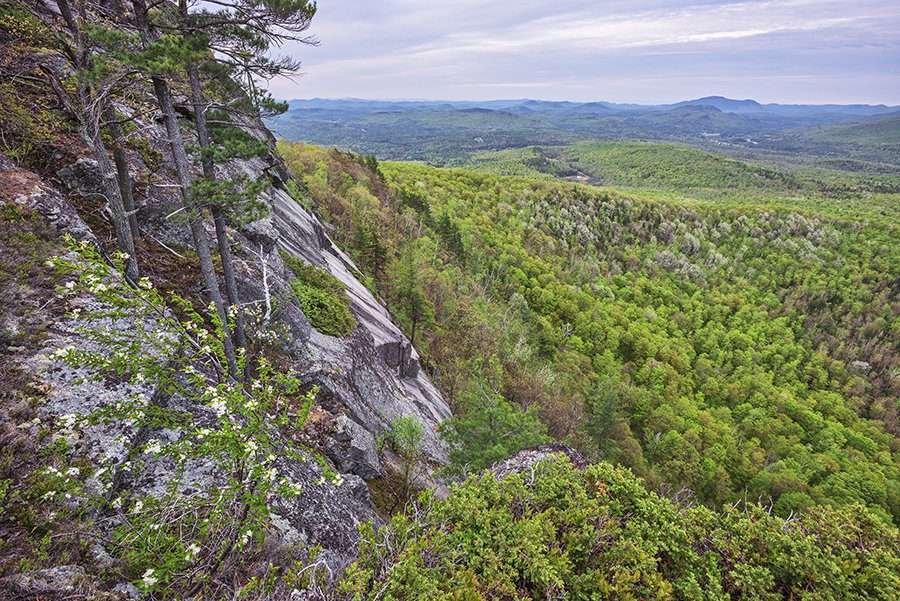
The Forest Preserve begins
Last year marked the 140th anniversary of the Forest Preserve. In 1885, after years of unchecked logging and ecological devastation, unpaid taxes, looted timber, rail fires and fears of unchecked flooding, New York established a Forest Preserve in the Catskills and in northern New York and gave responsibility for “preservation of the forests” to a Forest Commission.
In that historic act, forests then owned by New York State, and “all lands” later acquired by NYS, were placed in the Forest Preserve, in public ownership and “forever wild.”
One has only to read the first annual report of the Forest Commission for the year 1885, or “The Great Forest of the Adirondacks,” by Barbara McMartin, to see that the landmark legislation that created the Forest Preserve was addressed to forests and wild lands. W. W. Ely’s popular map that depicted the larger, northern portion was entitled the New York Wilderness.
Keep up with the stories that matter. Google recently introduced a feature allowing you to customize your search results to prioritize content from sources you trust. ADD THE EXPLORER AS A PREFERRED SOURCE
In 1892, the New York legislature drew a “blue line” in and around 11 upstate counties and established the Adirondack Park. In 1894, the Forever Wild clause was added to the New York Constitution.
From wilderness to park
Fast forward to present times. The New York wilderness grew into the Adirondack Park, a nearly 6 million acre patchwork quilt of public and private lands, about 123,000 year-round residents, 101 towns and villages, connecting roads, a $2.5 billion tourist industry, and of course, our beloved treasure, the Forest Preserve.
The Adirondack Park Agency Act of 1972 created the Adirondack Park Agency (APA), and the APA was tasked with creating a master plan for the management of state lands. What emerged, the Adirondack Park State Land Master Plan, is the governing and planning document for the Adirondack Park.
The unifying principle of the master plan is that “the protection and preservation of the natural resources of the state lands within the park must be paramount.” The plan includes an inventory of state lands within the Adirondack Park, and a classification system that covers the range of lands and uses.
DON’T MISS A THING: Sign up for a daily dose of Adirondack news, information and commentary, emailed each morning.
DEC administers the Forest Preserve
Under the master plan, DEC administers the 3 million acres of the Forest Preserve. To determine which Adirondack lands are DEC Forest Preserve, and which are not, one need only consult a New York State Forester, or examine this property map created by the New York Department of State, which shows lands administered by DEC.
State administrative areas
Apart from the Forest Preserve, there are other state-owned lands in the Adirondacks, about 100, which the APA classifies as “State Administrative Area” (SAA). By its nature, an SAA is a highly developed, state-owned support infrastructure, which relates directly to the activities of state agencies.
An SAA is the antithesis of wild land. SAA facilities are not utilized to accommodate visitors to the Forest Preserve so much as to ensure the functioning of the entire Adirondack Park, or to serve other statewide functions.
Some of these state-owned SAA lands, such as gravel pits, are administered by DEC, but the APA classifies these DEC owned lands separately from DEC Forest Preserve.
The bulk of the SAA properties are administered by the Departments of Transportation, Corrections, Environmental Facilities Corporation, Division of Military and Naval Affairs and SUNY ESF.
A modern complication
More than a century ago, the people who campaigned to protect the Great Northern Forest, as it was also known, did not anticipate that one day the Adirondacks would be part Forest Preserve and part developed towns in a rugged and vast area with a permanent non-tourist population, who could not survive without ongoing support from the state.
In 1885, 1892 and 1894, the use of the term “all lands” referred to wild natural forests comprising, or purchased for, the Forest Preserve. Today, “all lands” cannot be interpreted to mean any land owned by New York State within the blue line, no matter what its purpose, use or character.
SAA properties are not “all lands” that are subject to forever wild constitutional protections. The APA appears to support this conclusion by classifying SAA support properties, even those administered by DEC, separate from the DEC Forest Preserve.
Why does this matter? Here is one reason to care about the meaning of “all lands.”
The Armory
The APA classifies the Armory on Route 30, in the Village of Saranac Lake and in Harrietstown, as an SAA, which in turn is located within a much larger area classified by the APA as “Hamlet.”
The Armory is built on land acquired by New York State in 1955, for free, from Harrietstown, pursuant to the New York Military Act, for purpose of building the Armory. Because it is so close to the village, there is good reason to believe that before Harrietstown owned it, the Armory parcel was never in the Forest Preserve. But there is research to be done, and the question is open.
Saranac Lake is looking to relocate its fire and emergency services to another building. One proposal is to spend $27 million on a new structure. The Armory is vacant and the perfect size. In this election year, chances are good that the state would just return the now unused Armory to Harrietstown, at no cost.
What is getting in the way? The erroneous belief that the Armory is in the Forest Preserve and cannot be conveyed back to Harrietstown without an amendment to the New York Constitution. This is flat-out wrong. Why?
“All lands” means wild forests and places of natural beauty. With extremely limited exceptions, man-made structures may not be built within the Forest Preserve. This is an ironclad principle. An SAA cannot be treated as forever wild Forest Preserve because man-made and Forest Preserve do not go together.
If “state-owned” and “forever- wild” become attached, as they should not, it seems to follow that North Country Community College is in the Forest Preserve, and the new APA headquarters will be in the Forest Preserve.
Only one question
In truth, Forest Preserve is a subset of all state-owned lands in the Adirondacks, but all state-owned lands in the Adirondacks are not the Forest Preserve.
Forest Preserve means that after consideration, DEC or its predecessor state agency formally placed a surveyed parcel of Adirondack land into the Forest Preserve because of its natural characteristics, and the placement is reflected on an official map, registry or otherwise.
For any SAA land in the Adirondacks, the question is whether that land was ever part of the Forest Preserve—as a matter of record—from 1885 to the present.
If the SAA land was never formally Forest Preserve, state land ownership for an SAA purpose does not make the land Forest Preserve, and the land is not subject to forever wild protections.
On the other hand, if the SAA land was part of the Forest Preserve, but informally adapted for another purpose, the SAA would be a non-conforming structure or use in the Forest Preserve.
Conclusion
State ownership of developed Adirondack land that is not in the Forest Preserve does not automatically make that land subject to the forever wild clause of the New York Constitution.
Assuming no information to the contrary emerges, the Armory land is not, and never was, in the Forest Preserve. As such, the Armory land is not covered by the forever wild clause of the state constitution.
This means that New York State is free to convey the land and the Armory to Harrietstown or Saranac Lake at any time by a simple executive order of Gov. Kathy Hochul.