As the world’s most multicultural city says “goodbye” to Asia Week New York, it says “hello” to the Midtown Cultural Alliance Open House program, another opportunity to travel the world without leaving Manhattan. The Midtown Cultural Alliance was formed in September 2025 by five member organizations, Japan Society, The Korea Society, Korean Cultural Center New York, L’Alliance New York, and Scandinavia House, to highlight Midtown NYC as a global cultural destination.
The Midtown East neighborhood of Manhattan—from 59th street to 34th street, bound by the East River and Madison Avenue—boasts dozens of distinct international cultural organizations connecting New York audiences to global culture through the arts, exhibitions, live music, performance, film screenings, lectures, language courses, and more.
“We’re all familiar with one another and we’ve been having conversations about this idea for a long time, in part because we’re conscious of the fact that there’s so many of us in this one corner of Midtown East, and we’re aware of how wonderful and valuable each other’s programs are, but for Midtown East, it’s possible for locations to get more lost than, say, Museum Mile or the gallery district,” Lori Fredrickson, Director of Communications and Marketing at Scandinavia House, told me via video interview. “We thought (Open House) would be great for us to collaborate and get audiences aware and excited about having all of these international cultural destinations within walking distance of each other.”
If the “open house” concept sounds familiar, it does take inspiration from Open House New York, an annual event launched in 2003 opening hundreds of buildings, parks, homes, and performance spaces to the public across the five boroughs.
Following the successful debut of Open House events in September 2025, MCA hosts a second cross-organizational Open House from Thursday, March 26 through Sunday, April 5, 2026, offering both free and paid programming spread across all partner organizations.
“We all care deeply about international exchange and cultural exchange with other countries; all of our missions are centered around that,” Fredrickson said. “New York audiences being able to experience that on a greater scale, by learning about Japanese culture, Korean culture, Francophone culture, and Scandinavian culture, all at the same time, promotes their interest in being able to learn about international cultures in general. It gets people thinking, too, about how you can learn and open your mind by seeing, say, some cinema or art from these other countries.”
Film screenings, talks, workshops, live music, art exhibitions, and language lessons will all be part of Spring ‘26 Open House events. Japan Society’s Language Center offers two lessons: Survival Japanese, an introductory workshop to quick and simple Japanese phrases, and Crash Course for Travelers to Japan, offering travelers a quick introduction to the Japanese language and customs, designed to help first-time or even veteran travelers to Japan. At Korea Society, Hangeul Help workshop sessions are a fun way to improve knowledge of the Korean alphabet, Hangeul. Learn about the history of Hangul, the creation principles behind its vowels and consonants, the basic letter forms, and how vowels and consonants come together to form syllable blocks. Guests practice combining them to create various words and read Hangul together—including the names of real Korean foods and popular snacks.
At Scandinavia House on Saturday, March 28, acclaimed Finnish artist Riitta Ikonen will present a day-long Mail Art Workshop, introducing participants to the practice of mail art as a collaborative and time-based artistic process. Guests will work with everyday materials to create postcard sized artworks intended for mailing, one of which will be mailed to the Finnish Postal Museum to be on view in a dedicated exhibition. Also on March 28, Scandinavia House’s veteran knitter Hilary Snell presents a day-long Nordic Knit-In, in which participants are encouraged to drop in and create what they wish alongside fellow crafters.
Screenings during the week will include “The Good Traitor” (Thursday, March 26), starring Ulrich Thomsen and based on the true story of Ambassador Henrik Kauffmann—Denmark’s ambassador to the U.S. during WWII, who helped engineer a rebellious plan to return freedom to Denmark following their 1940 invasion by Nazi Germany.
Open House coincides with another highly anticipated film series, this one at Japan Society, “Meiko Kaji: A Retrospective,” focusing on the legendary actress and singer. Kaji, whose iconic career playing outlaw and anti-establishment characters came to define an era of Japanese cinema, makes her first appearance in New York in over 40 years during the opening weekend of the series March 27-29.
At the Korean Cultural Center New York, see the world’s largest Hangeul Wall by artist Ik-Joong Kang. The Hangeul Wall, measuring 26 x 72 feet (8 x 22 meters) and composed of 20,000 Hangeul tiles, stands as a symbol of the rich cultural heritage of the Korean language which inspires its name, serving as a testament to shared human narratives and a universal freedom of expression.
At L’Alliance New York, a French book fair takes place April 4.
What would a sampling of international culture be without cuisine? At Scandinavia House, the spectacular Björk Cafe & Bistro specializes in beloved regional classics alongside American favorites with a Nordic twist.
Raggmunks våffla with a topping of gravlax, seaweed roe, or bacon, and lingonberry jam. Pickled or herb herring. Icelandic cod. Arctic Char. Braised short ribs. Red beet salad
Beers from Iceland. Chilled or warm glögg. Aquavit, a clear liquor infused with botanical combinations like caraway, dill, and fennel.
Scandinavia House’s gift shop also stands as the best place in New York for authentic Nordic licorice and marzipan.
Midtown Cultural Alliance Member Institutions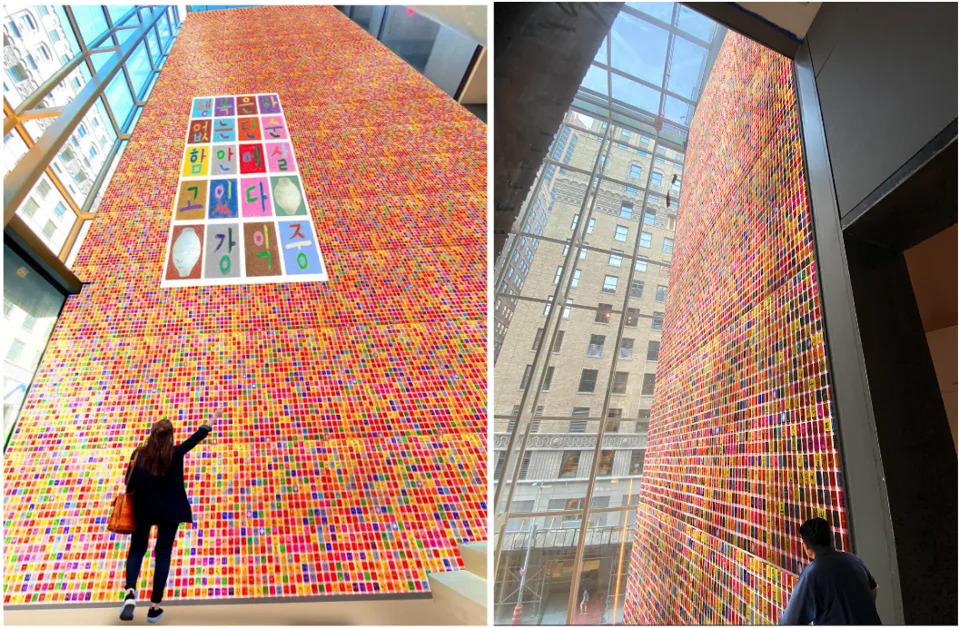
Ik-Joong Kang, b. 1960, Cheongju, Republic of Korea. ‘Hangeul Wall: Things I Love to Talk About,’ 2024. 20,000 Hangeul tiles (Mixed media on wood: 3×3 inches each). Dimensions: Approximately 26 x 72 ft (8 x 22 meters).
Korean Cultural Center New York.
Founded in 1907, Japan Society is the leading organization committed to deepening mutual understanding between the United States and Japan in a global context.
The Korea Society is a nonprofit, nonpartisan, 501(c)(3) organization with individual and corporate members that is dedicated solely to the promotion of greater awareness, understanding, and cooperation between the people of the United States and Korea.
The Korean Cultural Center New York is a government institution dedicated to promoting Korean culture and strengthening cultural exchange between Korea and the United States. Established in December 1979, KCCNY has presented the richness of Korea’s traditions and the creativity of its contemporary culture through a wide range of programs, including exhibitions, performances, live music, and film screenings.
L’Alliance New York is the city’s premier center for French language and francophone arts and cultures.
Scandinavia House: The Nordic Center in America is the leading center for Nordic culture in the United States. It offers a wide range of programs that illuminate the culture and vitality of Denmark, Finland, Iceland, Norway, and Sweden along with the Baltic nations.
More From Forbes
MORE FROM FORBES‘Small Gestures That Change Large Structures’ At The Bronx MuseumBy Chadd Scott