
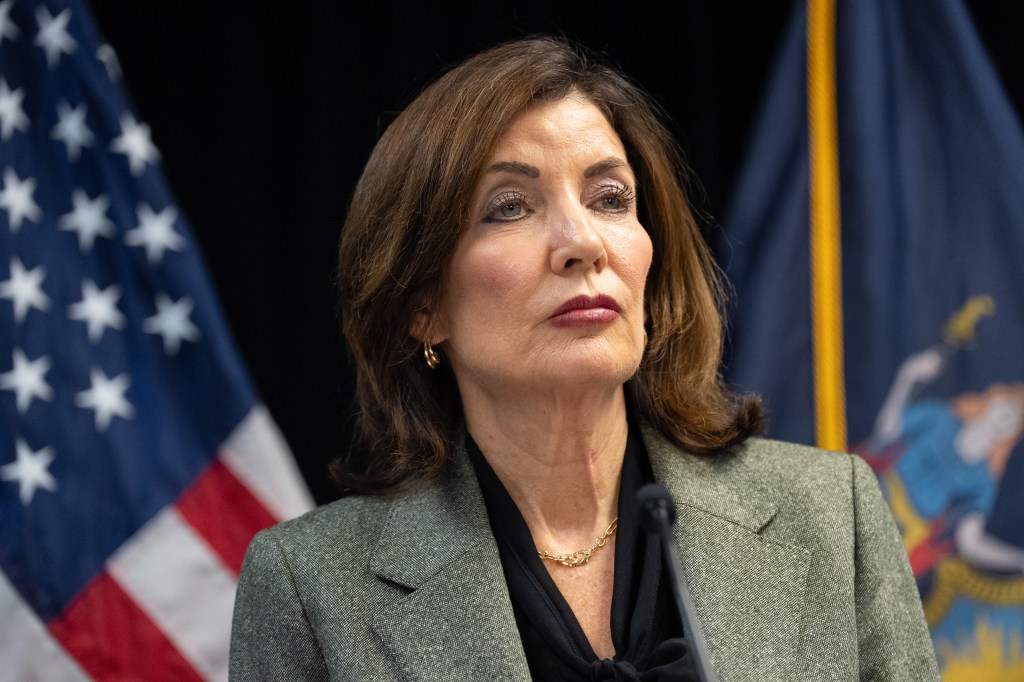
Gov. Hochul has wisely laid out her specific ideas for renegotiating the state’s overly ambitious 2019 climate law with a view towards delaying emissions reduction regulations, reformulating state emissions limits and redefining how emissions are counted.
She wants it done as part of the state budget due by April 1, which is smart because that’s the only time that the Legislature is forced to move. And the Climate Leadership and Community Protection Act must be amended. The laudable goals of 2019 simply cannot be met and trying to get there will cost a fortune and we will still fail.
The specter of the re-jiggering had already been causing a stir in Albany, but now lawmakers at least have something more concrete to go off; they should work with the governor to arrive at something that makes sense.
As they move forwards with negotiations, Hochul, Senate Majority Leader Andrea Stewart-Cousins and Assembly Speaker Carl Heastie, should keep in mind a few things that can often exist in some level of tension.
One, affordability is not just an abstract issue but a life-or-death situation for New Yorkers around the state, who should not be expected to pick between heating or cooling their homes in extreme weather and the ability to put food on the table.
Energy, like rent or food, is not an optional cost that families can simply ease up on when times are tight. It is the responsibility of our political leaders to ease this blow, however well-intentioned their initial policy.
Two, the issue of climate change broadly and emissions more specifically are also not just abstractions. If we’re going to talk about affordability, the cumulative costs of climate change will be immense, for the state and for the individual New Yorkers that will be affected by things like superstorms and fires.
More immediately, emissions have consequences — just ask the Bronx residents that suffer from higher rates of asthma as a result of vehicle emissions in tandem with other pollutants. Methane, carbon monoxide, particulate matter in the air and water all have real consequences to our health and 48 others states (like California, Washington, and Colorado) have a sound path towards reduction that New York should follow as well.
Three, in the long term, costs can best come down and be made stable by embracing the adoption of renewables, which are at their core efforts to turn the unlimited energy of nature into energy we can use. These are not quite as susceptible to the global supply chain shocks that have so disrupted fossil fuels in recent years, including the current chaos for oil and natural gas due to the Iran war.
If the state can really invest into solar, wind, hydroelectric, nuclear and so on, as well as related infrastructure like high-voltage transmission lines, then we can get pretty close to energy independence as a state, a hell of a legacy.
This should be the end goal for everyone involved, with the primary disagreement down to how quickly and in what manner to implement the transition. On this front, Hochul is correct to push for a reevaluation, and the lawmakers dismissing the idea out-of-hand should come up with viable alternatives for protecting New Yorkers from price shocks that are well out of their control.
If we may suggest an additional topic of conversation for lawmakers: cutting some of the red tape that has been delaying or preventing the actual development of renewables, so much so that we’re being embarrassingly trounced by states like Texas.
No one wants the objectives to be entirely rolled back or for the state to step away from climate leadership. What we should be seeking is a resolution that recognizes the significant shocks that have taken place since 2019 and puts us on a path to that leadership without imperiling New Yorkers.