
The usual thing for la migra is to roam the subway stations around 79th Street, to prowl the corner of 18th and New Utrecht Ave., in the early hours just before dawn, hunting for folks who run ahead of the sun wearing steel-toed boots and cement-stained jeans, Quiché traces in their accents. On January 15, though, agents are conducting a stakeout inside a van in front of a gray apartment building on Bay Ridge Parkway, in Guatemalan Bensonhurst, in the heart of Maya Brooklyn. The security camera catches how Sebastián Renoj, grainy in the low-fi footage, leaves the block sometime between 5 and 6 a.m., pulls his hood up to stave off New York’s winter cold, and walks off down the sidewalk. The camera doesn’t record how the officers jump him, how Renoj is arrested, how six other men, all Guatemalan, all bricklayers on their way to work, follow in his footsteps, one by one.
The agents from Immigration and Customs Enforcement (ICE) leave Bensonhurst without making much noise. By lunchtime, every Guatemalan deli, restaurant, store and Facebook group already knows that ICE has arrested Renoj, 57, the deacon of the Iglesia de Evangelización Misionera Jóvenes Cristianos, right outside his front door. But while those days the eyes of the country—of the world—are fixed on the streets of Minneapolis, where patrols of balaclava-wearing men are throwing five-year-old kids behind bars and shooting American citizens dead, few pay attention to what’s happening in Bensonhurst.
It’s not the first time ICE has hit the neighborhood: it’s been a low-intensity but relentless siege over the past several months; a silent offensive that rarely travels beyond these streets or the news bulletins with which Reverend Erick Salgado opens the sermons at the Friday night service. Neither the individuals taken away nor their families have legal status, and the detainees end up bowing their heads and signing the “voluntary transfer” back to a country they no longer know, just to keep the ones left behind safe. They become a tiny percentage of the much-larger statistic that crosses all of the United States: 400,000 migrants detained since Donald Trump began his second term.
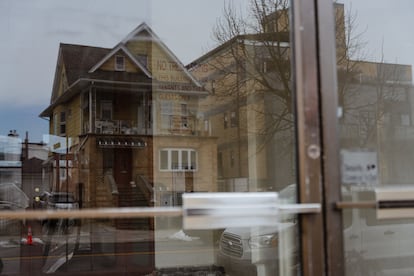 The neighboring houses are reflected in the entrance of the building where Sebastián Renoj lived at the time of his arrest by ICE. Corrie Aune
That’s why Renoj can be seen as the closest thing this community has to a symbol: the unwitting face of the times.
The day after the detentions, Reverend Salgado, Renoj’s friend and the head of his church—a Bronx-born Puerto Rican who ended up shepherding a Guatemalan flock in South Brooklyn— organizes a press conference alongside Susan Zhuang, the district’s city councilmember, in front of the gray building on Bay Ridge Parkway. Some outlets cover it, but the relentless events of those hurried weeks soon push Renoj and his people aside. Beyond those streets, the rage fades. The evangelical Maya of Bensonhurst form a tight-knit community, God-fearing and sheltered in their customs. They rarely raise their voices. They buy groceries at their countrymen’s stores, speak their native Quiché and secondhand Spanish at home, pray in their temples. Life goes on between invisible borders.
“I know that arresting a gang member isn’t the same as arresting Sebastián. Sebastián is not going to resist, he’s going to cooperate — and so will most people in this community,” protests Reverend Salgado, weeks later, in his office. “They’re fishing in this neighborhood. They’re profiling. I have other congregation members in more formal jobs, they dress in professional clothes, and nobody even asks them any questions. They’re only going after people with boots and work pants.”
“You leave the house and don’t know if you’re coming back”
When Roberto heard about his friend’s detention, he thought it could just as easily have been him. He thought about his cousin, whom la migra took a few days before Renoj—an ambush while he was picking up dinner at a neighborhood restaurant. Roberto remembered the call from jail, and how his cousin told him about the hunger and the cold they punished them with, about the “harsh words” from the officers, about the wife and children left without a husband, without a father, without the only paycheck coming into the house.
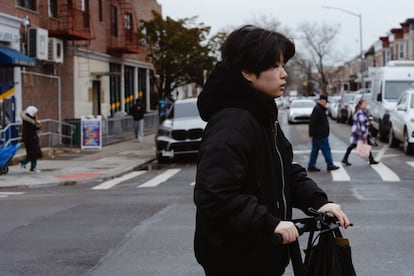 Pedestrians on 18th Avenue in Bensonhurst, Brooklyn. Corrie Aune
Roberto arrived in New York 29 years ago. Like Renoj—“a good person, a brother devoted to the work of the Lord, respectful, well-mannered,” he says—and his cousin, he crossed the border illegally. He’s turned 40 driving his taxi through all five boroughs of the city, working nine to 12 hours a day, Monday through Saturday, to make, on a lucky week, $1,500.
“Now you’re just working to keep yourself going: rent, insurance, tolls, food, clothes, and a little bit you put away. You can’t go out safely anymore. Now I just go from the house to work, from work to the house, from the house to church, from church to the house. Before there was some fear, but now there’s more. You leave the house, and you don’t know if you’re coming back.”
Before setting out for work he commends himself to the Lord’s will and keeps one eye on his phone, where drivers warn each other about checkpoints and raids. Some days in the taxi Roberto feels like cars with tinted windows are following him. “I get a little nervous, but what can I do? Stay calm and keep following my route.” Once he confirmed his suspicions when the vehicle tailing him lit up its siren and veered off down another street. The other day he spotted them, over by Federal Plaza, when he was dropping off a passenger. “There were about six of them. They were wearing their badges.” He has thought about going back to Guatemala, a country alive in his memory through scarce, distant childhood memories, but he has decided to leave it in the hands of his God.
“If they detained you, would you accept voluntary return or would you fight it in court to stay here?”
“I’d fight to stay here.”
In the hands of his God and the courts.
Twenty-six years ago, the U.S. first deported Renoj after he crossed the border, according to the Department of Homeland Security. He found a hole in the wall again and came back. He has spent the last 18 years in Brooklyn with a clean record, working as the right hand of Salgado, even during the trying coronavirus times in the food distribution drives that the church organized. He worked as a bricklayer. He enjoyed music and sang in the church’s choir during every service. He saw his children, and then his grandchildren, being born on American soil. He built a life.
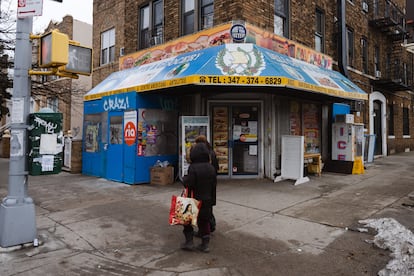 A store in the Guatemalan neighborhood in Bensonhurst, Brooklyn. Corrie Aune
After being transferred to a detention center in New Jersey, a federal judge reviewed his case and found nothing to justify the arrest—no charges or convictions for violent crimes, like the vast majority of those arrested. He paused the deportation and ordered a bond hearing.
Days after the arrest, Salgado visited his friend in prison. The immigration bureaucracy made him wait in the snowy streets outside the detention center for four hours in temperatures under 12 °F. He got to see the deacon for 15 minutes. Renoj told him the food was bad and the agents treated them like criminals. “Bullying, verbal abuse,” Salgado lists. Renoj tried to keep his spirits up, the reverend says, but he couldn’t take it anymore. Despite the judge’s ruling, despite his lawyer telling him he could win, he signed the papers for return to Guatemala. “Believe me, the majority of people I’ve spoken with have opted for voluntary departure, because they don’t want to be held there for four, five, six months,” Salgado says.
The Guatemalan community settled in Bensonhurst in the mid-1990s, running from a war that massacred more than 200,000 people—the vast majority, Indigenous Mayans, like themselves—after decades of instability and U.S.-backed coups. “They were persecuted for the way they dress, for the way they speak, for their religion and also for their ethnicity. They came here to try to live a life without persecution, and we find that the persecution is now here,” says Salgado. “Our advice as pastors has always been: ‘Don’t get in trouble with the law, don’t drive without a license, don’t drive drunk, obviously don’t steal, behave yourselves.’ Now we give out the same advice, but we add: ‘Pray before you leave your house and commend yourselves to the Lord, because they are going after everyone.’”
Fear can be read on the lips of M., a seamstress in her forties who has lived here for 15 years and who, despite still trusting God, confesses that lately she has gotten into the habit of looking out the window at the street before stepping outside. It can be seen in the daily routine of J., a 20-year-old from Totonicapan, a Guatemalan mountainous region where Renoj himself comes from. “Honestly, I don’t go out anymore. I just work,” he says. In his free time he studies and thinks about what he wants to be when he grows up: “The way things are going, a cop. There’s a lot of racism.” It can be felt in M., 25 years old, born and raised in Brooklyn, a young Quiché woman with a U.S. passport: “Now in America you can’t even speak out against the president or the government.”
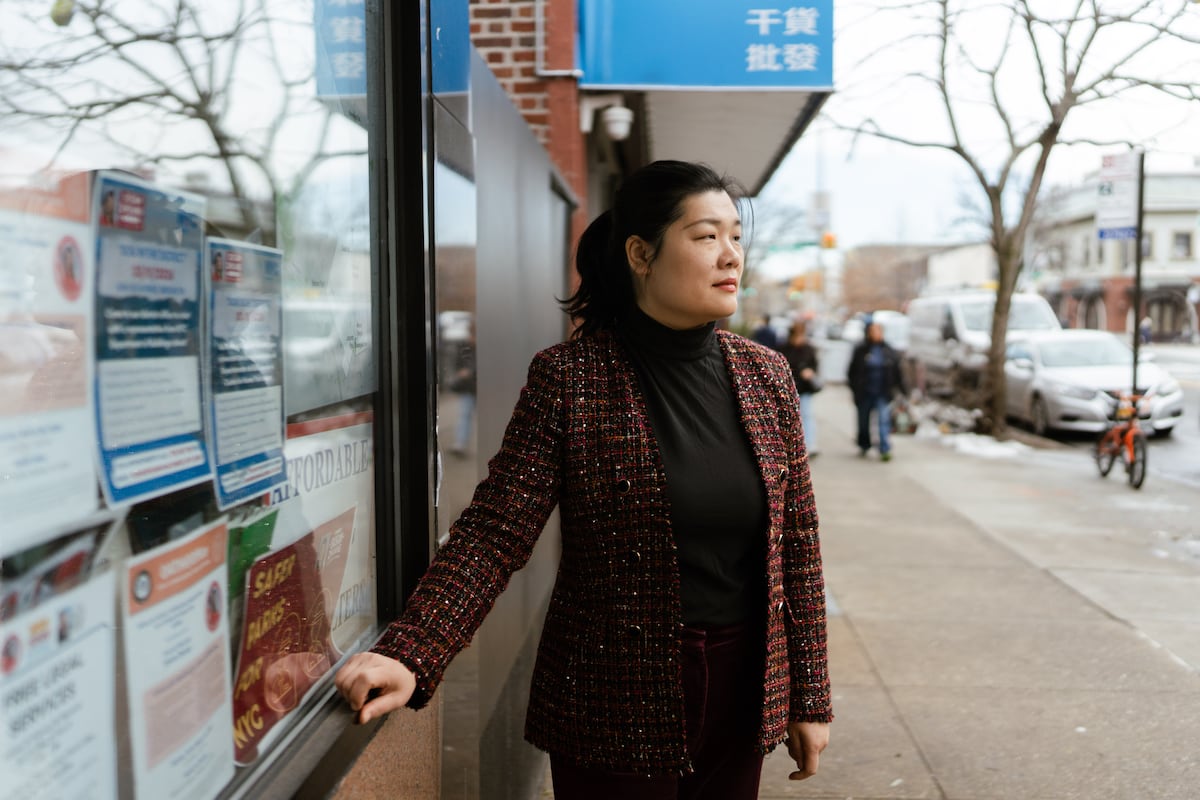
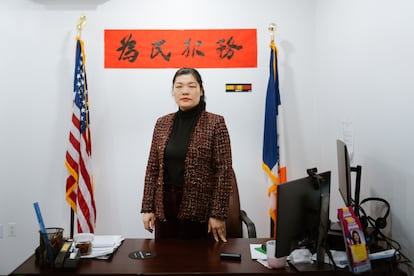 Susan Zhuang in her office in Bensonhurst, Brooklyn. Corrie Aune
The last two decades took Susan Zhuang, 40, from the outskirts of Shanghai, China, to the outskirts of Brooklyn, from a student visa to U.S. citizenship. Today she is the Democratic city councilmember for District 43, which includes Bensonhurst, where—along with Sunset Park and Dyker Heights—the majority of Brooklyn’s 12,733 Guatemalans are concentrated. “Before coming to the United States, I saw New York as such a beautiful, modern, awesome city—best of the best in the world. After living here for years, I appreciate the opportunity New York gave me as an immigrant, but I also see a lot of injustice. On the surface, it looks so pretty. Underneath there is still a lot of work to be done.”
Zhuang has watched her neighbors fall into the hands of ICE, sometimes right in front of her office. Hers is an unusual district, a Trumpist patch on the overwhelmingly Democratic map of New York City; a district where 70% of the residents are immigrants, the majority Asian, and Trump won the election with 62% of the vote. “But this year, if you talk to people living in this neighborhood again, they’d say they regret it,” Zhuang says. Her office has been offering legal support to around 250 migrants since last May, when they saw the raids intensify. “A lot of people come to contact us. They have never committed any serious crimes. Even people with green cards get detained without any reasonable reason (…) ICE is not welcome in this neighborhood.”
“Is ICE profiling?”
“Definitely.”
Reverend Salgado walks to the altar and the music stops. The band has barely rested during the first hour and a half of the Friday night evangelical service in southern Brooklyn. The faithful sway to the rhythm of songs that speak of hope, joy, and redemption. They raise their arms, they kneel in penitence, they bury their faces in their hands as they murmur their prayers. When the pastor takes the microphone, the rapture comes to an end. The sermon is about to begin.
“First of all, we commend ourselves into the hands of the Lord. But if anyone is arrested by Immigration, let me know as soon as possible, because it is important to get a lawyer immediately.”
The silence of the temple and a hundred serious faces answer him.
“I got a call this Tuesday that one of our ushers had been arrested on 18th Street on his way to the laundromat. Two immigration agents showed up, asked several questions, and by the time he knew what was happening, he had 10 agents surrounding him. They threw him to the ground and took him away. His wife called me the moment it happened, we got in touch with the lawyers, the next morning the defense was already in court and, thank God, yesterday he walked out, for the glory of the Lord, brothers.”
This time, applause answers him.
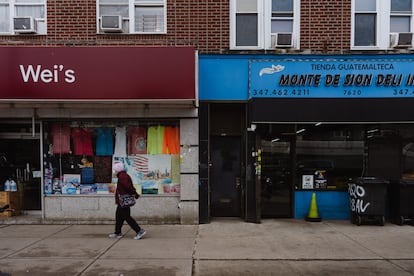 Guatemalan and Chinese businesses line 18th Avenue in Bensonhurst. Corrie Aune
This story was produced as part of the M.A. program at the Craig Newmark Graduate School of Journalism.
Sign up forour weekly newsletterto get more English-language news coverage from EL PAÍS USA Edition