
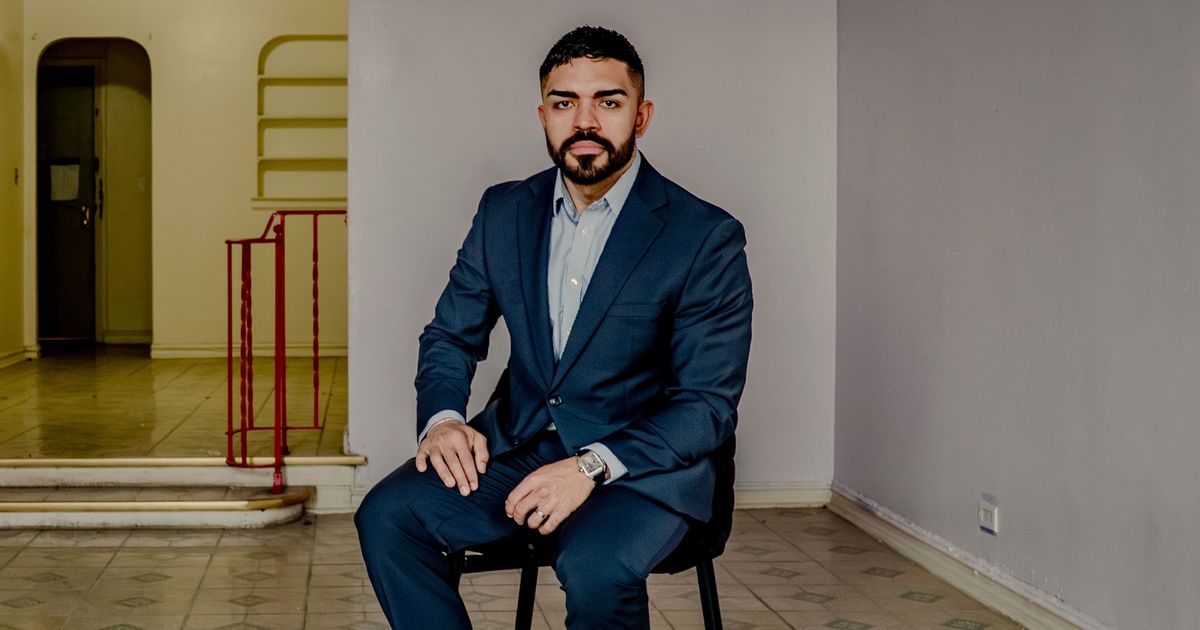

Over a half-melted peanut-butter açai bowl at a picnic table in the Bronx’s Pelham Bay neighborhood, Kenny Burgos explains why rents for nearly a million apartments in New York need to go up. “The Bronx, to this day, has buildings that are almost 100 percent — if not 100 percent — regulated,” he says, his gaze unblinking. “And those are the buildings that are struggling the most, that have the highest violation counts.” He’s making the case that, as things stand with our current housing laws, keeping apartments in those buildings habitable means tenants will have to pay more. The 31-year-old former assemblyman and CEO of the New York Apartment Association — a group whose members include property owners and managers of some 500,000 rent-stabilized apartments — knows it’s an unpopular opinion, especially in a city where the majority of people rent. And it’s especially unpopular now, since the mayor, another former assemblyman in his 30s, was elected on a promise to freeze the rents on those very apartments. “I do this work because I know I’m right,” Burgos says. “And I know that we are on a path to destroy the housing people live in.”
Burgos may spend his days fighting Mayor Mamdani’s housing policies, but he also likes the guy. He was two years behind him at Bronx Science, though the pair didn’t meet until they were both elected to the State Assembly in 2020. Burgos, then 26, came in to represent the 85th District in the Bronx. Mamdani was 29 and represented the 36th District — Astoria and much of what has been called Queens’s “Commie Corridor.” They quickly hit it off. “We were both these two young guys from New York City who had similar backgrounds in the sense of our taste in music and internet culture and just joking around,” says Burgos, still dressed the part in green track pants, gray ASICS, and a YoungLA T-shirt. “We appreciated each other being in that body because we were trying to reshape what it meant to be an elected official.”
In Albany, they played basketball on Tuesdays. (“I’m better at basketball, 100 percent,” Burgos tells me.) Back in town, they once shared a hookah on Steinway Street. While the two were regularly confused for one another in the Capitol — both are bearded and have a penchant for Carhartt jackets — “we just carved out our own political lanes,” Burgos says. Now, their ideologies will go head-to-head at the annual Rent Guidelines Board meetings that kick off in March, where tenant reps, landlord groups, and housing wonks make their case for how much to allow stabilized rents to increase, if at all. The potential four-year rent freeze Mamdani promised is on the line. Burgos and his team have spent hours in their Fidi office planning the arguments they’ll make to the board. “I’m obviously going to be painted as the heel,” Burgos tells me. “But I just know, based on the data and based on the trend line, that this is not sustainable.”
The affordable-housing crisis is a complex blend of problems, among them rent hikes outpacing wage growth, a historically low vacancy rate, and, per the Abundance crowd, a sluggish timeline for new development. But whether it’s tenants or landlords who pay too much for the rent-stabilized units that make up nearly half of all rentals remains singularly contentious. According to a recent report by NYU’s Furman Center, nearly half of all the stabilized units in the five boroughs are in so-called legacy properties, which were built before 1974, and are entirely rent regulated (or close to it). These apartments are heavily concentrated in northern Manhattan and the Bronx, where Burgos grew up, and are among the cheapest in the city — with an estimated median rent of $1,400 a month in 2023 — but generally in the worst shape. Mamdani and Burgos agree on some things that could change to help distressed buildings: the city’s complicated property-tax system and sky-rocketing insurance fees.
But as to why rent-stabilized buildings remain in disrepair — there, the two definitely don’t agree. Mamdani and his team see rampant speculation and slumlordism as the major causes and argue that only a narrow slice of buildings with at least one stabilized unit are in financial distress such that the net operating income, or rent minus operational and maintenance costs, is negative. Burgos gripes that this measurement excludes landlords’ debt service on their properties. Mamdani has argued that there is a state program in place to help landlords in dire financial straits. Burgos says it doesn’t help: “The ‘hardship’ program is basically a program in name only.”
Burgos also believes a 2019 law is part of what set the city’s rent-stabilized housing on course for disaster. Before the Housing Stability and Tenant Protection Act, landlords had a relatively seamless way to increase rents and convert regulated apartments into market-rate ones. Because this was theoretically a great way to make money, particularly in newly gentrifying neighborhoods, interest in stabilized properties ballooned and landlords took on debt to acquire and maintain them, thinking their value would continue to rise. Once the law passed, however, owners were limited in their ability to raise rents and flip units and lost two of the biggest profit drivers at their disposal: an automatic 20 percent increase in rent between tenant vacancies (which encouraged harassment and evictions) and the ability to pass on large portions of the costs for apartment and building improvements to tenants as rent (which incentivized fraud). Margins slimmed substantially. “It was night and day,” Burgos says, arguing that the changes exacerbated maintenance deferral, leading to horrid living conditions for tenants like a lack of heat, pest infestations, and leaks. He also sees it as part of the reason tens of thousands of units are empty. “People try to frame me as if I want to raise rent on grandmas, as if my own grandmother-in-law doesn’t live in a stabilized apartment,” Burgos says. But “this is a math problem, not an emotional one.” To his mind, a rent freeze will only make things worse. “None of that is good for renters. None of that is good for the City of New York.”
Burgos landed his current gig in the summer of 2024 as two landlord lobbying groups were merging and needed someone in charge. The timing was ideal, Burgos says: He and his wife were about to have their first child, and those Albany commutes were rough. (Burgos owns two properties, one in Throggs Neck, where he lives with his family, and another in Soundview that he rents out, in case you’re wondering.) Much like his frenemy, Burgos takes his political messaging to the public via Instagram and TikTok, trying to unspool wonky and complicated housing policy in 60-second clips. It’s a testament to Burgos’s personal appeal — and the overwhelming popularity of the mayor’s campaign message — that this head of a lobbying group, which spent $2.5 million trying to defeat Mamdani, can sometimes come across as an underdog in the fight. “Right around when Zohran was about to win the general and a couple of my videos had gone more viral on X, people were like, ‘Temu Zohran!’” Burgos tells me. He’s used to being called a knockoff or worse. “If it brings the eyeballs and the ears, they can call me his Wario — I don’t care.”
In the afternoon, I walk him back to the health-food store where we got açai bowls so he can grab a pair of C4 energy drinks. “My body’s a temple,” he says, laughing, “then I drink this shit.” A gym rat who dabbles in competitive bodybuilding, Burgos tells me he puts almost everything he eats at home on a food scale and can now ballpark a dish’s caloric content on sight. Our melting smoothie bowls? “The whole thing, believe it or not, is easily 1,200 calories,” he says. But, true to form as a facts-not-feelings guy, Burgos argues that what’s good for you isn’t always so cut-and-dried. “Don’t confuse healthy with low calorie,” he says. “That’s one of the biggest misconceptions people have.”
Thank you for subscribing and supporting our journalism.
If you prefer to read in print, you can also find this article in the March 23, 2026, issue of
New York Magazine.
Want more stories like this one? Subscribe now
to support our journalism and get unlimited access to our coverage.
If you prefer to read in print, you can also find this article in the March 23, 2026, issue of
New York Magazine.