
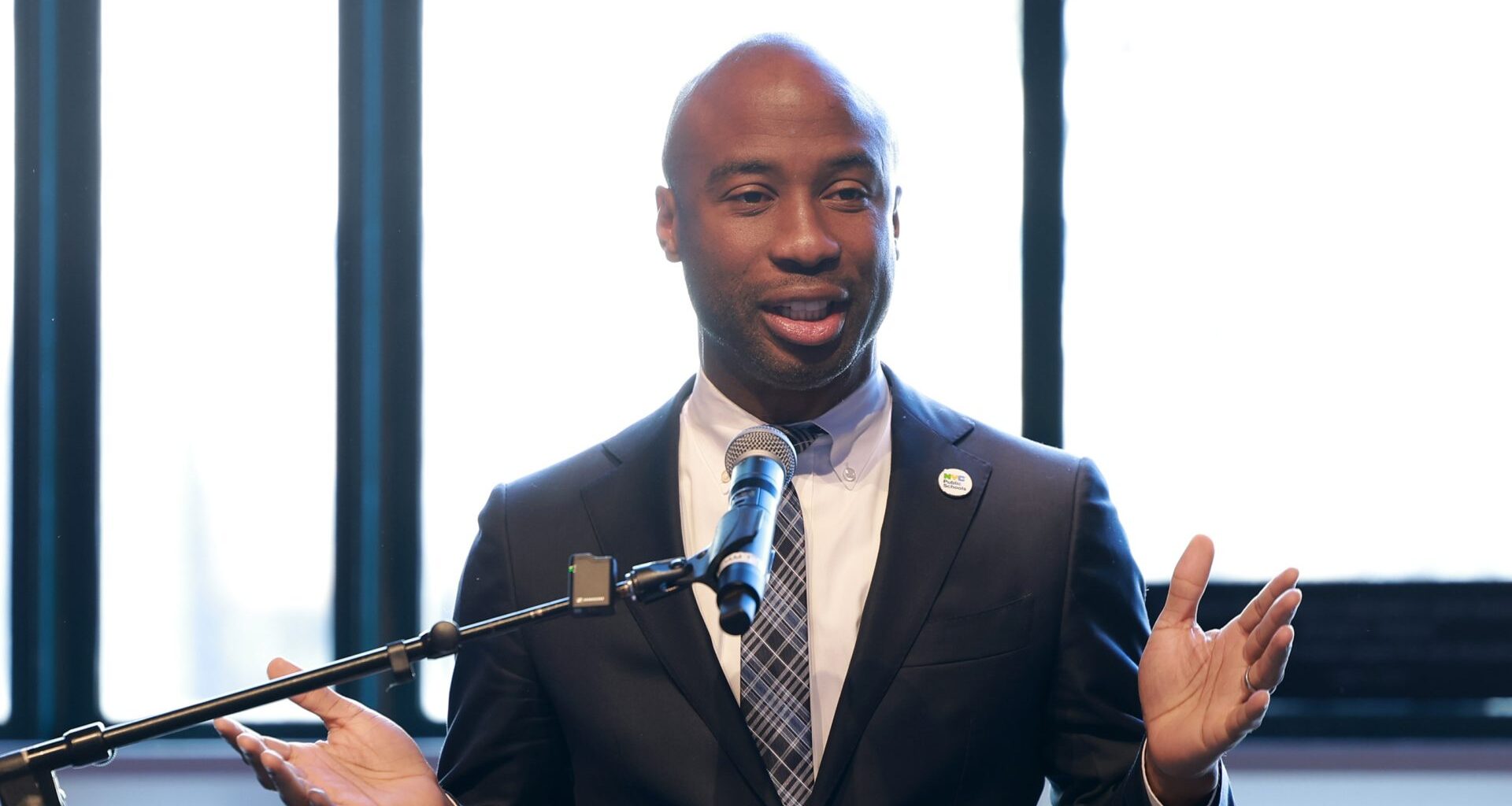
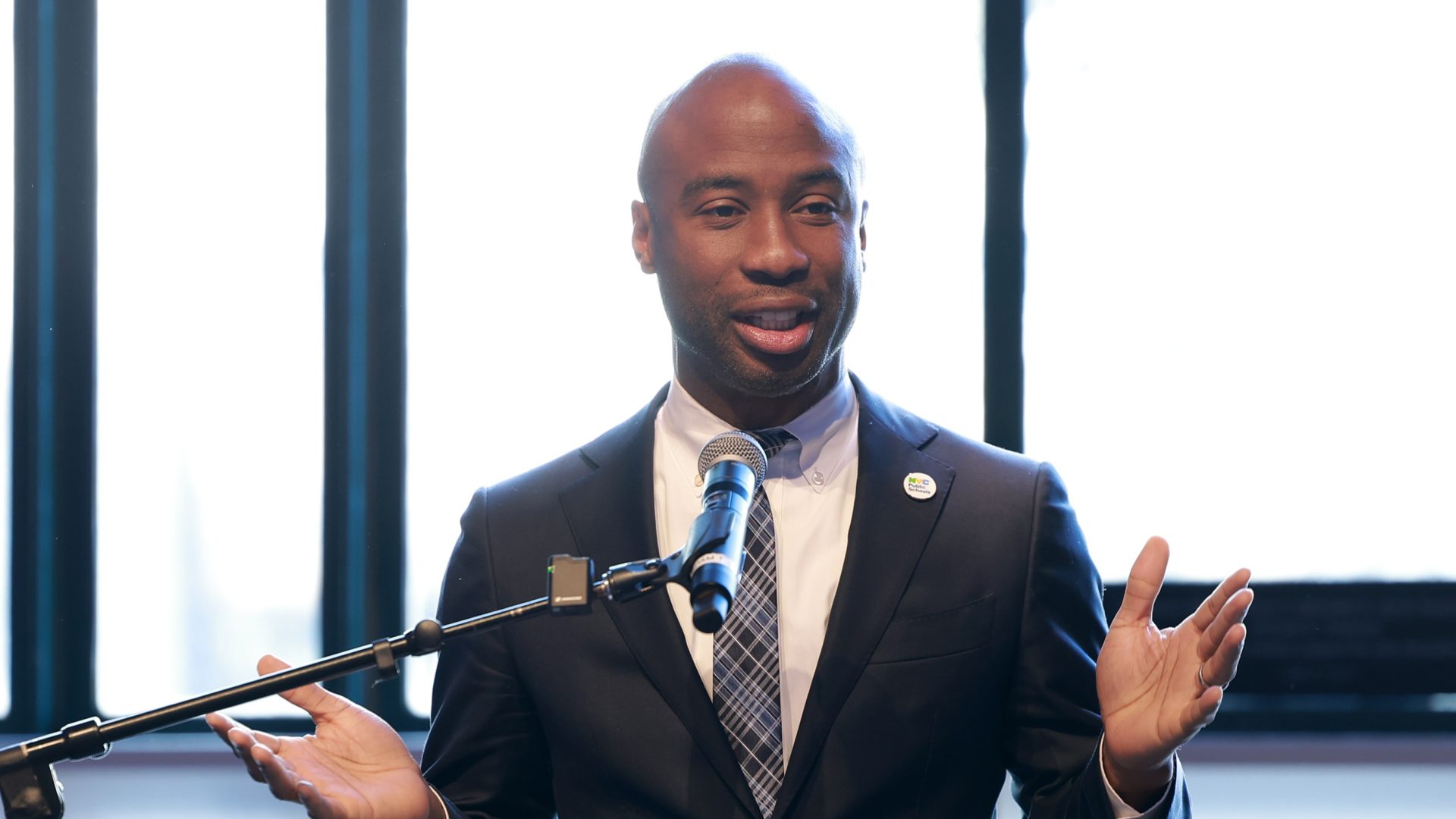
NYC Schools Chancellor Kamar Samuels / (Photo by Jason Mendez/Getty Images for Brooklyn Academy Of Music)

As the largest school district in the country, more than 900,000 students attend public school in New York City from kindergarten through twelfth grade (K-12). It is both a distinct honor and a huge feat to lead NYC’s Department of Education and to have such a tremendous impact of so many young, impressionable minds. As of January 2026, a new chancellor filled this influential role and took the reins of public schools in The Big Apple: His name is Kamar Samuels.
Born in Kingston, Jamaica, Samuels has more than two decades of education experience. After immigrating to the U.S. as a teenager, Samuels earned degrees from Baruch College and Lehman College. He began his education career as an elementary school teach in the Bronx and steadily worked his way up to become a principal before holding leadership roles throughout the five boroughs including being a superintendent in both Brooklyn and Manhattan. On December 31, 2025, NYC Mayor Zohran Mamdani announced that Kamar Samuels would begin serving as the city’s school chancellor on January 1, 2026.
Samuels manages an adopted annual operating budget of an astounding $42.8 billion for the 2026 fiscal year. Yet, Samuels has a lot to prove with what seems like a hefty amount of cash. The city’s school system is no stranger to challenges, from alarming literacy declines to decreases in enrollment (in part due to an influx of charter institutions), to families with special needs children seeking additional support. The expectations he’s faced with are daunting; however, Samuels is ready to make a positive difference. We caught up with the husband and father of three to find out how he plans to do it.
ESSENCE: New York City has the largest school system in the country, but it is also the most segregated. Thoughts?
KAMAR SAMUELS: A large number of Black families have been moving out of our city for affordability. As those Black families move out of the city, we will see an impact on the schools where most Black students attend. Our schools get funded by the number of students in them. So, if Black families are leaving, then it means that the schools are having fewer and fewer kids in them. When you look at the under enrollment or the enrollment crisis in our city, it disproportionately impacts Black communities.
ESSENCE: Right. Especially during and post-COVID.
SAMUELS: Some schools would be, robustly enrolled in, and other schools would be under enrolled. And sometimes it feels like these schools are only blocks from each other. One school is disproportionately, you know, White and more affluent, and one school is going to be disproportionately Black and Brown. We need to be able to merge those schools and do it in such a way where we truly end up with an integrated environment. We also need to be able to enter into thoughtful conversations. That will lead to more integrated, more diverse schools.
ESSENCE: You and MayorMamdani are engaging with constituents via social media in a way that New York City has never seen. It is allowing marginalized people to feel more seen. Is this intentional?
SAMUELS: Well, you have a chancellor that is Jamaican and an immigrant.You have a mayor who is Indian and an immigrant from Africa. We are certainly thinking about how immigrants are treated in our city. We are heavily invested in a K-12 Black History curriculum. What I hear from from families has completely [positively] shifted over the last 2 months. When I think about the purpose of public schools, they are for marginalized groups in the city and to ensure that there is an engine for social mobility.
ESSENCE: And you see education as a vehicle for social mobility?
SAMUELS: I went to public college. CUNY (City University of New York) and SUNY (State University of New York) always rank among the highest index across the nation. It’s a wonderful testament to what we do that at the end of 11th grade or 12th grade, when you’re graduating high school, and every student in New York City gets some automatic acceptance letter to a CUNY school. We’re also giving opportunities to students to do early college work with programs in fields like culinary arts and nursing.
ESSENCE: That is awesome.
SAMUELS: This is giving our young people wonderful pathways to social mobility. So, in addition to making sure that everyone is literate at the end of the second grade with our New York City Reads Program, which is truly transformative, we are [trying to make sure that] New York City has initiatives which help traditionally marginalized families. These families have a pathway to and then engine towards social mobility. That’s critical to our mission.
ESSENCE: Is this part of the catalyst for the expansion of the 3K/4K For All initiative to 2K?
SAMUELS: Yes. In an effort to make this city more affordable, the mayor has chosen to highlight and tackle early childhood and universal childcare, which is huge. It is a huge part of making sure that our families have access to a free and high-quality high quality early childhood services.
ESSENCE: Speaking of leveling the education playing field, what are your thoughts on the digital divide in our communities?
SAMUELS: We have enough devices for every single child in our system, we have access in our in our shelters to broadband or to Wi-Fi, I think, you know, we are at a moment where we’re going to have to navigate with our parents, the opportunity to [explore] AI more. Because there is fear around AI but there are some positive things about AI, too, right?
In the sense of, you know, we can already see how in some ways it could accelerate learning. And I don’t believe that AI will ever replace what I’ve considered the most sacred thing about what educators do, which is the connection between a human teacher and a student. We need to be thoughtful as we develop our AI guidance as a city, and then hopefully we’ll get to an AI playbook and we’ll be able to think about appropriate usages.
ESSENCE: Another disturbing divide is the low number of Black students at the city’s coveted specialized high schools. How do you intend to work with families to address this issue?
SAMUELS: We need to continue to create high quality high school options that are accessible to everyone. For example, we have HBCU Early College Prep High School. We’re going to be working hard to ensure that all around the city, we have high quality options. We also need to do work on how we think about belonging in schools, like our specialized high schools, where we want to get a more diverse group of families into them.
I think about schools that are safe, not just physically, but social emotionally, safe, a school that is welcoming, affirming and a school that simultaneously holds you to high expectations. We’re doing a lot of work now, with our parent coordinators to ensure that we have parent coordinators across the city can do strong outreach with other parents and connect them with the resources that they need.
And as I think about how I’m organizing our NYC public schools, I want to ensure that we are promoting community schools and make that connection with families. When I think about family and community engagement work, that’s what is going to make sure that our PTAs are stronger and more active. Because oftentimes that’s what goes far: when a parent can help and support another parent.
Think about what happens on the playground. It’s the parents who are having the conversations. And so, if we get more parents informed through our parent coordinators, then we will make sure every family’s voices are heard.