
Residents of Pelham Parkway and nearby neighborhoods are in a heated debate over plans to develop 626 Pelham Parkway South into a deeply affordable housing development with 106 smaller-than-studio units, 60% of which are for formerly homeless individuals.
The nonprofit Bowery Residents’ Committee (BRC) purchased the former Apple Bank building as-of-right in Feb. 2025 and plans to demolish it in favor of nine stories of permanent, rent-stabilized single units for people exiting city shelters and Housing Connect lottery winners at 30% AMI — $34,020 for a single person. BRC expects a move-in date of fall 2029.
As the as-of-right property owner, BRC has no obligation to seek the community board’s approval or even engage in discussion and the board has no formal role in the process.
Still, the nonprofit has held multiple sessions with elected officials and the board to convey their plans — and try to dispel misinformation — as the project faces stiff opposition.
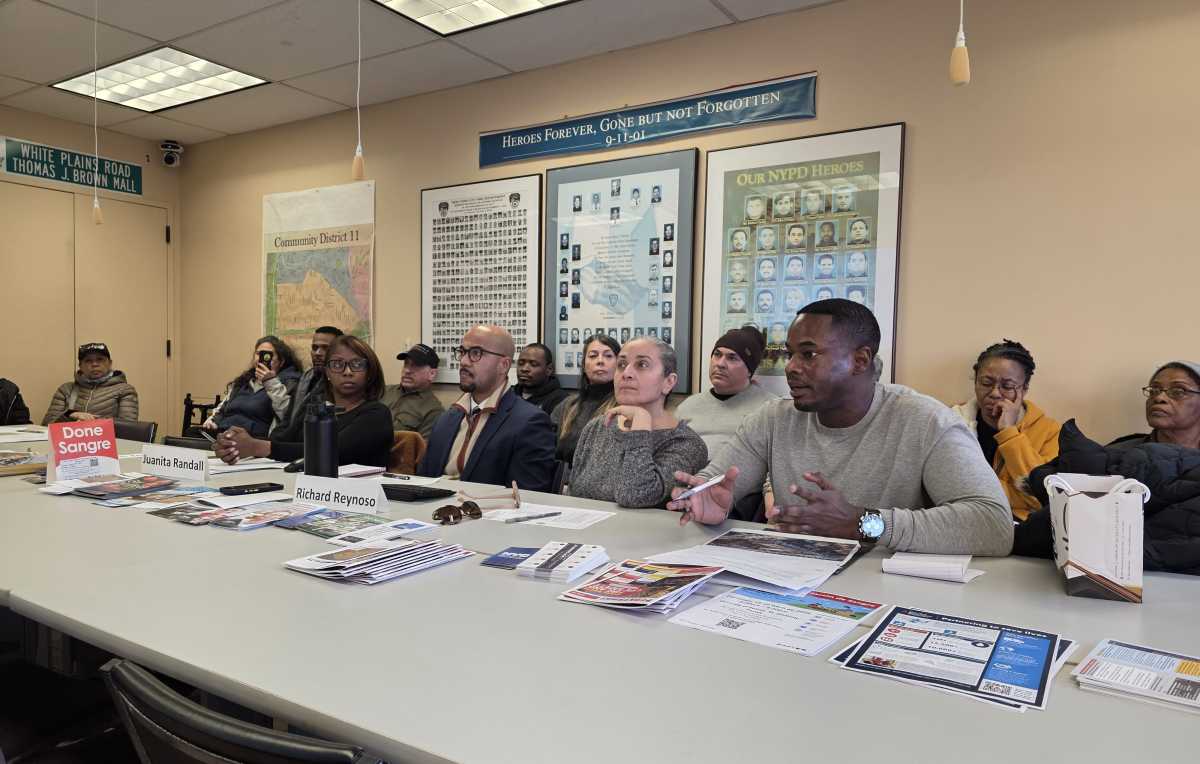
CB11, which covers Pelham Parkway section, plus Allerton, Van Nest, Morris Park and more, has been no stranger to controversy over the years, and tensions again spilled over during a March 19 public session with the Housing and Land Use Committee regarding the BRC proposal.
At the session, opponents of the project implied, or outright stated, that people who are formerly homeless or have mental illness necessarily present a safety threat to the community.
Kyle Jeremiah, BRC’s director of external affairs, was on hand to answer questions and address concerns from board members and the public. He also presented to committee members on Jan. 15, has engaged with elected officials and will become a familiar face on both sides.
While most of the CB11 event remained civil, emotions heated up towards the end, and Committee Chair Richard Reynoso threatened at least once to shut down the meeting, which hosted close to 20 residents in person at the CB11 office and 16 to 20 more online.
But several people on both sides wanted the last word — and continued arguing outside on the sidewalk well after the meeting ended.
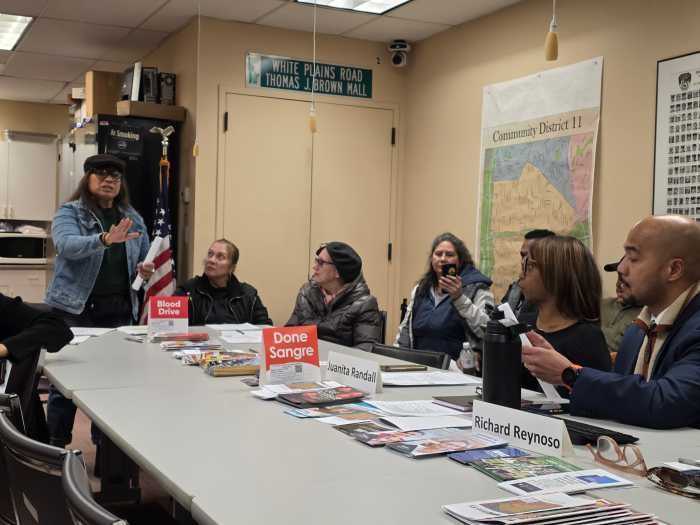 The CB11 public session got heated, with several residents raising their voices and continuing to argue outside afterwards. Photo by Emily Swanson.
During the session, it became apparent that misconceptions about the project have already been circulating.
For instance, some believed that the units will have no windows, that it will provide only transitional housing and that BRC could at any point decide to turn the building from permanent housing into a shelter — none of which are true, according to Jeremiah.
Why Pelham Parkway?
At the CB11 public event, Jeremiah repeatedly explained that the development will only accept those leaving shelters whom city agencies have deemed capable of independent living.
He also explained plans for the property, which will have onsite support staff, a courtyard, community space and a 24/7 staffed front desk.
Each unit of less than 300 square feet will have its own bathroom, microwave, mini-fridge/freezer and countertop, and each floor will share laundry facilities and a kitchen with two sinks, two ranges, and full-size fridge and freezer.
Jeremiah pointed to BRC’s track record among similar developments throughout NYC and said that 94% of residents remained stably housed with them after leaving shelters.
He also discussed important reasons for putting the supportive housing project in this location.
For one, the vacant building is right next to the 2/5 train station with buses, parks, shopping and other community amenities nearby.
But Pelham Parkway was also selected because Council District 13 ranks 38 out of 51 in affordable housing production, having built just 369 new units from 2014 to 2024, according to a report by the New York Housing Conference.
Other Bronx districts have carried a much heavier share. For instance, District 15 and District 17 rank number 1 and 2 citywide, with 13,552 total units created between 2014 and 2024.
Jeremiah also addressed why BRC opted to build micro units. He said the tiny units are the most deeply affordable option and will be aimed at reducing isolation among seniors living in poverty.
Some CB11 attendees said they would have preferred family-sized units in the building, but Jeremiah said that more single units must be created for individuals in order to free up larger apartments for families.
In the Pelham Parkway building, BRC opted to build the 106 micro units, as opposed to only 64 traditional studios, according to Jeremiah.
‘Dignity and a starting point’
During the meeting, a few residents expressed wholehearted enthusiasm for the project.
Miguel Dyer, a former CB11 member, testified that he previously experienced homelessness and spent time in city shelters.
“My experience taught me something very simple: housing matters more than anything else when someone is trying to rebuild their life,” he said. “Stability, even in a small space, gives people dignity and a starting point.”
Morris Park resident Michael Kaess spoke in support via video, saying he wished the development could be even larger.
Given the city’s housing crisis, “Micro units have to be part of the mix,” Kaess said. “It’s another option, and we have to give people options.”
However, more than a dozen participants opposed the development, sometimes while expressing misconceptions or assumptions about the population that will live there.
Some said that the units’ tiny size —approximately 270 square feet— and lack of full kitchens make them substandard housing. At least two referred to the development as “transitional housing,” which it is not.
Others expressed concern that tenants with mental illness may live for free using city vouchers with no employment or attachment to the community and may not take advantage of onsite support services.
Some residents asked for a measure of community control over the private project.
For instance, Gina Caliendo testified online that a building with micro units “further denigrates these individuals “ and asked, “Will they be a positive influence or a negative influence?”
She later wrote in the chat, “We need to have a reciprocal social contract. If you are given a place to live, you must agree to follow common sense rules that respect the community.”
Upping the opposition
Those against the BRC project are led at least in part by Roxanne Delgado, founder of the community group Friends of Pelham Parkway.
Delgado has previously criticized new “affordable” buildings in the area for charging rents well above most residents’ actual incomes. But even though the BRC development would contain 41 deeply affordable units at 30% AMI —$34,020 for a single person— she still maintains that it is a “waste of taxpayer money,” if it receives public funds.
Like-minded neighbors held a demonstration on March 7 outside the former bank building.
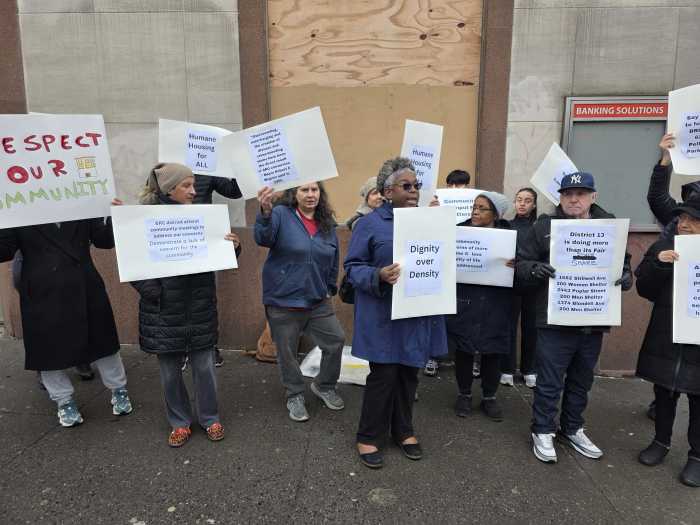 Opponents of the project rallied on March 7 and plan another rally at City Hall. Photo by Emily Swanson.
Speakers at the rally said they supported new affordable housing in Pelham Parkway but opposed a single-room occupancy-type development.
“It’s just not for this neighborhood,” said Sharlene, a resident at the March 7 rally. “SROs create slums. We’re not a slum neighborhood.”
Delgado said at the rally the BRC plan would create “a revolving door” of residents who would not want to remain there long-term, despite having brand-new apartments and rent-stabilized leases.
“They’re living in basically a warehouse,” she said at the rally. “Why are we spending public money to have not real apartments, especially for the most marginalized?”
In addition to concerns about the housing type and population, Delgado has also questioned BRC’s track record as a provider.
In an email to the Bronx Times, she shared a 2020 audit by State Comptroller Thomas DiNapoli that accused BRC of failing to conduct proper outreach to assist homeless people staying in the transit system, effectively wasting taxpayer dollars.
“They’re not good neighbors,” Delgado said at the rally, adding that her concerns are “Not based on fear, opinion, ignorance.”
When she and others raised concerns about BRC’s performance at the CB11 meeting, Jeremiah said all past issues were resolved and contracts were renewed, showing the city’s ongoing faith in the nonprofit.
But longtime residents are not giving up without a fight.
Another rally attendee, Francis Lui, said she has lived in the area for 77 years and carried a collection of black-and-white photos of the neighborhood when she was a child.
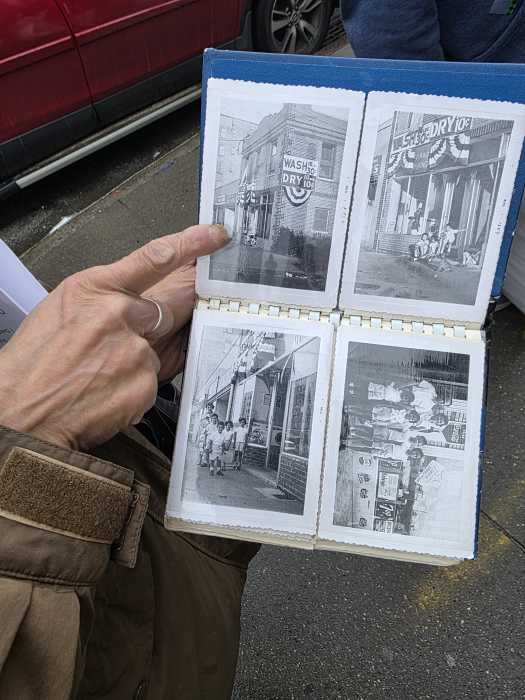 Longtime Pelham Parkway resident Francis Lui said she believes the neighborhood has declined over the decades. Photo by Emily Swanson
Over the decades, “I don’t see Pelham Parkway and White Plains Road getting better,” she said.
Lui said Pelham Parkway has become “too congested,” especially on trains and buses, and that the proposed development would bring more problems.
Jenny, another resident who has lived next to the bank building since 2001, was among those who expressed concern about the population who will live in the new development.
“Some of these people don’t care for themselves,” she said. “This neighborhood is constantly trying to protect itself from people coming in to just destroy it. And they’re going to mix them up with our teenagers and elderly?”
Having said their part at the rally and directly to BRC leaders, the group is preparing to take their effort to the next level.
“This is the start of a big campaign,” Delgado said. “We’re gonna have to keep fighting.”
She scheduled an April 10 rally on the City Hall steps aimed at convincing Council Member Shirley Aldebol, Borough President Vanessa Gibson and other elected officials to deny funding. Gibson and Aldebol did not respond to request for comment.
But Jeremiah said that the BRC project will proceed with or without funds allocated by elected officials, which make up a small component of the overall financing. The organization plans to start demolition and construction in fall 2027 and welcome residents in fall 2029.
Reach Emily Swanson at eswanson@schnepsmedia.com or (646) 717-0015. For more coverage, subscribe to our newsletter and follow us on Twitter, Facebook and Instagram!