
An Air Canada jet carrying more than 70 passengers collided with a fire truck while landing at New York’s LaGuardia Airport late Sunday, killing the pilot and copilot and injuring several others, officials said.The fire truck was crossing the tarmac after being given permission to respond to another plane reporting an odor onboard. Before the collision, an air traffic controller can be heard on airport communications frantically telling the fire truck to stop.In a transmission nearly 20 minutes later, the controller appears to blame himself. “We were dealing with an emergency earlier,” the controller said. “I messed up.”About 40 passengers and crew members on the regional jet were taken to hospitals, some with serious injuries. Most were released by Monday morning, authorities said.The impact crushed the regional jet’s nose, leaving cables and debris dangling from the mangled cockpit. Images from the crash site showed the damaged fire truck flipped onto its side.A key question for investigators will be examining coordination of the airport’s air traffic and ground traffic at the time of the crash, said Mary Schiavo, a former Department of Transportation Inspector General. “I don’t know how many wake-up calls the (Federal Aviation Administration) needs, but this has been happening for years and sadly some of the most horrific air crashes in history happen on the ground at the airport.”The crash shut down LaGuardia — the New York region’s third busiest hub — until at least Monday afternoon, during what was already a messy time at U.S. airports. Travelers have been facing long security lines due to a government shutdown and the busy spring break travel season.Video above: Passenger describes moments after collisionPilot and copilot were based out of CanadaThe pilot and copilot who died were both based out of Canada, Garcia said during a news conference.The airport will remain closed until at least 2 p.m. Monday to facilitate the investigation, which is being led by the National Transportation Safety Board.“Two pilots were killed and dozens injured in this tragedy. Our thoughts are with the victims, their families, and everyone affected,” New York Gov. Kathy Hochul posted online.The firetruck was traveling across the runway to respond to a separate incident aboard a United Airlines flight, whose pilot had reported “an issue with odor,” said Garcia, who deferred additional questions about the sequence of events leading up to the crash to the NTSB.There were 72 passengers and four crew members aboard the aircraft, a Jazz Aviation flight operating on behalf of Air Canada, according to a statement from the airline. The flight originated at Montreal-Pierre Elliott Trudeau International Airport, the major airport serving Montreal.Photos and videos from the scene showed severe damage to the front of the aircraft, with cables and debris hanging from a mangled cockpit. Nearby, a damaged emergency vehicle lay on its side.Stairways used to evacuate passengers from the aircraft were pushed up to the emergency exits on the jet, a Bombardier CRJ. The impact left the jet with its crumpled nose tilted upward.Video above: Briefing on Air Canada collisionAir traffic controller tried to stop vehicle after giving clearanceThe air traffic controller tried to warn the vehicle.“Stop, Truck 1. Stop,” the transmission says. The controller can then be heard frantically diverting an incoming aircraft from landing.Air traffic controllers are not impacted by the partial government shutdown that has caused long delays at airport security checkpoints in recent days. They have been affected by past shutdowns.As passengers straggled out of the airport into the dark early Monday, some described having arrived at LaGuardia hours before their flight, hoping to beat the lines.Arturo Davidson said his Miami-bound flight was on the tarmac Sunday night when fellow passengers saw the collision or its aftermath and reactions rippled through the cabin.The passengers were soon told there had been an accident. About 20 minutes later, they were informed the airport was closing and they must return to the terminal, he said later Monday, gazing at a departure board filled with cancellations.“I don’t think we’re going at two,” he sighed, referring to the time Monday afternoon that officials gave as the earliest for reopening LaGuardia.One of the nation’s busiest airportsLaGuardia was 19th busiest in 2024 out of more than 500 U.S. airports, with over 16.7 million passengers boarding there, according to a 2025 FAA database.The airport, which opened to commercial traffic in 1939, covers 680 acres and borders Flushing and Bowery bays in Queens. The Port Authority of New York and New Jersey describes it as “one of the nation’s leading domestic gateways for business and leisure travel” in its 2024 Airport Traffic Report.LaGuardia is one of 35 major airports across the country equipped with an advanced surface surveillance system that uses radar and data from locator systems on planes to alert controllers to potential conflicts on runways, according to the FAA.There are three different models of Aircraft Rescue and Firefighting trucks, according to a video put out last year about the unit by the Port Authority. One carries 1,500 gallons of water and firefighting chemicals. Two others carry 3,000 gallons of water. One of those models is also equipped with a turret that can extend 65 feet to penetrate inside an aircraft and discharge firefighting chemicals.It’s still too early to tell what went wrong, and investigators from the NTSB will now start collecting facts, interviewing people, downloading recordings and reviewing data from flight recorders, aviation safety expert Jeff Guzzetti said.“It might be easy enough just to say, ‘Oh, the controller made a mistake.’ But there’s got to be deeper questions,” he said.
NEW YORK —
An Air Canada jet carrying more than 70 passengers collided with a fire truck while landing at New York’s LaGuardia Airport late Sunday, killing the pilot and copilot and injuring several others, officials said.
The fire truck was crossing the tarmac after being given permission to respond to another plane reporting an odor onboard. Before the collision, an air traffic controller can be heard on airport communications frantically telling the fire truck to stop.
In a transmission nearly 20 minutes later, the controller appears to blame himself. “We were dealing with an emergency earlier,” the controller said. “I messed up.”
About 40 passengers and crew members on the regional jet were taken to hospitals, some with serious injuries. Most were released by Monday morning, authorities said.
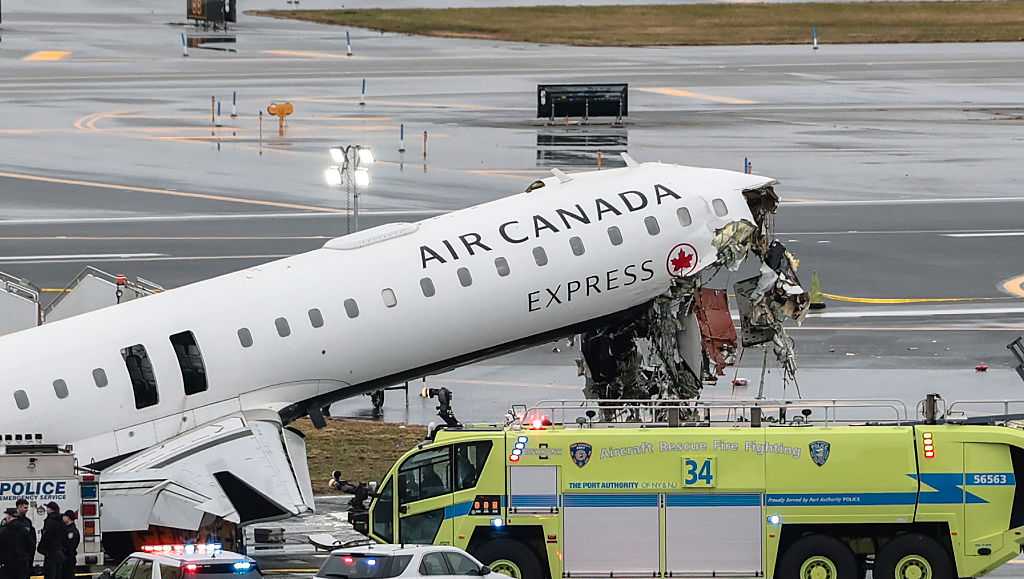
The impact crushed the regional jet’s nose, leaving cables and debris dangling from the mangled cockpit. Images from the crash site showed the damaged fire truck flipped onto its side.
A key question for investigators will be examining coordination of the airport’s air traffic and ground traffic at the time of the crash, said Mary Schiavo, a former Department of Transportation Inspector General. “I don’t know how many wake-up calls the (Federal Aviation Administration) needs, but this has been happening for years and sadly some of the most horrific air crashes in history happen on the ground at the airport.”
The crash shut down LaGuardia — the New York region’s third busiest hub — until at least Monday afternoon, during what was already a messy time at U.S. airports. Travelers have been facing long security lines due to a government shutdown and the busy spring break travel season.
Video above: Passenger describes moments after collision
Pilot and copilot were based out of Canada
The pilot and copilot who died were both based out of Canada, Garcia said during a news conference.
The airport will remain closed until at least 2 p.m. Monday to facilitate the investigation, which is being led by the National Transportation Safety Board.
“Two pilots were killed and dozens injured in this tragedy. Our thoughts are with the victims, their families, and everyone affected,” New York Gov. Kathy Hochul posted online.
The firetruck was traveling across the runway to respond to a separate incident aboard a United Airlines flight, whose pilot had reported “an issue with odor,” said Garcia, who deferred additional questions about the sequence of events leading up to the crash to the NTSB.
There were 72 passengers and four crew members aboard the aircraft, a Jazz Aviation flight operating on behalf of Air Canada, according to a statement from the airline. The flight originated at Montreal-Pierre Elliott Trudeau International Airport, the major airport serving Montreal.
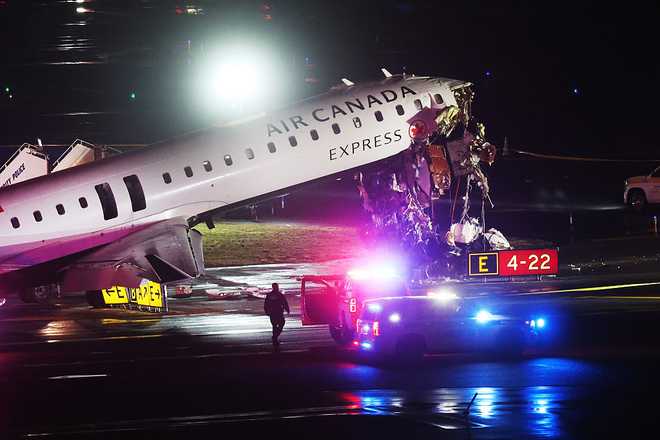
Photos and videos from the scene showed severe damage to the front of the aircraft, with cables and debris hanging from a mangled cockpit. Nearby, a damaged emergency vehicle lay on its side.
Stairways used to evacuate passengers from the aircraft were pushed up to the emergency exits on the jet, a Bombardier CRJ. The impact left the jet with its crumpled nose tilted upward.
Video above: Briefing on Air Canada collision
Spencer Platt/Getty Images
An Air Canada Express plane sits on the tarmac after it collided with a fire truck on the tarmac at LaGuardia Airport on March 23, 2026 in New York City.
Air traffic controller tried to stop vehicle after giving clearance
The air traffic controller tried to warn the vehicle.
“Stop, Truck 1. Stop,” the transmission says. The controller can then be heard frantically diverting an incoming aircraft from landing.
Air traffic controllers are not impacted by the partial government shutdown that has caused long delays at airport security checkpoints in recent days. They have been affected by past shutdowns.
As passengers straggled out of the airport into the dark early Monday, some described having arrived at LaGuardia hours before their flight, hoping to beat the lines.
Arturo Davidson said his Miami-bound flight was on the tarmac Sunday night when fellow passengers saw the collision or its aftermath and reactions rippled through the cabin.
The passengers were soon told there had been an accident. About 20 minutes later, they were informed the airport was closing and they must return to the terminal, he said later Monday, gazing at a departure board filled with cancellations.
“I don’t think we’re going at two,” he sighed, referring to the time Monday afternoon that officials gave as the earliest for reopening LaGuardia.
One of the nation’s busiest airports
LaGuardia was 19th busiest in 2024 out of more than 500 U.S. airports, with over 16.7 million passengers boarding there, according to a 2025 FAA database.
The airport, which opened to commercial traffic in 1939, covers 680 acres and borders Flushing and Bowery bays in Queens. The Port Authority of New York and New Jersey describes it as “one of the nation’s leading domestic gateways for business and leisure travel” in its 2024 Airport Traffic Report.
LaGuardia is one of 35 major airports across the country equipped with an advanced surface surveillance system that uses radar and data from locator systems on planes to alert controllers to potential conflicts on runways, according to the FAA.
There are three different models of Aircraft Rescue and Firefighting trucks, according to a video put out last year about the unit by the Port Authority. One carries 1,500 gallons of water and firefighting chemicals. Two others carry 3,000 gallons of water. One of those models is also equipped with a turret that can extend 65 feet to penetrate inside an aircraft and discharge firefighting chemicals.
It’s still too early to tell what went wrong, and investigators from the NTSB will now start collecting facts, interviewing people, downloading recordings and reviewing data from flight recorders, aviation safety expert Jeff Guzzetti said.
“It might be easy enough just to say, ‘Oh, the controller made a mistake.’ But there’s got to be deeper questions,” he said.