
March 23, 2026
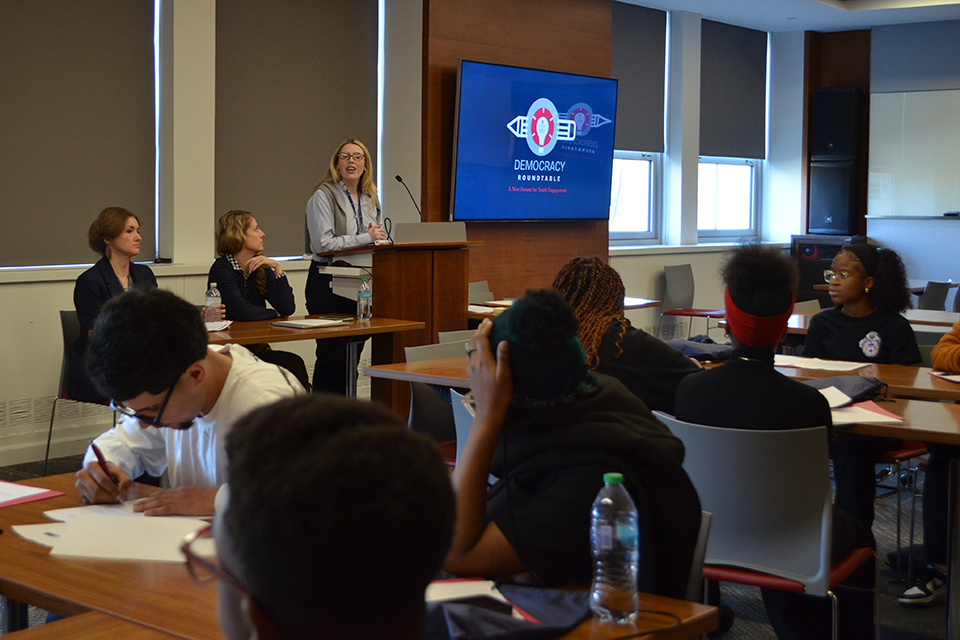
St. John’s University recently hosted a democracy roundtable in St. Augustine Hall, welcoming students from William H. Maxwell Career and Technical Education High School in Brooklyn, NY, for a one-day event focused on the democratic process.
“Democracy Roundtable: A New Forum for Youth Engagement” was built on the success of the inaugural 2024 roundtable, offering students the opportunity to engage directly with the democratic process. The 2024 roundtable made an impression on Maxwell student Christian Vazquez Jr., who attended the event as a junior and returned this year with a new perspective on his future.
“Being here before really opened my eyes to college,” he said. “Now, I am coming to St. John’s this fall and am very excited about all the activities on campus.”
The four-hour event on March 14 brought 25 students to the University’s Queens, NY, campus. It featured discussions, policy debates, and competing small-group presentations about safe and appropriate artificial intelligence (AI) use in school homework.
Students began the day by hearing from faculty members Meghan M. Dunn, Ph.D., Assistant Professor, and Elisabeth Fondren, Ph.D., Associate Professor, both of the Division of Mass Communication in The Lesley H. and William L. Collins College of Professional Studies. The faculty members portrayed key stakeholders—an educator and a technology entrepreneur—with competing perspectives on the use of AI in education. While one argued that AI can support learning and creativity, the other raised concerns about what an overreliance on AI could mean for students’ ability to think independently.
“Concepts like democracy can feel distant or overly complicated,” said Luca Iandoli, Ph.D., Dean, the Collins College of Professional Studies, and Professor, Division of Computer Science, Mathematics, and Science. “What we want to do is allow students the opportunity to experience that complexity firsthand and understand how different perspectives come together and how policy is shaped.”
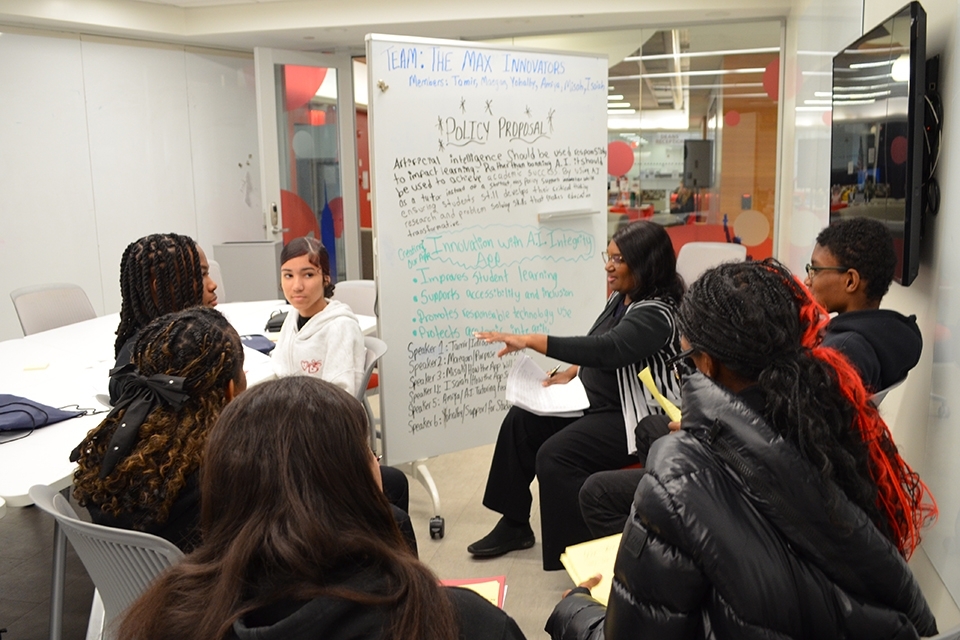
Students were divided into small groups to discuss the issue and create policy proposals that were later presented to the entire assembly. While opinions varied, most groups supported the use of AI in education, emphasizing its responsible use with clear guidelines. Some groups concentrated on developing such plans, while others developed broader policy approaches.
Dr. Dunn said the event provided valuable insight into how students already engage with AI.
“This is a great opportunity for students to be thinking about these kinds of issues early,” Dr. Dunn said. “AI is going to be such a pervasive tool, and understanding its impact on learning and development is incredibly important.”
The roundtable also gave students a voice in conversations that directly affect them.
“Too often, young people are spoken about rather than spoken to,” said Miriam E. Prever, Adjunct Instructor, the Collins College of Professional Studies. “This event allows them the opportunity to express how they feel about democracy and engage with real-world issues.”
The visiting students said the event helped them better understand both sides of the AI debate.
“I feel like it is very informative,” Tamir Sobers said. “It helps students understand AI, including the pros and cons. It gives us a chance to talk and debate about it.”
“It allows you to see both sides of the issue—what we know and what we do not,” added Isaiah Slaughter. “I think it is a really good thing St. John’s is doing.”
Chevron Cox, a special education teacher and Student Government adviser at Maxwell High School, said the debate over AI use inspired her students. “Students are split on AI,” Ms. Cox said. “Some want to embrace it, while others feel like it replaces thinking. I was interested to see what they produced.”