
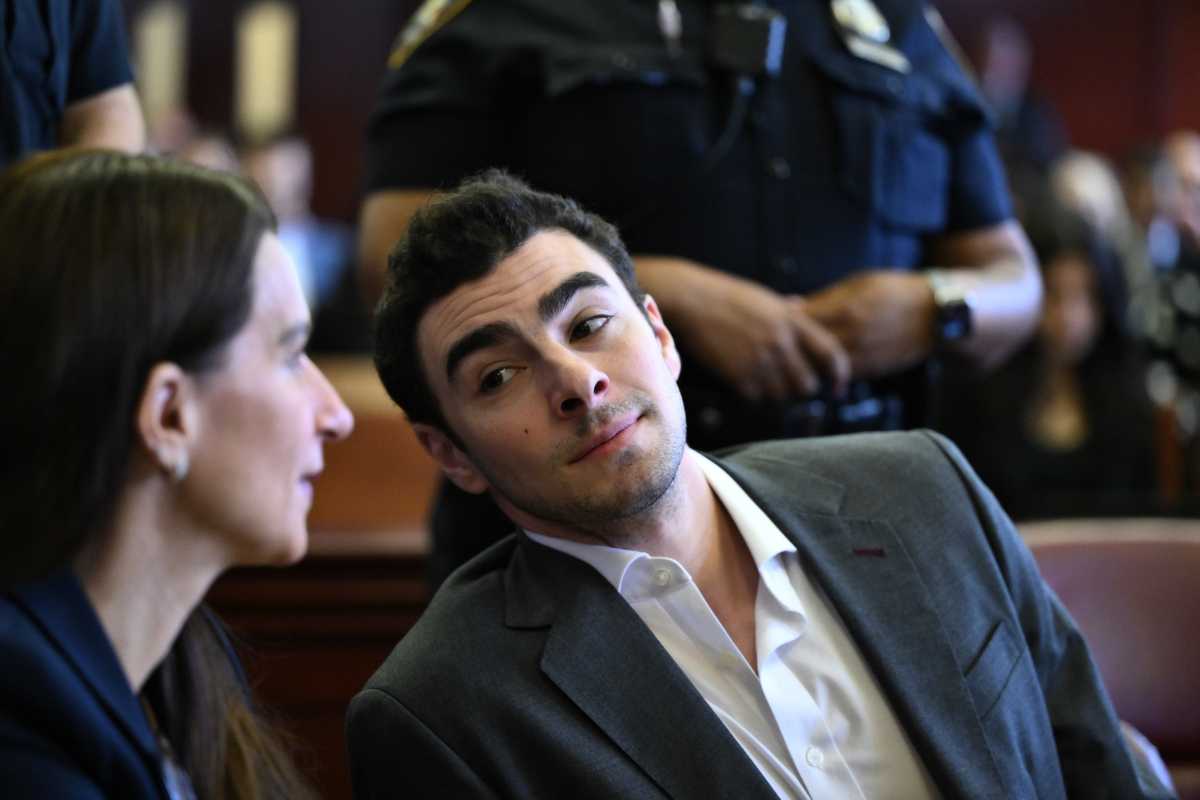
Luigi Mangione appears with his attorney Karen Agnifilo, left, in Manhattan Supreme Court for a suppression of evidence hearing in the killing of United Healthcare CEO Brian Thompson.
Dec. 4, 2025
Photo by Curtis Means for Daily Mail/Pool
Ahead of a Manhattan judge’s May decision about whether to suppress Luigi Mangione’s backpack from his upcoming state murder trial, the Manhattan District Attorney and Mangione’s lawyers clashed in a series of final filings.
After the DA and defense counsel both filed lengthy arguments over the evidence in late January and early March, Mangione’s lawyer Karen Friedman Agnifilo wrote an additional letter to Manhattan Supreme Court Justice Gregory Carro last week that claimed local Pennsylvania police made an illegal search of Mangione’s backpack that should exclude it as being used for evidence.
Assistant District Attorney Joel Seidemann rebuffed the argument in a reply he sent to Carro Thursday.
Both sides have been laser focused on the backpack because of its crucial contents: a notebook that prosecutors have described as Mangione’s manifesto — a characterization that defense attorneys reject — as well as a 3D-printed pistol and silencer. Mangione’s lawyers also argued that statements he made under interrogation should also be excluded from the trial.
The last-minute arguments come as Carro is poised to issue a decision about the evidence on May 18. Mangione is charged with the December 4, 2024 shooting death of UnitedHealthcare CEO Brian Thompson outside the New York Midtown Hilton in Manhattan.
In her letter to the judge, Agnifilo argued that when Altoona, Pennsylvania police officers detained Mangione at a McDonald’s and brought him back to the police station, they broke multiple search-and-seizure rules looking through his backpack
She argued that because officers testified to “immediately” identify Mangione as the New York City shooter, they were aware the case would be prosecuted in New York and would be subject to its search-and-seizure standards. She said local police also broke Pennsylvania search-and-seizure laws.
Seidemann has argued that the Altoona Police Department officers shouldn’t be expected to know New York law. In Thursday’s letter, he wrote that the evidence at the hearing established that it was not until well after APD officers left the McDonald’s that New York Police Department investigators contacted them.
Police officers explicitly said they had concerns over whether the backpack could contain explosives in the bodycam footage of the search. Agnifilo argued that these verbal warnings were pure pretext to justify the search.
“The officers’ claim about a bomb was a blatantly false and pretextual justification for conducting an evidentiary search,” Agnifilo wrote in the letter, pointing out that they never took the threat seriously enough to clear the fast food restaurant of customers.
The bomb concerns, coupled with the assertion that officers were also concerned about the backpack containing a firearm, would have made the search lawful, even under New York search-and-seizure law, Seidemann argued.
Mangione’s defense team and prosecutors also butted heads about the search of the notebook. Agnifilo made the case that the Altoona officer who searched the backpack violated Pennsylvania law when she flipped through the pages of Mangione’s notebook and observed that “it’s like a journal.”
Seidemann rejected the contention that the police officer’s handling of the notebook in the McDonald’s could be characterized as a search of the item, and maintained that when it was later opened at the station house it was done lawfully.