
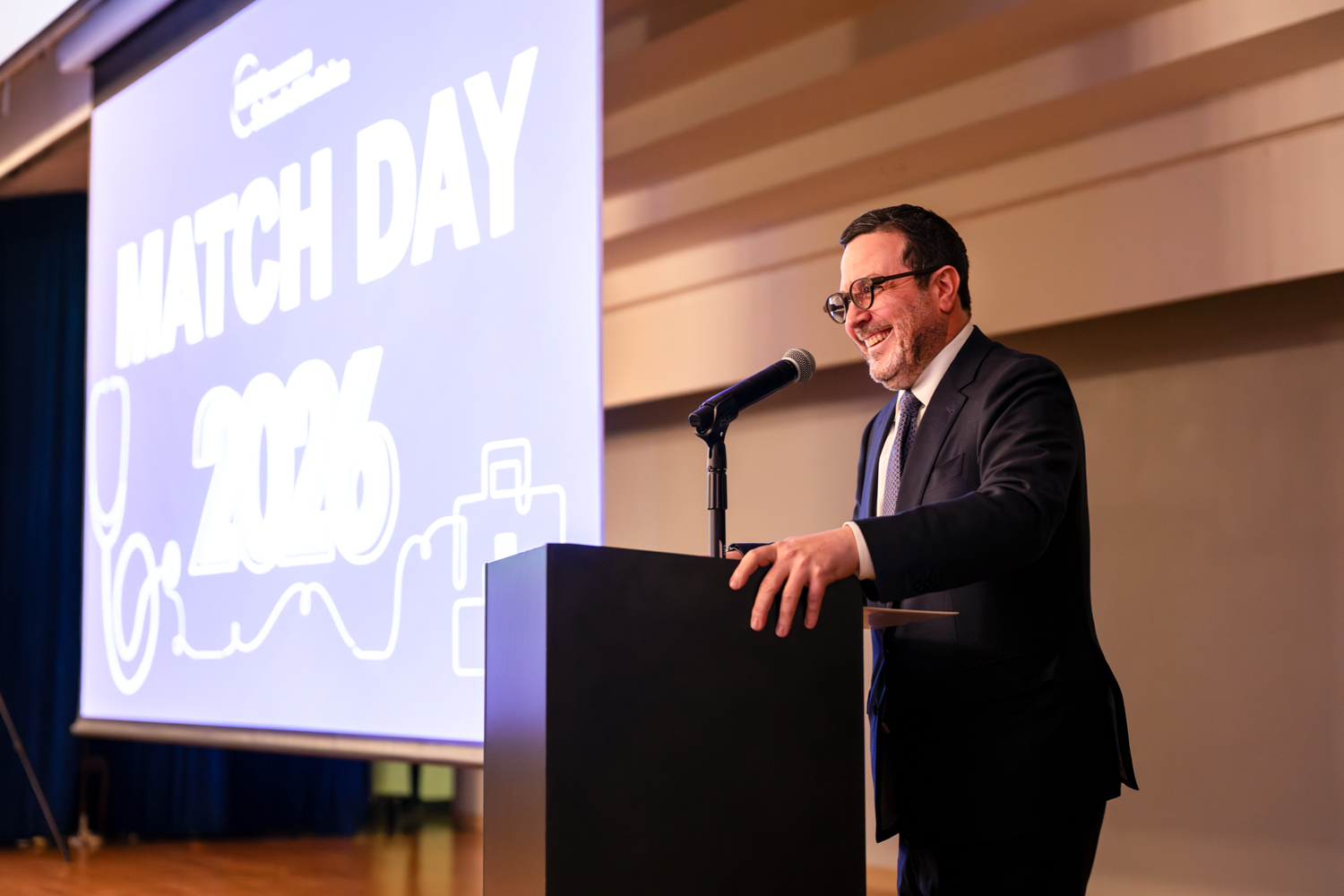
On March 20, the graduating class of NYU Grossman School of Medicine (GSOM) gathered at the Armenian Church on Second Avenue for Match Day. In this annual ritual, medical students across the country open sealed envelopes to learn which residency programs have accepted them. The day was especially significant for this class as they are the first in NYU Grossman’s history to have graduated in only three years, after completing the school’s unique fast-track curriculum.
Before the students opened their envelopes, Dean Alec C. Kimmelman, MD, PhD, addressed the room. The three-year program, he said, is supported by a decade of data showing that its graduates perform as well as four-year physicians by every measure.
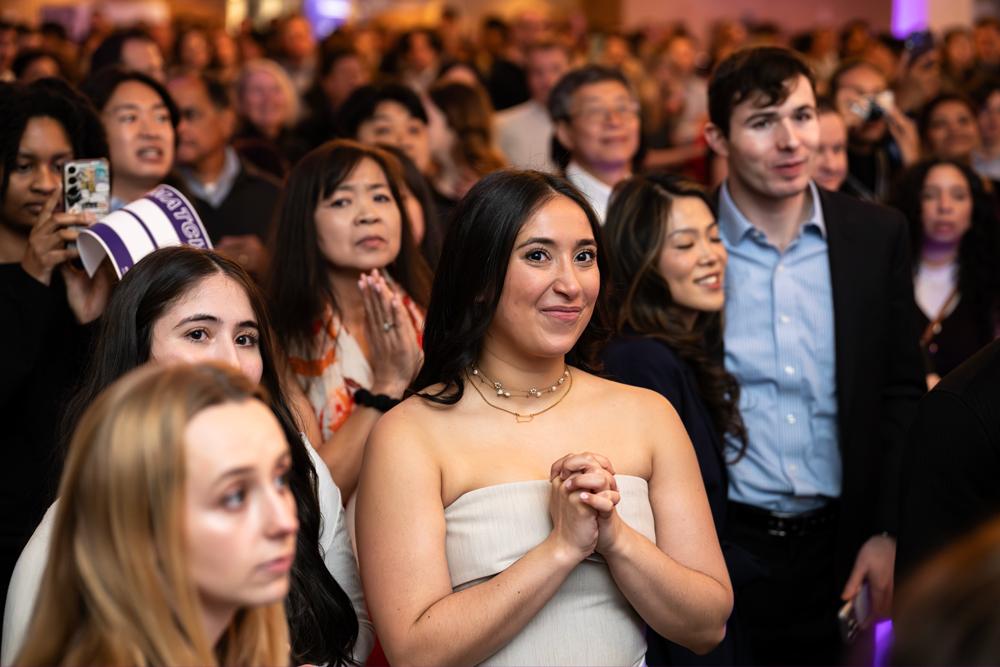
Hopeful students await news on their residency matches.
The class’s match results added to a growing body of evidence about the success of this model.
“Residency programs across the country and right here at NYU Langone Health are eagerly awaiting your arrival,” said Dr. Kimmelman.
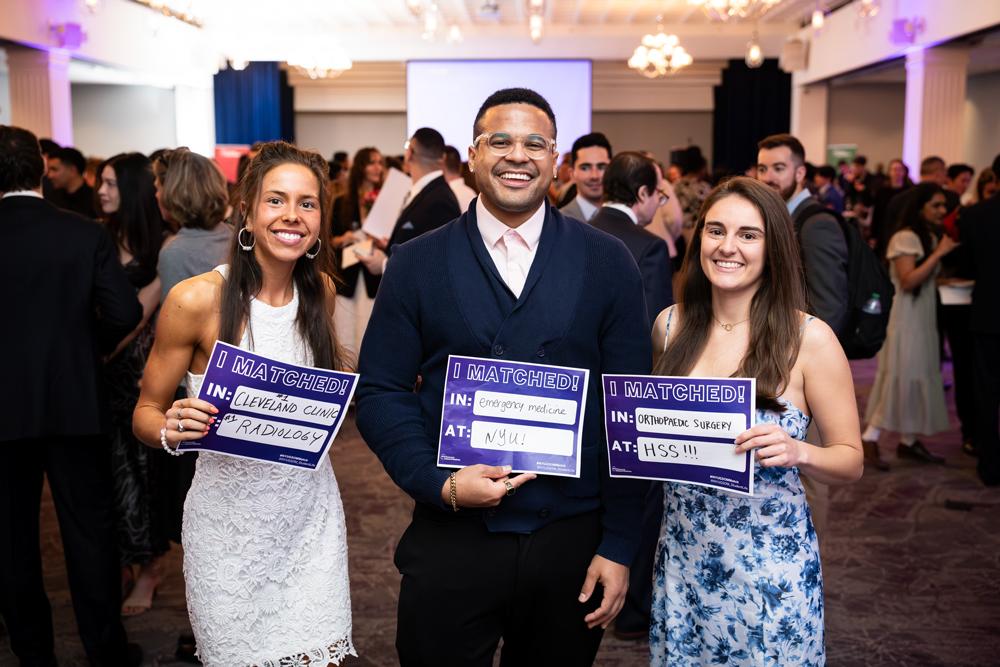
Three students reveal their matches.
“They recognize that NYU Grossman School of Medicine graduates are not only excellent clinicians but also doctors who place the highest importance on providing compassionate care, creating a healing patient experience, and serving their communities,” said Dr. Kimmelman.
Peek into any one of their stories, and you start to understand why residency programs were paying attention and how each student kept themselves competitive along the way.
Every morning since July 2023, Felicia Pasadyn has been on the StairMaster before 5 a.m., earning her the nickname StairMaster Girl. During her third year at NYU Grossman, she trained 2.5 hours a day, reading anatomy flashcards on the treadmill. She designed her own conditioning program using the physiology she was learning in class. In December Pasadyn became one of the first 60 runners in the country to qualify for the 2028 Olympic Marathon Trials. In March, she waited for an envelope.
Pasadyn is the youngest of four sisters—all physicians, all valedictorians at their high school in Brunswick, Ohio and all each other’s loudest cheerleaders along with their parents who met as nurses in the intensive care unit. She graduated from Harvard in three years, earned a master’s degree in bioethics while swimming for Ohio State on an athletic scholarship, and arrived at NYU Grossman only half sure of her specialty.
She was awed by radiology at age 16 when she had a stress fracture in her metatarsal and a scan identified what her doctors had missed. A second-year elective confirmed this was her calling. “Being able to help patients point to it and literally say, ‘This is the pathology that you’ve been describing’ and validate their feelings—I really like that about radiology,” she said.
The doctor she wants to be is someone who holds herself to high standards and makes patients feel heard. She credits the power of relentless belief in oneself, daily family calls, and 9 hours of sleep as her jet fuel.
On Match Day, Pasadyn opened two envelopes—one for her transitional year, one for her radiology placement. Her parents and sisters were in the room.
NYU Grossman’s tuition-free model let her focus completely on her education. “It allows our brains every day to actually be engaged with clinicals and patients and lectures and not just thinking about how we can save money or what we’re going to do when we have to pay off our loans.”
Max Shulaker took a longer route. He earned a doctorate in electrical engineering, joined the faculty at MIT, and supervised PhD students who have since become professors at leading research universities.
Shulaker had no plans to be a doctor until he was chatting with one of his mentors who was an infectious disease doctor and he found himself saying “It would be so cool to do what you do.” The physician responded with “Why don’t you?” and Shulaker didn’t have a solid answer.
Shulaker enrolled in introductory biology at MIT the following semester, still on faculty. He worked through prerequisites without leaving his job, applied to NYU Grossman, and continued teaching through medical school. He chose NYU Grossman because of the breadth of clinical exposure it offers. He direct matched, meaning he knew his result before he opened the envelope, into internal medicine at NYU Langone Health before Match Day arrived.
“I’ve been on both sides—as a student and as faculty,” he said. “GSOM was the best place in my opinion to learn.”
Shulaker wants to be a physician who combines a researcher’s rigor with a student’s humility. He chose internal medicine for its complexity; it’s the kind of practice where intellectual curiosity is a professional requirement, he said. Of tuition-free education, Shulaker said, “It clears one of the major obstacles toward pursuing a passion, particularly a passion that you develop later in life.”
Colin Webster had the inverse of Shulaker’s later discovery of a medical career. He grew up in a medical family. His mother is a pediatrician. His father is an ENT. His older sister became a physician. He went into nonprofit consulting steering hard against medicine.
A rotator cuff injury after college changed his direction. Physical therapy—watching his body recover through precise, targeted intervention—was “the biggest delta of change I’ve ever felt from something.” A trip to his father’s annual health fair in Anguilla, his home country, deepened his passion. “To deliver a service like healthcare that supports people’s most basic needs felt so much more impactful than anything I was doing at the time.”
Webster got the call from Rafael Rivera, PhD, MBA, the senior associate dean of admissions and financial aid, while running at the gym. He called his mother first, and his sister joined the call. His mother’s reaction: “Free tuition is the best thing you’ve ever gifted me!” His father’s: “Now the real work begins.”
Webster matched into emergency medicine at NYU Langone through a direct match. What surprised him was the confidence he felt going into it. “When I compare myself to four-year people on away rotations, I don’t feel that dissimilar to them.”
Webster thinks it’s important that doctors make a room feel safe the moment they enter it—patients should feel comfortable to say what they need to say, even when time is short. He described emergency medicine as a natural fit for him. “It’s a puzzle, a person, and an outcome all at once,” he said.
He called the class of 2026 “the party class.” “There’s real intimacy in pockets,” he said. “I came in worried I’d feel different, age-wise. But I actually feel very close to a good circle of people here.”
Zachary LaPorte grew up just outside Baltimore, where his mother is an orthopedic surgeon and residency program director at Johns Hopkins. Putting limbs back together was casual dinner table conversation. He went to Dartmouth, did a research year at Massachusetts General Hospital, and applied to NYU Grossman as his first choice.
He learned he got off the waitlist while checking his phone before heading out for dinner with his sister. He immediately called his mom, who was away for a lecture in Israel. She took his call at 3am that day and was at the Armenian church to see him open his envelope.
LaPorte and some classmates participate in a Wednesday rollerblade night that draws 200 to 300 people through Times Square, down Wall Street, and into Brooklyn. “We enjoy what we’re doing day-to-day in the hospital—and then we can get together, have a dinner party or go for a skate, and it keeps us balanced.”
LaPorte said he never looked at salary when ranking programs, and NYU Grossman’s tuition-free model made that possible. “Living in New York City while not having to pay off $200,000 of med school debt is something that takes a big piece of the puzzle out of my mind,” he said. “Without debt I could rank based purely on the best fit for training.”
LaPorte wants to be the kind of doctor where each patient feels like the most important patient of his day.
Emily Berzolla also has a passion for orthopedics. Berzolla studied mechanical engineering at MIT, then worked in the medical device industry. She met orthopedic surgeons while working on devices which set her path.
At NYU Grossman, in addition to her MD, she also completed a master’s in clinical investigations, studying the inflammatory environment in patients’ knees before surgery—cataloguing biomarkers, identifying proteins linked to cartilage degradation, looking for signals that might allow earlier intervention.
Growing up, Berzolla’s aunt, an OB-GYN, was one of the few adults she watched who seemed genuinely in love with her work—routinely on call, leaving parties, and always glad to go. It is one of the images she clung to when applying to medical school unsure of where she could get accepted. Her father pushed her to apply to NYU Grossman. “I almost didn’t apply, because I thought I wasn’t going to be good enough to get in,” she said. Her father cried when she called with the news—and got to say “I told you.” He was in the room on Match Day.
Berzolla believes teaching is inseparable from care. When she sees patients, she wants them to gain an understanding of what happened to them—to feel not just treated but informed.
When she’s not studying, she plays soccer and hosts themed Sunday potlucks. “Our class tries to prioritize the things that make us happy,” she said. “We take school seriously of course—but we also make time for each other. Working out, getting outside, seeing the city. Those things kept me happy and motivated.”
Just before noon, Dr. Kimmelman began the countdown. Across the Armenian Church, envelopes opened.
Pasadyn matched to Cleveland Clinic for radiology. Shulaker matched internal medicine at NYU Langone. Webster matched to emergency medicine at NYU Langone. LaPorte matched to Johns Hopkins for orthopedics. Berzolla matched to Hospital for Special Surgery for orthopedics.
While the contents of the envelope may have been uncertain, each student already knew what they needed in their lives to be the kind of doctor they want to be. Three years turned out to be exactly enough time to get there.
NYU Grossman School of Medicine Class of 2026 by the Numbers
156: number of students in the graduating class (3 are not pursuing residency)
153: number of students who matched (98 percent match)
7: students who completed a dual MD/master’s degree program
31: 3-year pathway graduates
13: students in the MD/PhD Program
4: students in the MD/MS in translational research program with NYU Langone’s Clinical and Translational Science Institute
1: student in the MD/MPH program with NYU School of Global Public Health
1: student in the MD/MPA program with NYU Wagner Graduate School of Public Service
1: student in the MD/MBA program with NYU Stern School of Business
50: number of students who matched at NYU Langone Health locations (32 percent)
Media Inquiries
Arielle Sklar
646-960-2696
Arielle.Sklar@NYULangone.org