
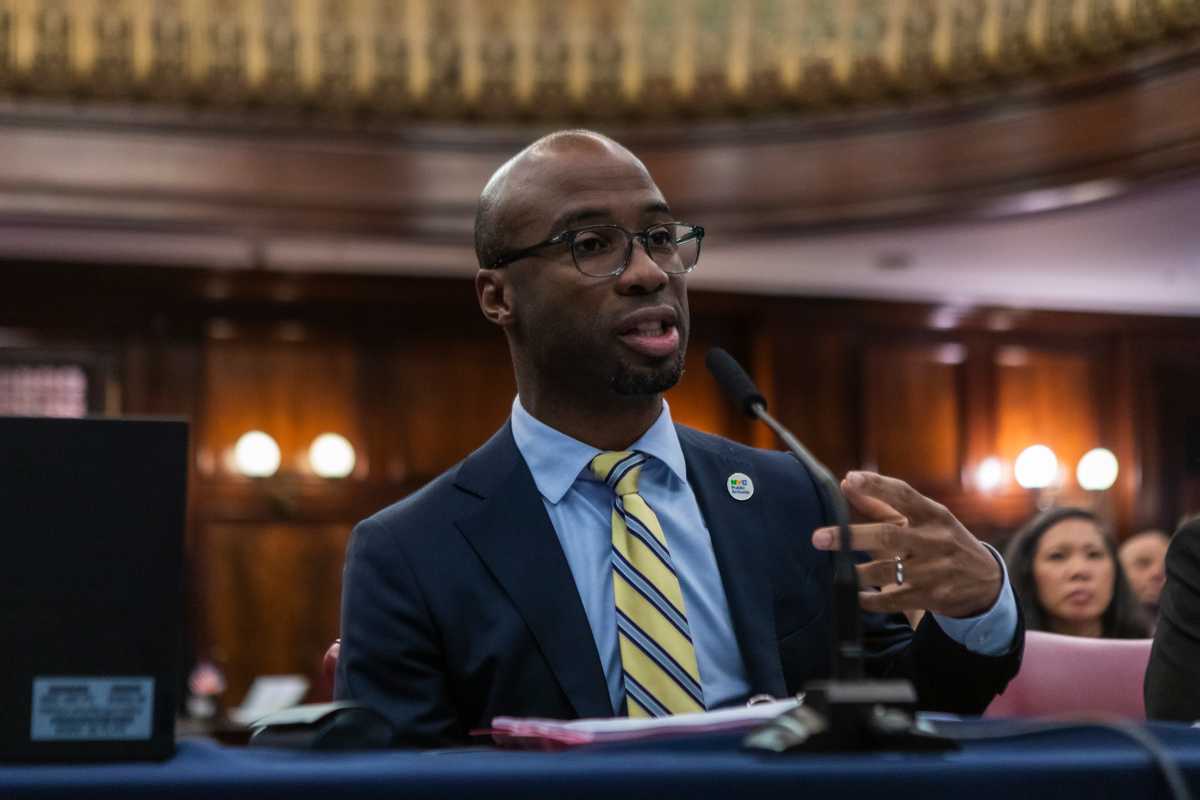
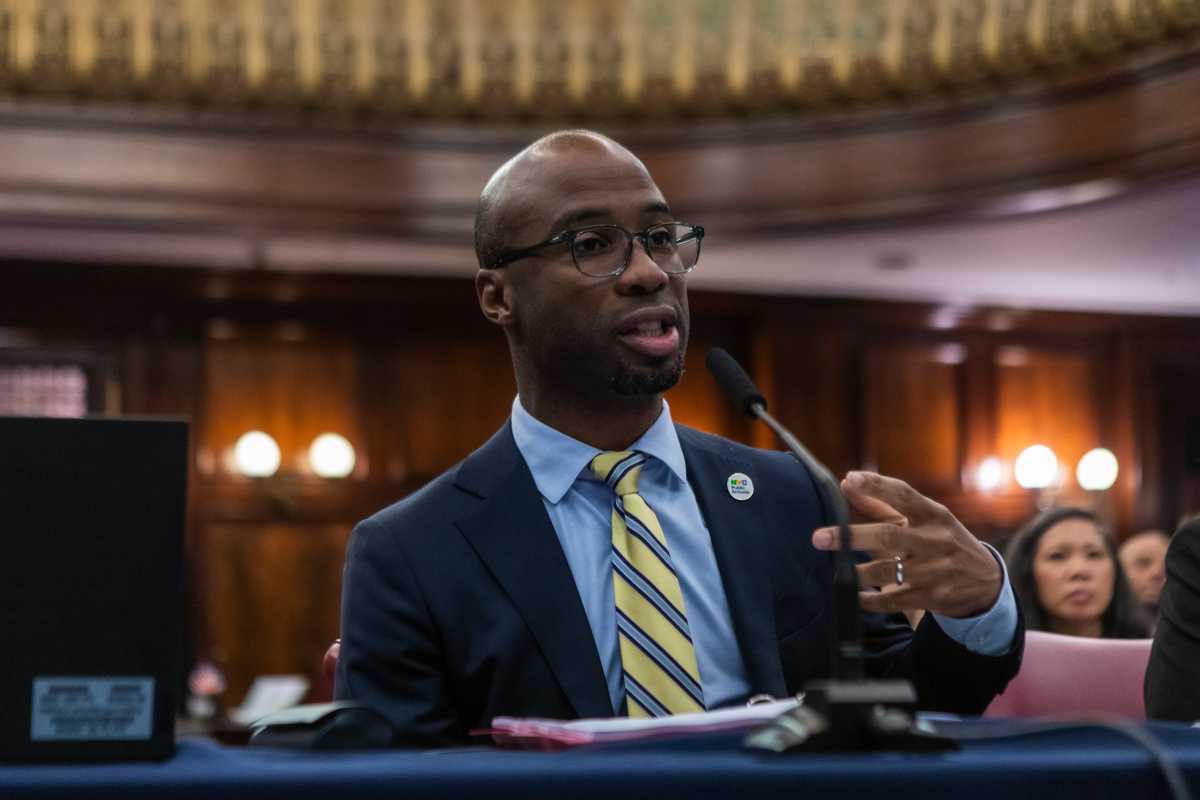
Kamar Samuels, chancellor of New York City Public Schools, testifies during a New York City Council preliminary budget hearing on education at City Hall on Monday, March 23, 2026.
Photo by Emil Cohen/NYC Council Media Unit
Monday, March 23, marked the 82nd day of Zohran Mamdani’s term as mayor. amNewYork is following Mamdani around his first 100 days in office. We are closely tracking his progress on fulfilling campaign promises, appointing key leaders to government posts, and managing the city’s finances. Here’s a summary of what the mayor did.
Schools Chancellor Kamar Samuels told the City Council on Monday that it will be “very difficult” for the city to meet a September deadline requiring 80% of classrooms to comply with the state’s class-size law.
The news came as council members pressed education officials on whether the school system can shrink classes while also identifying budget savings.
The City Council’s budget analysis says NYCis at 64% compliance for the 2025-26 school year, above this year’s 60% threshold but short of the 80% required for 2026-27. Asked during a preliminary budget hearing whether planning accounted for demographic changes, DOE officials said they were planning for flat enrollment.
“I think it’s going to be very difficult to get to 80% by September,” Samuels said.
Council members also pressed DOE about possible cuts or efficiencies under Mayor Zohran Mamdani’s savings drive, but officials provided few specifics. Finance Chair Linda Lee (D-Queens) asked what the department had submitted under the administration’s chief savings officer process. Samuels said the department had gone through “significant deliberations” and submitted a plan while trying to protect schools.
Mamdani announced in February that agencies would be asked to identify savings equal to 1.5% of their budgets this fiscal year and 2.5% next year, with reports due March 20. amNewYork reached out to City Hall to find out when the reports of the “Chief Savings Officers,” members of each agency whom Mamdani appointed to the task of finding savings, would be made public and is awaiting a response.
Council grills Mamdani’s education chief on achieving class size goals
The Council analysis says DOE’s preliminary fiscal 2027 plan adds $600 million for class-size compliance, including $542.9 million in city funds and $57.1 million in state funds, with the money intended to support roughly 6,000 teachers, assistant principals and room conversions. The same report says DOE’s proposed fiscal 2027 budget would increase by $2.61 billion from the November plan.
Lawmakers repeatedly questioned how the city plans to reach the 80% benchmark without losing art rooms, theaters and other specialized spaces. DOE officials said they are relying on principal surveys and school-by-school planning to identify room conversions, annexes and capital needs.
They also said staffing remains a major obstacle, especially in high school license areas. DOE officials said the department hired about 3,700 teachers last year and is trying to expand that pipeline, but shortages remain especially difficult in subjects such as science and world languages. The Council analysis says compliance is especially weak in several outer-borough districts, with Districts 20 and 31 at 50% compliance, and notes that science and world language classes are among the hardest to staff and bring into compliance.
The hearing also broadened into a larger debate over what falling enrollment should mean for school budgets. Council members asked whether the city would continue its “hold harmless” policy, which has protected some schools from enrollment-based budget cuts since the pandemic. DOE officials said no final decision had been made. Later, asked whether consolidation was being considered for under-enrolled schools, officials said such discussions were part of the department’s planning around noncapital strategies.
That argument is also being made outside City Hall.
In written testimony to the council, the Citizens Budget Commission urged the city to fund schools based on actual enrollment, reconsider hold-harmless funding, merge under-enrolled schools, pause some new construction and seek relief from the class-size mandate — arguing those steps could save $400 million annually on school funding and at least $1.2 billion annually if the state rescinded the mandate.
The hearing highlighted other budget pressures as well. The Council analysis says the preliminary plan adds $550 million in fiscal 2027 for special education due process cases, bringing that budget line to $1.55 billion.
During questioning, DOE officials said a major share of recent growth had come from cases involving students whose families were seeking publicly funded services while attending private schools, and said the city had tightened oversight and made criminal referrals in some cases.
Early childhood also surfaced repeatedly. DOE officials said the city is working on a new Early Childhood Management System, expected by the end of the calendar year, to give providers better visibility into contracting and payments. They also said the city is “aging down” underused pre-K capacity in some neighborhoods as it prepares for a 2-K rollout
Samuels also used his opening testimony to make a broader appeal to Albany. Along with asking for changes in state funding, he urged lawmakers to extend mayoral control, saying it allows the city to pursue “big, bold systemwide goals” and respond effectively in crises. Mamdani, who previously opposed mayoral control, has since said it is necessary to advance his education agenda, including expanding child care.
Chalkbeat previously reported that state Sen. John Liu, the lead sponsor of the class-size law, is open to giving the city more time if it produces a credible plan.
Additionally, on Monday, Samuels said the department would release its “foundational AI guidance” on Tuesday and that it would include community input before implementation.