
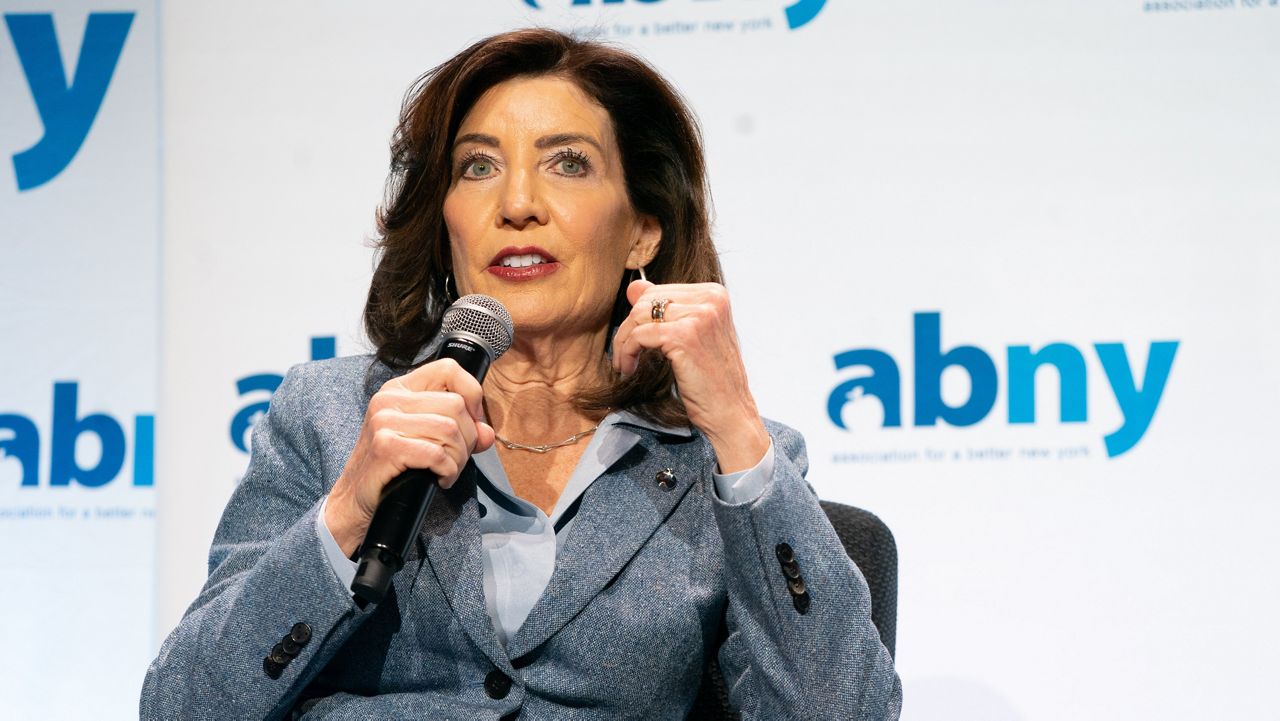
Gov. Kathy Hochul was in Albany Monday working to sell her proposal to change the state’s environmental quality review (SEQRA) to spur housing development.
Hochul has touted the policy as a key element of her affordability agenda. It would cut through red tape, allowing for an expedited review timeline in some cases while allowing other projects to skip the review entirely.
The governor gathered with likeminded community leaders at the state Capitol as she begins substantiative budget talks with legislative leaders just over a week from the April 1 budget deadline.
The governor stressed that for projects with limited environmental impact and which are taking place on already developed land, developers should be able to get shovels in the ground if the project receives approval at the local level and clears other hurdles.
“They should not now get trapped in bureaucracy which can lead to upwards of up to two years of review mandated by the state,” she said. “Sometimes the developers would say it’s just not worth it.”
Expediting projects on previously disturbed sites forms a key aspect of support from local leaders.
“The current SEQRA process too often adds delays and unnecessary review without improving environmental outcomes,” said Stephen Acquario, executive director of the New York State Association of Counties. “This is especially true for projects on previously disturbed sites where environmental risk is already understood.”
The proposal has faced some pushback from environmentalists who argue that its scope is too broad — questioning allowing projects to bypass environmental review if the focus is not strictly on spurring affordable housing development. Hochul disagrees, and insists that the state needs to focus boosting development at all levels.
“We need the whole array of housing,” she said. “If you’re taking something that had been a parking lot, or a big box store, or an abandoned mall— I don’t see how anybody could disagree that the higher and better use is for people to have a home there.”
The proposal will have to make it through budget negotiations with the state Legislature, and has been cited as potentially one of the most difficult discussions. The state Assembly did not include a proposal in their one house budget as is typically the case for policy items, and the state Senate included language mirroring legislation sponsored by state Sen. Rachel May.
May said the Senate’s proposal is intended in part to open up options for development in urban areas upstate where Hochul’s proposal would have a 100-unit limit for exceptions and has a broader overall reach, applying to more than just housing development.
“What we’re finding is a lot of the projects upstate in urban areas are larger than that that we were hoping could bypass some of the more onerous provisions of SEQRA,” May said.