
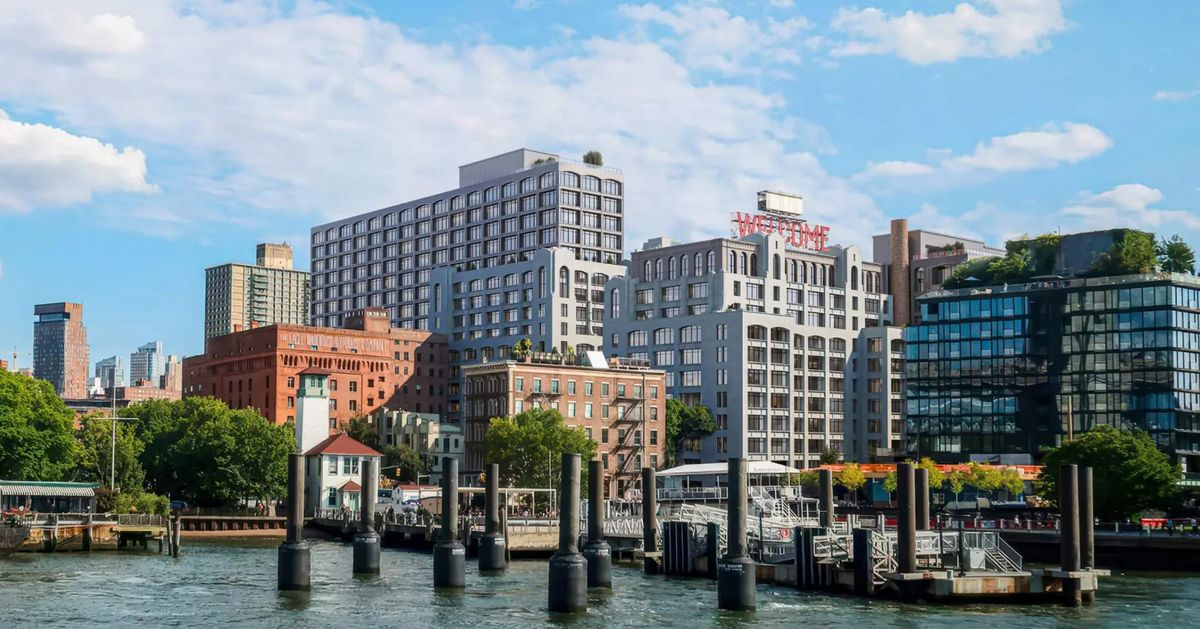
A rendering of what the enlarged complex might look like, as shown in the City Planning scoping session.
Photo: CIM Group
A decade ago, when the Jehovah’s Witnesses sold off their prime real-estate portfolio in Brooklyn Heights, one of the prizes was a complex of old industrial buildings next to the Brooklyn Bridge — 25–30 Columbia Heights, famous for the glowing red Watchtower sign that served as a Brooklyn landmark for nearly 50 years. In 2016, the CIM Group, along with the Kushner Companies and LIVWRK, paid $340 million for the buildings with plans to convert them into a sleek office complex and film studio called Panorama.
The red Watchtower sign came down and the 700,000-square-foot complex was renovated, but Panorama didn’t take off — the Brooklyn office market never materialized as developers had hoped it would, especially after COVID. It’s been largely vacant since the Witnesses left. Now CIM, which bought out its development partners in 2018, wants to convert the buildings into something there’s ample demand for on the Brooklyn Heights waterfront: housing.
CIM is proposing to build 661 apartments, 165 of which would be deemed affordable. It would do this, in part, by increasing the height of two of the five buildings in the complex — adding one story to 30 Columbia Heights (it would go from 13 to 14), the building right next to the bridge, and five stories to 25 Columbia Heights, taking it from 12 to 17 stories. The ground and some lower floors would remain retail and commercial space.
Here’s everything we know about the plans.
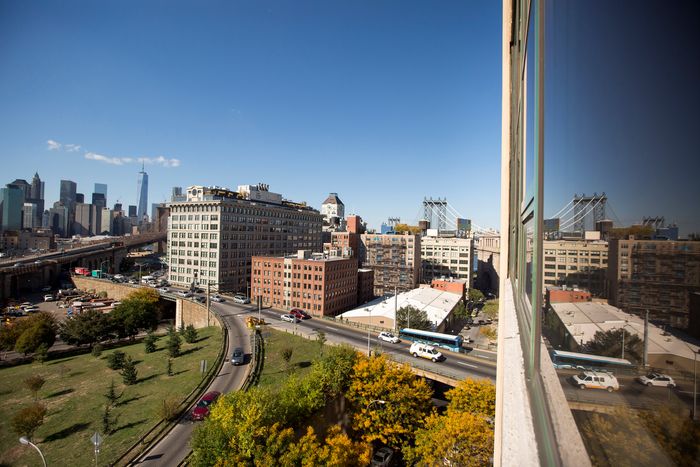
The location is prime, as are housing prices on the Brooklyn Heights waterfront. The Brooklyn office market, despite some promising early signs, has never really taken off.
Photo: Michael Nagle/Bloomberg/Getty Images
The 25–30 Columbia Heights complex is composed of five buildings that originally made up the Squibb Plant, built by the Squibb pharmaceutical company as a factory that produced mineral oil and vitamins among other medical products. The Jehovah’s Witnesses bought the buildings in 1969 to use for their headquarters and kept administrative offices in the building, along with a museum, a dining room that could seat 2,000, and a commercial kitchen where a New York Times reporter once saw aproned chefs “preparing a loaf of bread the size of a tire.” Around the same time, the Witnesses also bought up a lot of other property in the area, including the Hotel Bossert and the Leverich Hotel, using them for their publishing house and shipping rooms and as dorms.
The Witnesses were known for being good stewards of their real-estate empire, maintaining the buildings well and keeping things in good working order, even if the renovations were utilitarian rather than glamorous or luxurious. They sold off all their Brooklyn holdings, including the Hotel Bossert and 25–30 Columbia Heights, in the mid-aughts to fund the construction of a new headquarters upstate.
CIM did not respond to a request for comment, but several sources said that the complex was renovated, and the Panorama website shows finished spaces with stunning views of the bridge and East River. But the would-be tech and creative tenants never arrived — at least, not enough of them to make the office buildings a going concern. They’ve been largely vacant ever since the Witnesses left.
This seems to have less to do with the buildings themselves than the fact the Brooklyn office market never really took off — there’s a reason that the Downtown Brooklyn rezoning, originally intended to add outer-borough office space, resulted in thousands of apartments instead. After COVID hit, developers were briefly optimistic that new lifestyle and office habits might provide a shot in the arm, but even Domino Sugar in Williamsburg, Two Trees’ widely praised adaptive-reuse office space, has struggled to find tenants.
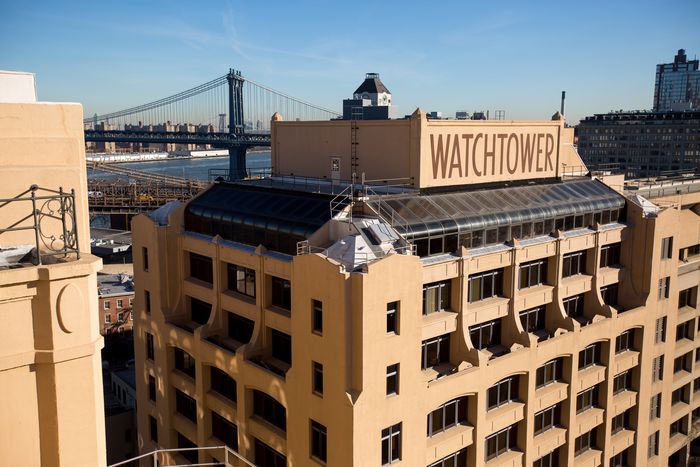
The buildings were bought in 1969 by the Jehovah’s Witnesses, which sold them in 2016 to fund a new headquarters upstate.
Photo: Michael Nagle/Bloomberg/Getty Images
Documents submitted to City Planning propose a zoning change — from commercial/manufacturing to mixed-use — with most of 25 and 30 Columbia Heights converting to residential. The developers plan to create 661 apartments, 165 of them affordable, or 25 percent, as required by mandatory inclusionary zoning. The one- and five-story additions would increase the size of the buildings from around 700,000 square feet to 831,000 square feet, with the larger five-story addition going on top of 25 Columbia Heights, the building farther from the Brooklyn Bridge (three of the five buildings would not increase in size as part of this proposal). The one next to the Brooklyn Bridge, 30 Columbia Heights, would get a one-story addition, with its current wedding-cake cutout shape mostly filled in. The bottom floors would be for retail and commercial uses.
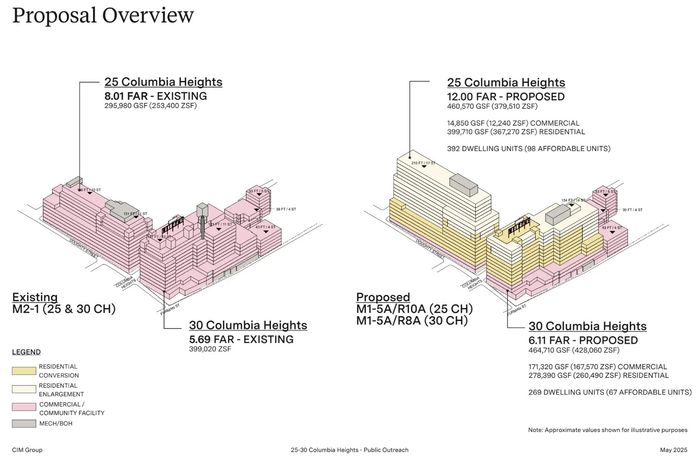
A massing diagram shows the new proposed additions for 25 and 30 Columbia Heights.
Photo: New York City Department of City Planning
CIM is a national developer with properties in Austin, Texas, and Atlanta, where it built 50-acre mixed-use development Centennial Yards. It also has another residential project nearby, at 85 Jay Street in Dumbo, that it partnered on with LIVWRK, a Brooklyn-based company focused on mixed-use developments including 160 Van Brunt Street in Red Hook. Completed in 2021, the Jay Street building is a 401-unit ground-up tower built on a vacant lot that was also owned by the Jehovah’s Witnesses. Currently, there’s a $1.195 million one-bedroom for sale in the building, which has amenities such as a pool, decks, a large courtyard, and a children’s playroom. There’s a Life Time gym in the building as well.
Before submitting the proposal, CIM hosted a number of sessions with neighborhood stakeholders: civic organizations, community groups, and commercial entities like the ferry. When I spoke to several, they emphasized that it’s still early in the process to come out definitively for or against the proposal, but they were happy to see the owners trying to repurpose a building that has spent the last ten years mostly vacant. They also felt that residential conversion, given the housing crisis and the desirability of living in Brooklyn Heights, seemed like a good use. Lincoln Restler, the local councilmember, voiced support for the broad outlines of the plan; he said he would be excited to see “two vacant buildings reactivated,” adding that “over 600 units of housing, more than 100 of them affordable, could be a real win for the neighborhood.” Someone with knowledge of the discussions also said that the developers claimed the affordable apartments would include two- and three-bedrooms — something there is overwhelming demand for among families in Brooklyn — not just studios and one-bedrooms, which are cheaper to build and tend to be far more plentiful in mixed-income buildings.
Some people I spoke with told me they are concerned about whether the proposed additions would block public views of the Brooklyn Bridge from the Brooklyn Heights Promenade and parts of Brooklyn Bridge Park. It’s likely that the five-story addition would, at least, block some views from apartments in the area, but that’s also par for the course in New York.
There were also concerns about public-school capacity if more than 600 new apartments are added to the neighborhood. The local elementary school, P.S. 8, is already oversubscribed, and the city mandate to reduce class sizes, while welcome, has raised fears that the school won’t even be able to accommodate all the kids who are currently zoned to attend.
The developer has initiated the first steps of a site-specific rezoning, known as ULURP, or Uniform Land Use Review Procedure, filing the application in mid-February. Last week, the City Planning Commission held a scoping hearing, which precedes the formal start of the process, which will focus on the environmental-impact statement next, followed by presentations and reviews before the City Planning Commission, community board, borough president, City Council, and mayor. The process takes about seven months after an application is submitted.
Sign Up for the Curbed Newsletter
A daily mix of stories about cities, city life, and our always evolving neighborhoods and skylines.
Vox Media, LLC Terms and Privacy Notice
Related