
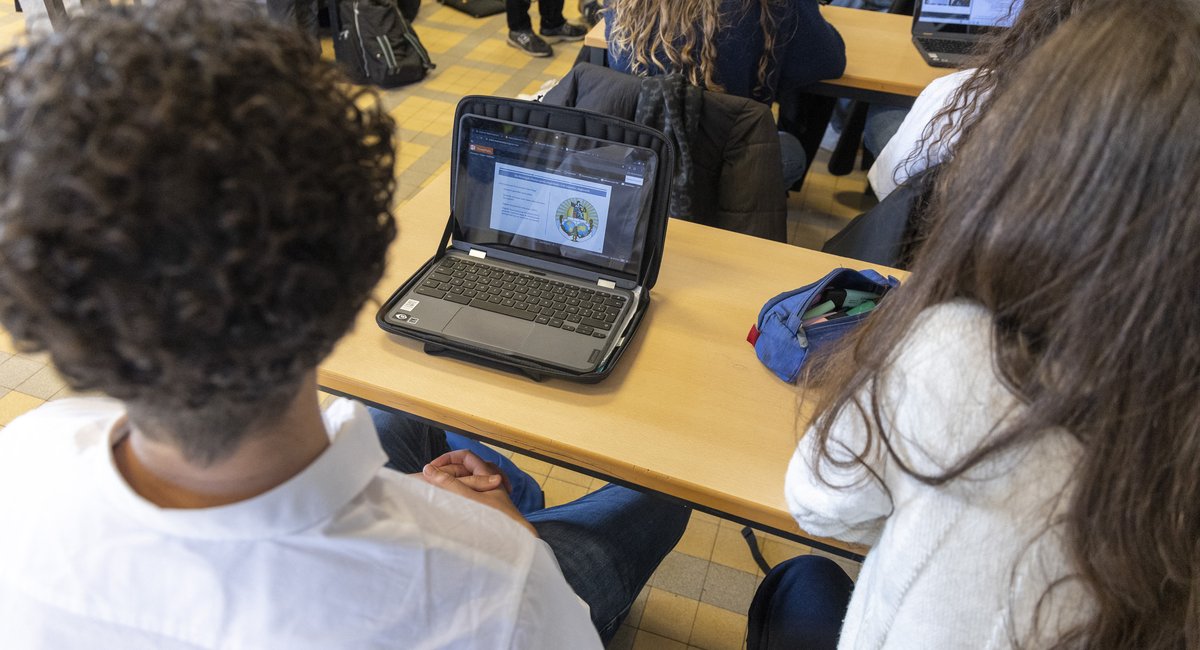
When it comes to artificial intelligence in schools, assigning grades gets a red light, translations get a green — and research gets a yellow.
The city education department released its long-awaited guidance on AI on Tuesday, rolling out a “traffic-light approach” for New York City’s 78,000 teachers that allows the technology in some cases, prohibits it in others and urges caution in areas that fall in between.
“The reality is our young people are using AI,” Schools Chancellor Kamar Samuels said. “We agree that the system needs guidance, the system needs significant safeguards so that families can feel comfortable. But what we cannot do is allow our fear to make us paralyzed.”
The role of AI in schools is one of the most contentious topics in education. As tech companies push multimillion-dollar contracts for academic software, many parents have called for tighter regulations.
More than 1,400 parents called for a ban on AI in the city’s public schools, citing concerns about data security, privacy and plagiarism. The city’s plan for a new AI-focused high school has fueled debate about how the technology should be used in the nation’s largest school system.
Samuels said the new guidance seeks to address dangers of AI — like exploitation of students’ data and negative effects on cognitive ability — while allowing uses that can enhance learning, like extra help in certain subjects for students trying to catch up. The department is soliciting feedback as it works on what it says will be a “comprehensive playbook” in June.
In the so-called red category, educators are barred from using AI for deciding grades, promotions, discipline and counseling. The tech cannot be used to develop special education plans for students with disabilities, and individuals’ data should never be used for training AI models, according to the guidance.
The approved — or green — category for educators includes translation, organizing information, lesson planning and drafting some communications to families and staff.
The yellow category — for “caution” — covers the broad area of “student use of AI for research, exploration and creative projects,” the guidance states.
Samuels emphasized AI cannot replace teachers.
“I hold the relationship between teachers and students as the most sacred thing we have in our system and profession,” he said.
The report urges educators to take responsibility for how AI is used in their classrooms, saying they must monitor the tech for bias and ethical responses. AI is known to “hallucinate” erroneous information, the guidance notes.
Teachers have complained AI has already led to a spike in cheating, prompting them to reduce take-home assignments and require students to use pens and paper to avoid plagiarism.
But Samuels said he believes the tech can be beneficial, citing examples like those lagging behind in reading who need targeted help, or students learning English who need materials tailored to their proficiency level.
Schools Chancellor Kamar Samuels urged educators to not be “paralyzed” with fear of AI’s effects on students.
NYC Public Schools
Officials said the guidance draws on months of engagement with educators, parents, experts and tech executives, though some participants have criticized the process for lacking transparency.
Leonie Haimson, a member of AI working groups formed by the education department, criticized the process for a lack of transparency.
“Our Working Group has been stymied, sidelined and stonewalled at every step of the way, and refused the most basic information, including the names of AI products currently used in schools, along with their privacy policies,” she wrote in a letter to the panel in December.
Officials said they are working on compiling a list of AI tech used in schools.
The guidance says all AI software is evaluated by education department headquarters to ensure compliance with data privacy and safety standards. Some tools might be approved for certain age groups, while barred from others.
The guidance notes a review is ongoing about voice and facial recognition, biometric data gathering and surveillance.
Gothamist reported Tuesday on some students’ unease with a new hall pass app that tracks how long they’ve been in the bathroom, and who else in the school has requested trips to the bathroom at the same time. And some parents have expressed alarm that their kindergartner was using voice recording technology.
The new guidance is sure to disappoint parents and educators calling for a complete ban on the use of AI in city schools.
“There are huge cognitive and developmental problems with offloading your thinking to AI,” said Kelly Clancy, founder of Parents for AI Caution in Educational Spaces.
Clancy pointed to a recent Brookings Institution study that argues the current risks of AI outweigh its benefits in education. She also pointed to mounting reports of kids developing toxic relationships with AI chatbots. Her group has called for a two-year moratorium on any use of AI in schools.
Clancy’s son Cyrus, a sixth grader, recently delivered the group’s petition for a moratorium to the chancellor at a public meeting, saying he’s seen kids “detach” from their academics because of the technology.
“They should get computers out of classrooms and let teachers teach students and not computers,” he said.
Samuels said managing AI will be an ongoing process.
“This is the beginning, not the end,” he said.
The education department guidance states “the use of AI in K-12 education is an evolving field.
“The long-term effects on how children learn, think, and develop in the era of AI are not fully understood,” it says. “No school system in the world has accounted for all the implications. [New York City Public Schools] will not pretend to have answers we do not have. We will not wait for certainty that may never come. And we will not let uncertainty become an excuse for inaction while our students navigate this technology.”