
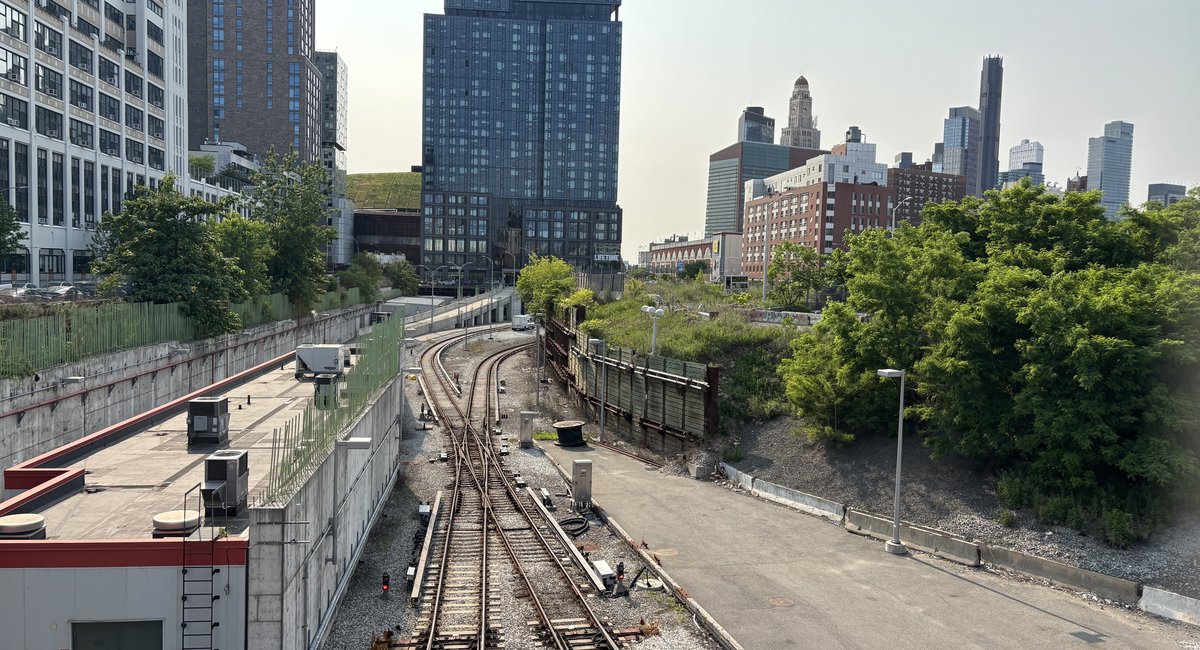
The long-stalled plan to build a platform and new apartment buildings above the train tracks at Brooklyn’s Atlantic Yards may soon get a major cash infusion not from a developer or private investor, but from New York state taxpayers.
The plea for public funds comes less than a year after developers behind the project skirted millions in monthly fines for failing to deliver hundreds of affordable apartments on time.
State economic development officials say public money is necessary to finally construct the platform over the MTA-owned railyard, a plan first hatched with a pledge to privately fund the deck in 2003 — five governors, four mayors and three development teams ago.
“We do acknowledge that there will need to be public resources to offset the value of, or the costs of the platform,” said Joel Kolkmann, senior vice president for real estate at Empire State Development during a public hearing last Thursday. “Platform construction is incredibly complicated. It’s incredibly expensive. And I think if you look at a lot of projects throughout New York City that have platforms, there’s been public resources dedicated to them.”
A new development team made up of the firms Cirrus Real Estate Partners and LCOR has asked for $350 million in state aid to build the Atlantic Yards platform, where they say they will construct a new park, along with thousands of apartments and condos in new residential buildings. Assemblymember JoAnne Simon, who represents the area and co-founded a coalition to hold developers accountable to the project plan, described the request to Gothamist.
Simon said she expects the governor to approve the funding during the ongoing budget negotiations, but said it should also come with commitments to build more deeply affordable apartments under the terms of previously broken Atlantic Yards agreements.
“If that $350 [million] to help them build the platform helps address that, I’m good,” Simon said. “We’re throwing public money at this project but what is the public getting?”
Empire State Development spokesperson Emily Mijatovic said the agency is “evaluating the request and New York State has not committed to providing funding at this time.”
Gov. Kathy Hochul’s spokesperson Kristin Devoe declined to say whether the governor and state lawmakers would issue the funds, but said the governor is “laser-focused on building more housing.”
Cirrus Managing Partner Joseph McDonnell declined to comment.
The request for state aid was first reported by the watchdog website Atlantic Yards/Pacific Park Report.
More than two decades ago, the controversial effort to build 16 residential buildings and a sports arena, which became the Barclays Center, included a promise to build the platform and create 2,250 affordable units. But a parade of developers failed to break ground on both the platform and nearly 900 of those units by a May 2025 deadline, despite a legally binding agreement that was supposed to impose $1.75 million in monthly penalties. The original developer, Ratner Forest City, sold the project to another firm, China-based Greenland.
Change in plans
The project plans, and what gets built atop the platform, are also changing.
The original proposal included five residential buildings atop the platform, including one above a thicket of train tracks.
At a public hearing Thursday, McDonnell, the head of Cirrus, said building large apartment complexes over that section of track would be “extraordinarily expensive” and unrealistic given space constraints.
His venture has instead proposed building a park atop the platform and concentrating most of the new housing in buildings surrounding the covered trainyard, including a pair of high-rises on a nearby, but separate lot known as “Site Five,” the longtime location of P.C. Richard and a defunct Modell’s on Flatbush Ave. across from the Barclays Center.
Those towers, and a third building proposed for the edge of the new platform, would contain 2,000 apartments, with 500 priced for low- and middle-income renters under the rules of a state property tax abatement known as 485x, officials said Thursday.
In all, the revised plan calls for nearly 6,000 new apartments across the Atlantic Yards sites for a total of 9,000.
McDonnell said at the hearing that he anticipated completing the entire development project, including the platform and new apartment buildings, by the late 2030s at the earliest.
“It’s an infrastructure project that becomes a housing development project,” McDonnell said. “There’s a long way to go here.”
The Atlantic Yards project, decades in the works, is now just one of several similar mega-projects in five boroughs. The Related Companies, the firm that owns the Hudson Yards development in Manhattan, is now seeking $2 billion to expand its existing deck and add more luxury housing.
State officials are also leading the planning for a new residential neighborhood along the industrial waterfront in Red Hook, and the Mamdani administration has revived a plan to deck over Sunnyside Yards in Queens, at an estimated cost of $21 billion. In late February, the mayor visited the White House to pitch President Donald Trump on investing federal funds into the project.
‘Never doable’
To community leaders long frustrated by the chronic delays and broken promises at Atlantic Yards, the change in plans and the request for state funding are an acknowledgement that the original proposal was never realistic to begin with — and may have been merely a tactic for gaining public support for a controversial plan.
Simon, the state assemblymember who cofounded the coalition Brooklyn Speaks, which won the legal agreement to build the affordable housing, said the state seemed to “finally” acknowledge that the original “was never doable.”
“It was never going to be self-sustainable,” Simon said. “They were never going to be able to do it without state support.”
Gib Veconi, a director of the Atlantic Yards Community Development Corporation and member of Brooklyn Speaks, said the request for state funding marks a “narrative change” from the story state officials and developers have long told about the development as “a snakebit project” that would have been completed if not for unforeseen problems. It has dragged out so long, it’s seen a few: the global financial crisis, the bankruptcy of the China-based developer Greenland and the COVID pandemic.
But he agreed with Simon that the original plan was unfeasible from the start.
“This project has been operating on a set of assumptions that were never verified and turned out to be completely inaccurate,” Veconi said.
He also agreed that state aid should come with more housing affordable to low-income New Yorkers.
“That’s a very large new injection of subsidy, so the public needs to see if it’s getting a good deal in this project,” he said. “Is there enough public good to justify such a large investment?”