
Innovative Research / Groundwork Collaborative
Overview
As the state Assembly and Senate prepare to finalize their budget in Albany, this brief analyzes Mayor Mamdani’s proposed budget and the fiscal realities of funding the largest city in the country.
Executive Summary
In February, newly-elected mayor of New York City Zohran Mamdani announced his inaugural budget proposal. As legally required, the budget for Fiscal Year (FY) 2026 is balanced. In FY2027, New York City faces a $5.4 billion budget gap – the product of four years of systematic underbudgeting by Mayor Eric Adams, which saddled Mamdani with $12 billion in unaccounted for spending obligations.
Mayor Mamdani, who ran on a sweeping affordability campaign focused on lowering the cost of housing, child care, and transit, proposed a prudent, fiscally responsible budget that identifies aggressive savings measures and operational reforms. Governor Kathy Hochul authorized $1.5 billion in state aid to address the budget shortfall. Despite these efforts, the budget gap cannot be closed without significant additional revenue.
The solution is straightforward. Mayor Mamdani proposed a surtax of two percentage points on New York City millionaires – 0.7% of total city taxpayers – that would generate approximately $3 billion annually. Combined with a fairer revenue split between New York City and New York state and other tax measures, the tax hike would be sufficient to balance the budget in the out years. Because New York City has limited revenue authorities, state legislators in Albany and Governor Kathy Hochul must enact the proposal in the state’s FY2027 budget. If granted the authority to raise taxes, New York City Council Speaker Julie Menin must then enact it. If Governor Hochul and Speaker Menin, who have opposed increasing taxes on the wealthy, do not approve the proposal, Mayor Mamdani will be forced into a drastic fallback measure: levying a 9.5% property tax that would hit the lowest-income New Yorkers the hardest.
As the state Assembly and Senate prepare to finalize their budget in Albany, this brief analyzes Mayor Mamdani’s proposed budget and the fiscal realities of funding the largest city in the country, as well as the distributive implications of both the millionaire tax and the fallback property tax proposal. Finally, it addresses many of the myths around millionaire tax flight, using historical and empirical data to show that the dire warnings of disinvestment and capital flight are overblown. New York should proceed in authorizing a tax hike on the wealthiest New Yorkers to ensure a sound fiscal future for the city.
I. A Crisis Inherited
Former mayor Eric Adams introduced his FY2026 Executive Budget in May 2025, under the now-ironic title “Best Budget Ever.”1 The budget called for 5,000 new New York Police Department Officers, 20,000 new after-school seats, expanded library hours, and nearly $25 billion for investments in affordable housing. These new spending commitments came on top of a budget that was already overstretched and undercounted. To make room for personal priorities, Adams ignored spending obligations he knew were coming. In November 2025, Adams presented a Financial Plan Update that showed outyear gaps of $4.7 billion in FY2027, $6.3 billion in FY2028, and $6.3 billion in FY2029.2 On their face, these numbers represented the largest outyear gaps since the Global Financial Crisis. Upon closer inspection, they were drastically understated. The NYC Comptroller estimated the true shortfalls were more than double what Adams presented, with significant downside risks from federal funding cuts and economic downturn. Subsequent estimates from current and former Comptrollers found the FY2027 gap reached more than $12 billion.3
In a press conference shortly after taking office in January, Mamdani detailed the extent of the previous administration’s budget mismanagement and deliberate undercounting of unfunded future outlays. New York City Comptroller Mark Levine identified $3.8 billion in unbudgeted spending in FY2026 and a $10.4 billion FY2027 gap, a catastrophic handoff to a new administration.4 Levine noted the historic budget gap was not “caused by a bad economy – it’s the result of budgeting decisions from the previous administration that we must now deal with.”
Prior to the Adams administration, city spending exceeded preliminary budget projections by an average of 3.5%. Under Adams, the city dramatically overspent projected budgets each year, underbudgeting by an average of 10% throughout his administration.5 Adams’ chronic underbudgeting was flagged in real time, with independent city budget observers and multiple national and local media outlets noting the systematic overspending.
These omissions were concentrated in social services that millions of New Yorkers depend on and mandated spending that cannot be cut. Adams projected that social service spending would shrink from FY2025 – FY2027, when historical data showed robust growth, driven by housing vouchers, public assistance, and shelter costs that increase with demand. Similarly, state class-size mandates and private tuition for special needs students ensured that education spending would rise by more than projected. Across social services and education, Levine estimated a $7 billion gap between Adams’ projections and actual spending in FY2027.6
When Mamdani took office, the administration identified $7.54 billion in shortfalls across six major needs left unbudgeted by Adams: cash assistance, rental assistance, shelter costs, due process cases, judgments and claims, and the Metropolitan Transit Authority structural deficits, as well as $6.67 billion in additional unfunded mandates over FY2026 – FY2027 alone, including the Health Insurance Stabilization Fund, state class size mandates, health plan increases, and early childhood spending.7 The gaps that Adams left behind are not easily managed through spending reductions or administrative efficiencies. Between state mandates and critical city services, the only option to balance the budget and set New York City on sound fiscal footing will be to increase revenue to cover the shortfalls.
II. Running the Largest City in America
The New York City budget looks gargantuan when compared to other large municipalities, leading critics to caricature the city as a chronic over spender that merely needs to tighten its belt and get its fiscal house in order. But New York City is not like any other municipality in the country, and its budget reflects its unique structure. Its budget, workforce, and services rival those of the largest U.S. states and even entire nations – as does its gross domestic product. Before discussing how to close the $5.4 billion budget gap Mamdani faces in FY2027, it is worth understanding the scale of what the city government does, and why cutting spending alone is not a viable option.
In raw dollars, New York City spends more than the next ten largest cities combined.8 But New York City consolidates many functions that are usually spread across municipal, state, county, and special district budgets. New York City maintains the largest school district, police force, health care system, and public housing system in the country. The public school system, encompassing New York City public schools as well as the City University of New York system, enrolls 1.2 million students.910 The New York City Police Department employs 34,000 officers, more than three times the next largest city force. The New York Health and Hospitals system serves more than 1 million patients annually across more than 70 locations.11 New York City Housing Authority houses nearly 300,000 residents across 153,000 apartments.12
The scale of this spending is commensurate with the size of New York City’s economy. The city has a gross domestic product (GDP) of $1.38 trillion, large enough to place it in the top 17 countries in the world.1314 New York City’s revenue as a share of its GDP has fallen as tax receipts collected have not kept pace with the growth of the city’s economy, even as GDP continues to rise at a healthy pace. Since 2010, GDP has more than doubled in New York City, while rising just 68% in the rest of New York.15 New York City accounts for 60% of the entire state’s economy and sends Albany 55% of all state tax revenues yet only receives about 40% of state expenditures.16
New York state, in addition to taking more revenue from New York City than it returns, has also added expenses to the city over the last several decades through spending cuts and cost reallocations. In 2010, the state ended Aid and Incentives to Municipalities (AIM) payments to New York City, which funded essential services and infrastructure to the tune of hundreds of millions per year.17 While intended as a temporary measure to shore up state finances during the Great Recession, the exclusion became permanent under former Governor Andrew Cuomo, with New York City shut out of aid. Cuomo imposed further costs on New York City, restricting state aid for homeless shelter costs, known as the Adult Shelter Cap, and cutting hundreds of millions from health programs, foster care aid, housing assistance, and rental assistance.18
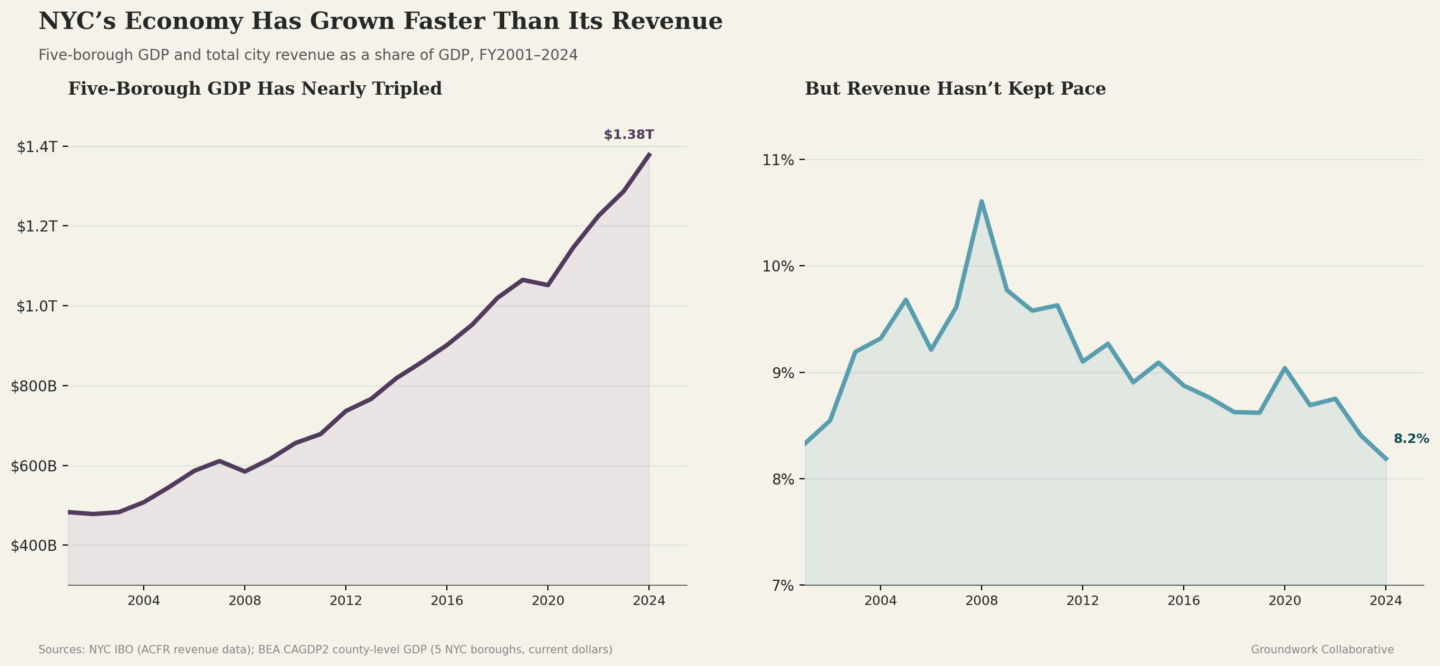
While the New York City economy shows some of the same structural weaknesses as the broader U.S. economy, particularly among low- and middle-income households, wealthy New Yorkers are reaping record gains. Wall Street posted profits of $65 billion in 2025, a 40% increase over 2024, when profits nearly doubled from 2023.19 The shrinking share of revenue, a function of New York City’s inability to control its own local tax base, the rising wealth and profits of the city’s wealthiest individuals and corporations, and the imbalance of revenue flow between New York City and the rest of the state make for an opportune time to reset the revenue base to put the city’s budget on sound fiscal footing for years to come.
III. Closing the Gap
The preliminary budget Mayor Mamdani put forward is a return to sound and honest accounting that aims to lay out the full scale of city spending and shortfalls and initiate a dialogue on the optimal way to close a budget gap that is nearly entirely his predecessor’s making. Comptroller Levine called the budget “significantly more transparent and accurate” than former Mayor Adams’ efforts, and the paths forward laid out by Mayor Mamdani provide a menu of savings and revenue increases to address the fiscal imbalance. Speaker Menin, Governor Hochul, and the New York state Senate and Assembly will ultimately choose whether the gap is closed on the backs of working families or by asking the wealthiest New Yorkers to contribute their fair share.
As illustrated, very little of the large structural components of the city budget can be meaningfully cut without drastic impacts on city services and the New Yorkers who rely on them. Still, Mayor Mamdani has prioritized finding operational efficiencies and cost savings, issuing Executive Order 12, which created first-of-a-kind Chief Savings Officers in every city agency targeting cost reductions of 1.5% in FY2026 and 2.5% in FY2027, totaling $1.7 billion.20 New investments in city capacity, including new auditors for the Department of Finance and additional lawyers and support staff at the Law Department, will generate additional revenue from existing tax receipts and savings from reduced tort liability. Yet, even with these savings and drawdowns from reserves, the budget gap can only be fully closed through an increase in revenues.
The Choice: Tax the Rich or Working Families
Mayor Mamdani put forward a suite of revenue raisers to fully close the budget gap, yet only one of the proposed fixes is fully within the city’s control to implement. Because New York City’s revenues are largely controlled by Albany, Mayor Mamdani is left with the city property tax as his only lever to pull. The FY2027 budget includes a 9.5% property tax increase that would generate $3.7 billion, an option that the mayor explicitly frames as a Plan B.21 The property tax is regressive, falling the hardest on working families who can least afford it. New York City’s unique property tax structure leaves working families in Staten Island, Southeast Queens, Eastern Brooklyn, and Northeast Bronx paying the highest effective rates, while the most expensive and high value condos and co-ops pay a disproportionately lower effective rate.22 Renters would also be impacted, as property-owners pass on costs in higher rents.
The more progressive solution would be to ask a very small percentage of New Yorkers to pay 2% more in income taxes. Mayor Mamdani’s Plan A would have Albany enact the Fair Share Act, a 2-percentage point increase on income above $1 million, which would generate $3 billion annually, combined with a targeted corporate income tax and other smaller measures to fully close the budget gap.23 Millionaires make up just 0.7% of New York City taxpayers, and those making over $10 million make up just 0.04% of taxpayers while making nearly one-fifth of all city income.24> The measure is extraordinarily popular – a recent Siena Poll found that 54% of New York State voters support the legislature giving the city the ability to raise taxes on incomes over $1 million, to just 29% who oppose. Support is even higher in New York City, where 62% of voters support the measure, to just 21% who oppose.25
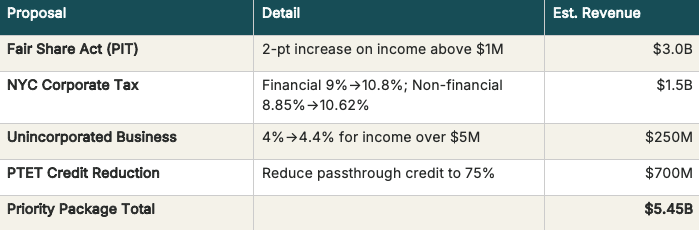
Source: Office of NYC Mayor, “Tax Revenue Raiser Proposals,” 2026.
Speaker Menin and Governor Hochul have adamantly opposed raising taxes on the rich, both state- and city-wide. The New York State Assembly and Senate proposed several tax increases, including on high earners in their initial budgets, which are due on April 1. However, neither chamber adopted Mayor Mamdani’s Fair Share Act, and without the dedicated revenue from New York City millionaires, the state fixes for the New York City budget fall short of filling the full gap.
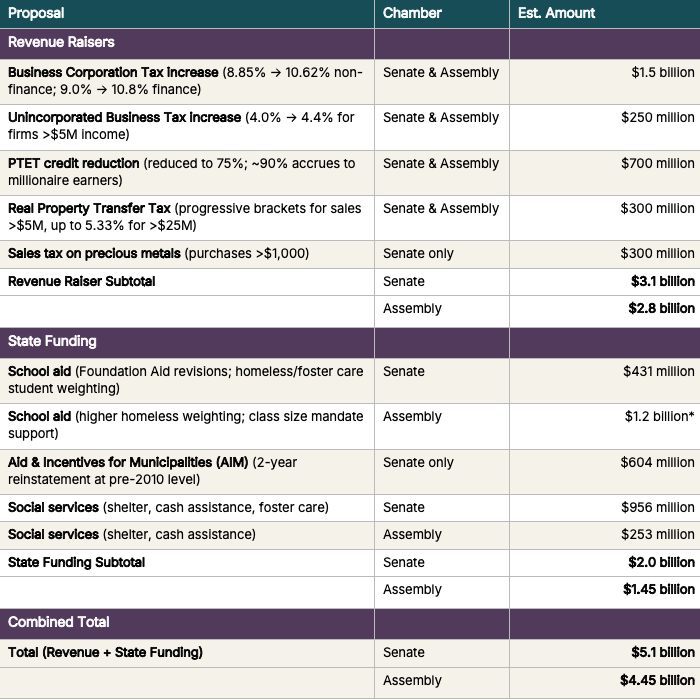
Source: Fiscal Policy Institute, “The Legislature’s Plans to Put New York City on Sound Fiscal Footing,” March 2026*
Assembly school aid includes $600M recurring + $600M one-time.
IV. The Millionaire Flight Myth
Speaker Menin and Governor Hochul have warned of “millionaire migration,” arguing that higher taxes on wealthy residents will prompt them to relocate to lower-tax jurisdictions. The claim is persistent in tax debates, but the evidence supporting it is thin.
Take the case of Massachusetts. In 2022, voters approved the Fair Share Amendment, a 4% surtax on incomes over $1 million. The proposal proved highly successful, generating $5.7 billion in revenue in its first two years including an additional $2 billion more than projected in the last year alone. Contrary to predictions of wealthy residents leaving the state, research indicates that Massachusetts’ millionaire population expanded by 38.6% between 2022 and 2024, as their aggregate wealth increased by more than $580 billion.
Across the country, this pattern holds almost universally.26 Overall, researchers estimate that a one-percentage-point tax increase in an average state with a population of 9,000 millionaires would lead to the departure of about 23 high earners. In other words, 99.75% of the millionaire class would remain. Importantly, any modest outflows are often offset, if not exceeded, by new high-income residents moving in.27
For example, in both 2017 and 2021, when New York increased personal income tax rates for millionaires, there was no statistically significant evidence of migration effects on high earners.28 In fact, after the implementation of the 2021 personal income tax increases, New York’s millionaire population grew by 21%, outmigration fell by a quarter, and the provision delivered roughly $3.6 billion in annual revenue.29 In neighboring New Jersey, when the state raised taxes on high earners in 2004, only 37 millionaires left the following year. That same year, 3,000 new millionaires were added to the state’s rolls.30
For most Americans, regardless of income, relocation decisions are driven less by tax policy than by everyday considerations: family ties, the search for good schools, business networks, and more. Conversely, these factors often encourage individuals to stay put. An analysis of 45 million U.S. tax filings with over $1 million in income demonstrates that elites are ‘embedded,’ with social and professional ties that tie them to the place where they initially built success.31
V. Conclusion
Aside from record snowfall, the inaugural budget is the first major test of Mayor Mamdani’s short tenure. While diligently documenting and revealing the gross fiscal mismanagement left to him by former Mayor Adams, Mayor Mamdani has laid out a responsible, progressive, and popular pathway to righting the city’s finances and laying the groundwork for fully enacting his affordability agenda, which would take aim at the skyrocketing housing, child care, and transportation costs that make New York City unaffordable for working families. However, if forced to adopt a regressive property tax hike to fill the budget hole, New York would be further piling costs onto those who are already struggling.
Governor Hochul and Speaker Menin should not heed the vocal minority who threaten to leave due to a modest, popular increase. Instead, they should enthusiastically support the wealthiest New York City residents paying their fair share in a time of record city-wide inequality and wealth creation to close the budget gap and keep the economic engine of the state thriving and humming.
Footnotes
[1] “Mayor Adams Releases ‘Best Budget Ever,’ Fiscal Year 2026 Executive Budget Makes Significant Investments in Safety, Affordability, and Quality of Life, Expands Opportunities for Working-Class New Yorkers,” The Official Website of the City of New York, 2026, https://www.nyc.gov/mayors-office/news/2025/05/mayor-adams-releases-best-budget-ever-fiscal-year-2026-executive-budget-makes-significant.
[2] NYC Office of Management and Budget, “November 2025 Financial Plan Update,” November 2025, https://www.nyc.gov/office-of-the-mayor/news/2025/11/november-2025-financial-plan.
[3] Comptroller Levine, January 16, 2026; NYS Comptroller DiNapoli, “New York City’s Fiscal Outlook,” December 2025, https://www.osc.ny.gov/reports/new-york-citys-fiscal-outlook-december-2025.
[4] “Comptroller Levine Projects $2.2 Billion Budget Shortfall in Fiscal Year 2026 and $10.4 Billion in Fiscal Year 2027,” Office of the New York City Comptroller Mark Levine, n.d., https://comptroller.nyc.gov/newsroom/comptroller-levine-projects-2-2-billion-budget-shortfall-in-fiscal-year-2026-and-10-4-billion-in-fiscal-year-2027/.
[5] Andrew Perry, “New York City’s Fiscal Challenge,” Fiscal Policy Institute, March 5, 2026, https://fiscalpolicy.org/nyc-fiscal-challenge.
[6] Office of the NYC Comptroller, “Comments on New York City’s Preliminary Budget for Fiscal Year 2027 and Financial Plan for Fiscal Years 2026–2030,” March 2026, https://comptroller.nyc.gov/wp-content/uploads/documents/Comments-on-New-York-Citys-Preliminary-Budget-For-Fiscal-Year-2027-and-Financial-Plan-for-Fiscal-Years-2026-2030.pdf.
[7] “Mayor Mamdani Details ‘Adams Budget Crisis,’” The Official Website of the City of New York, 2026, https://www.nyc.gov/mayors-office/news/2026/01/mayor-mamdani-details–adams-budget-crisis-.
[8] “Fiscally Standardized Cities,” Lincoln Institute of Land Policy, January 30, 2026, https://www.lincolninst.edu/data/fiscally-standardized-cities/.
[9] “NYCPS Data at a Glance,” NYCPS, n.d., https://www.schools.nyc.gov/about-us/reports/nycps-data-at-a-glance.
[10] “Governor Hochul Announces Third Consecutive Rise in Student Enrollment at City University of New York,” Office of Governor Kathy Hochul, January 5, 2026, https://www.governor.ny.gov/news/governor-hochul-announces-third-consecutive-rise-student-enrollment-city-university-new-york.
[11] NYC Health + Hospitals, “NYC Health + Hospitals – Public Health Care System in the US,” March 11, 2026, https://www.nychealthandhospitals.org/.
[12] New York City Housing Authority, “NYCHA Fact Sheet,” 2025, https://www.nycha.nyc.gov/section/about/pages/factsheet.
[13] Bureau of Economic Analysis, “GDP by County, Metro, and Other Areas,” 2024, https://www.bea.gov/data/gdp/gdp-county-metro-and-other-areas.
[14] “World Bank Open Data,” World Bank Open Data, n.d., https://data.worldbank.org/indicator/NY.GDP.MKTP.CD?most_recent_value_desc=true.
[15] “Annual Budget Briefing Fiscal Year 2027,” Fiscal Policy Institute, February 24, 2026, https://fiscalpolicy.org/wp-content/uploads/2026/02/FY-2027-Budget-Briefing.pdf.
[16] Carla Sinclair, “The Fiscal Flow Between New York City and Albany — CUNY Institute for State & Local Governance (ISLG),” CUNY Institute for State & Local Governance (ISLG), March 6, 2026, https://islg.cuny.edu/resources/fiscal-flow-nyc-albany.
[17] “Division of the Budget Releases Enacted Budget Financial Plan,” State of New York Division of the Budget, August 20, 2010, https://www.budget.ny.gov/pubs/press/2010/pressRelease10_FinancialPlan.html.
[18] Claire Salant, “How Have City Costs for Homeless Shelters Changed With Shifts in State and Federal Support?,” New York City Independent Budget Office, March 10, 2023, https://www.ibo.nyc.gov/content/publications/2023-march-how-have-city-costs-changed-with-shifts-in-state-and-federal-support-for-homeless-shelters.
[19] “Comments on New York City’s Preliminary Budget,” Office of the New York City Comptroller Mark Levine, March 11, 2026, https://comptroller.nyc.gov/reports/comments-on-new-york-citys-preliminary-budget-for-fiscal-year-2027-and-financial-plan-for-fiscal-years-2026-2030/.
[20] Mayor’s Office of Management and Budget, “The City of New York Preliminary Budget Fiscal Year 2027,” February 2026, https://www.nyc.gov/assets/omb/downloads/pdf/feb26/sum2-26.pdf.
[21] Mayor’s Office of Management and Budget, “Financial Plan Detail Fiscal Years 2026 – 2030,” February 2026, https://www.nyc.gov/assets/omb/downloads/pdf/feb26/tech2-26.pdf.
[22] Iziah Thompson et al., “Footing the Bill: Fifty Years of NYC Overtaxing Tenants, Towers, and Low-Income Communities of Color,” March 2025, https://smhttp-ssl-58547.nexcesscdn.net/nycss/images/uploads/pubs/031425_CSS_TaxReport_it_V2_%281%29.pdf.
[23] Office of NYC Mayor Zohran Kwame Mamdani, “Tax Revenue Raiser Proposals,” https://s3.documentcloud.org/documents/27772948/mamdani-2026-revenue-proposals.pdf.
[24] “Raising Revenues,” Office of the New York City Comptroller Brad Lander, May 23, 2023, https://comptroller.nyc.gov/reports/raising-revenues/.
[25] “Strong Majorities of Democrats & NYC Voters Support Gov. & Leg. Giving NYC Ability to Raise Income Tax on Its Residents Earning at Least $1M,” Siena Research Institute, March 4, 2026, https://sri.siena.edu/2026/03/04/strong-majorities-of-democrats-nyc-voters-support-gov-leg-giving-nyc-ability-to-raise-income-tax-on-its-residents-earning-at-least-1m/.
[26] Cristobal Young et al., “Millionaire Migration and Taxation of the Elite: Evidence From Administrative Data,” American Sociological Review, 2016, https://doi.org/10.1177/0003122416639625.
[27] Michael Mazerov, “State Taxes Have a Minimal Impact on People’s Interstate Moves,” Center on Budget and Policy Priorities, August 9, 2023, https://www.cbpp.org/research/state-budget-and-tax/state-taxes-have-a-minimal-impact-on-peoples-interstate-moves.
[28] “New York’s High-Income Migration During Covid,” Fiscal Policy Institute, November 2023, https://fiscalpolicy.org/wp-content/uploads/2023/12/FPI-Who-is-Leaving-Full-Report-Dec-2023.pdf.
[29] “Fact Sheet: Millionaire Migration and Taxes,” Fiscal Policy Institute, 2023, https://fiscalpolicy.org/wp-content/uploads/2023/03/030223-Fact-Sheet_-Millionaire-Migration-and-Taxes.pdf.
[30] Cristobal Young and Charles Varner, “Do Millionaires Migrate When Tax Rates Are Raised?,” 2013, https://inequality.stanford.edu/sites/default/files/media/_media/pdf/pathways/summer_2014/Pathways_Summer_2014_YoungVarner.pdf.
[31] Young et al., “Millionaire Migration and Taxation of the Elite: Evidence From Administrative Data,” 2016.