
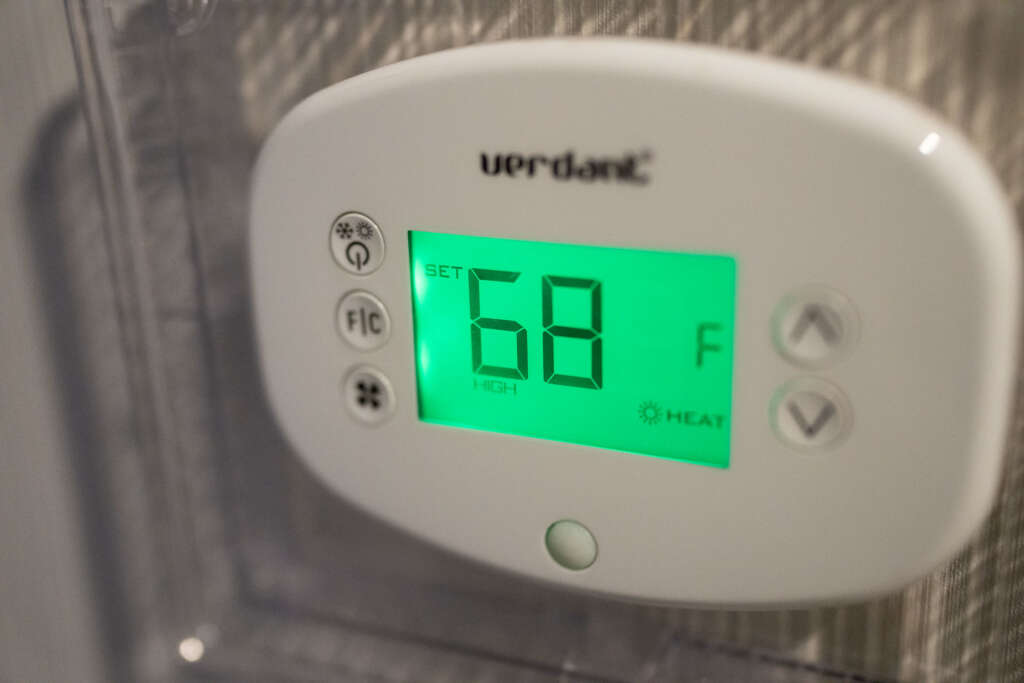
New York’s coldest winter in decades exacerbated a trend of steadily increasing utility rates. The average National Grid winter gas bill for NYC residential customers rose by 25 percent from last winter to this winter, according to the company’s filings.
 (Michael Appleton/Mayoral Photography Office)
When Marge Beane opened her December natural gas bill from National Grid, she thought the company had made a mistake. But when she called the customer service line, a representative confirmed the charge’s accuracy: She owed $463.74.
To Beane, 28, a vocal coach living in Brooklyn, the unexpected expense arrived at a bad time. She had been moonlighting at a bowling alley to help pay the bills, but recently lost that job.
“This is kind of a blow,” said Beane, looking over the bill on her laptop, sitting on the couch in the apartment she shares with two others. “My other roommates too, like, we don’t make a lot of money.”
Like Beane, many New Yorkers grapple each winter with higher power and gas bills. That struggle is exacerbated this year after an exceptionally long run of bitter cold in the city, including a nine-day streak in which temperatures remained below freezing from Jan. 24 to Feb. 2.
New York’s coldest winter in decades exacerbated a trend of steadily increasing utility rates. The average National Grid winter gas bill (from Dec. through Feb.) for New York City residential customers rose by 25 percent from last winter to this winter, according to National Grid’s filings to the state’s Public Service Commission. The average monthly charge shot up from $231 to $290.
What fueled the higher gas bills? For one, wholesale gas prices exploded due to record-setting usage caused by the cold spell.
“The extreme weather this winter is driving up bills,” said Destenie Nock, a professor of engineering and public policy at Carnegie Mellon University. “The heating system in a home can represent up to 40 to 70 percent of the energy bill.”
Even before this unusually frigid season, natural gas prices have ballooned in northeastern states like New York, where they rose by about 37 percent from 2020 to 2025, according to data from the U.S. Energy Information Administration.
But service rate hikes for both National Grid—which will climb 11 percent starting April 1— and Con Edison have compounded the problem. Rate increases, which are approved by state regulators every few years, cover the costs of the utility’s energy infrastructure buildout—including a controversial new pipeline under construction.
The price of electricity, which is largely generated by natural gas in New York, has also jumped significantly—up 50 percent from last January to this January, according to data from New York’s grid operator. In the past five years, the average Con Edison electric bill for New York City residents has increased from $82 to $113 dollars—a 37 percent increase, according to a calculation comparing charges from 2020 to 2025.
While initiatives like the Low Income Home Energy Assistance Program help people unable to pay their winter bills, the recent government shutdown delayed the opening of applications this year until early December. As a result, the 1.5 million New Yorkers who relied on the program may not have received assistance until late this winter, as states can take up to two months to disburse funds.
New York’s Office of Temporary and Disability Assistance, which oversees the distribution of energy assistance funding, has issued all payments for residents who automatically qualify for assistance through other programs (such as Medicaid).
While residents like Beane foot increasingly burdensome rates, utility profits have grown, according to a recent report from the Energy & Policy Institute. On average, about one in eight revenue dollars goes to utility profits.
Though regulated by state governments, investor-owned utilities like National Grid and Con Edison are private companies that receive a guaranteed return on equity. This profit margin, which is designed for utilities to attract investment for infrastructure spending, can constitute as much 20 percent of a customer’s bill, according to an analysis by the climate think tank RMI.
 A screenshot of Beane’s electric bill spanning Dec. 11, 2025, to Jan. 13, 2026. Credit: Marge Beane
A spokesperson for National Grid said, “There is no markup on supply costs – National Grid pays exactly what our customers pay – but these market conditions can lead to higher bills as well.” However, delivery costs, which often make up the majority of a customer’s bill (as in Beane’s case), include the utility’s return on equity markup.
Nock advises people struggling to pay their energy bills to seek assistance through customer advocacy groups or the utilities themselves as soon as possible. She recommends that New Yorkers apply for HEAP funding, either online or in person at a local office.
Even before the recent cold spell, more than a million households across New York were two months or more behind on their energy bills, totaling $1.84 billion in debt, more than double what was owed before the pandemic, state lawmakers said in December.
In addition to HEAP, New Yorkers can also apply for Energy Affordability Program funding or, if they don’t qualify for that, the Enhanced Energy Affordability Program.
“It is much easier to get assistance before you default on a bill,” said Nock.
To reach the editor, contact [email protected]
Want to republish this story? Find City Limits’ reprint policy here.