
This week in design, the best place to go dumpster diving for home goods is outside of the Hollywood venue that hosts the Oscars, where one local resident picked up a piece of the red carpet and found the perfect place for it in her apartment. Stay in the know with our weekly roundup of headlines, launches, showhouses, recommended reading and more.
Business News
The U.S. producer price index rose 0.7 percent last month—a seven-month high, signaling elevated costs for goods and services, Reuters reports. The reading surpassed the 0.3 percent economists had forecasted for February, suggesting that key inflation metrics went up throughout the month. That trend could continue as the war in the Middle East—which has driven up oil prices more than 40 percent in recent weeks—pushes the cost of fuel higher.
Imports of household furniture and bedding declined 12.7 percent last year, according to an analysis investment banking firm Mann Armistead & Epperson shared with Home News Now. According to the findings, furniture shipments to the U.S. last year amounted to $29.6 billion—a decrease from $33.9 billion in 2024. While Vietnam, the top exporter to the States, fared well over the last year (with exports rising slightly from $10.4 billion in 2024 to $10.6 billion in 2025), other countries saw their shipments substantially decrease: China’s fell about 36 percent, from $9.6 billion to $6.1 billion; while Mexico and Canada decreased around 22 percent and 20 percent, respectively.
New York Mayor Zohran Mamdani has announced a push to help the city’s homeowners build ADUs (accessory dwelling units) as part of a broader effort to improve housing access and affordability. The initiative includes new financing options—such as the Plus One ADU pilot program, which will provide up to $395,000 in loans each to 15 homeowners—and a website called ADU for You, offering a library of designs that have been reviewed for code and zoning compliance, along with estimated costs and names of registered firms that can facilitate the building process. As Realtor.com reports, the program is expected to lead to the construction of roughly 20,000 ADUs over the next 15 years.
As of last year, service-based tenants in the U.S. surpassed stores selling products when it comes to leasing space, accounting for just over 50 percent of total retail square footage—compared to 40 percent 15 years ago. The Wall Street Journal reports that much of the growth among service-based tenants is likely due to the expanding consumer interest in the wellness market—categories like spas, fitness, beauty and nutrition—which totaled $2.1 trillion in 2024. While primary service tenant categories like bars and restaurants have weakened amid a pullback in consumer spending, wellness categories have made up the difference—gym openings alone made up nearly 30 percent of service-based retail leases last year, up from 20 percent in 2016.
The metaverse—which has seen declining interest in recent years despite the buzz it generated during the height of the pandemic—may be losing one of its biggest players. Meta announced last week that it was shutting down Horizon Worlds, a virtual reality social network accessible through its Quest VR headsets, and transitioning the program to a mobile-only app, CNBC reports. Then the next day, Meta CTO Andrew Bosworth walked back the announcement, saying on Instagram: “We have decided just today, in fact, that we will keep Horizon Worlds working in VR for existing games, to support the fans who reached out.” As Ars Technica reports, “He went on to clarify that only games and experiences that already support VR will continue to do so, while new games will be exclusive to mobile, and the majority of the team’s development focus will be on mobile instead of VR.” The news comes just two months after Meta laid off more than 1,000 employees in its VR- and AR-focused Reality Labs division, marking a shift toward AI development and away from the metaverse—which CEO Mark Zuckerberg once called “the next frontier in connecting people” and believed in so fervently he renamed his company after it. Reality Labs has recorded billions in losses each quarter since the 2021 rebrand.
Ashley Furniture has announced layoffs for 266 workers as it prepares to close its manufacturing facility in Mesquite, Texas, The Street reports. The retailer informed employees earlier this month, offering some the option to fill positions at other manufacturing and distribution centers, while others will see their employment end on May 7. Among the affected employees, the largest group includes more than 100 upholstery training workers. They are joined by machine operators, packing employees, material handlers, operations supervisors, inspectors, and others.
Ingka Group, Ikea’s largest franchisee, announced last week that it may cut up to 800 jobs in an effort to simplify its organizational structure, Retail Dive reports. The reductions align with reorganization plans the company announced in January, which began with the addition of seven new executive roles to support CEO Juvencio Maeztu, and included plans to reinforce Ingka Group’s core business, Ikea Retail, and improve efficiency as an omnichannel retailer.
Last September, OpenAI announced that ChatGPT users could purchase products from Shopify merchants and several other vendors (including Etsy, and later Walmart and Target) from directly within its chatbot, thanks to a new Instant Checkout feature. Now, the AI company is pulling back on that strategy, Modern Retail reports. In an email sent last week, Shopify alerted merchants that, while users will still be able to find and purchase their products through ChatGPT, the platform will now redirect customers to an “agentic storefront” channel to complete the purchase, allowing merchants to “distribute products across AI shopping interfaces while keeping their own storefronts and checkout systems,” the article explains. In an email sent last week, Shopify alerted merchants of the change, which will be integrated by default for brands on its platform (who can then modify their settings to opt out).
California-based furniture manufacturer Jonathan Louis has reached an agreement to acquire the Style Line upholstery manufacturing operation from furniture wholesaler Elements International Group, Home News Now reports. A purchase price was not disclosed. The deal will include Style Line’s assets and its 350,000-square-foot manufacturing center in Verona, Mississippi. The acquisition will allow Jonathan Louis, which has operations in Los Angeles and Tijuana, Mexico, to achieve its ambitions of expanding east.
Launches and Collaborations
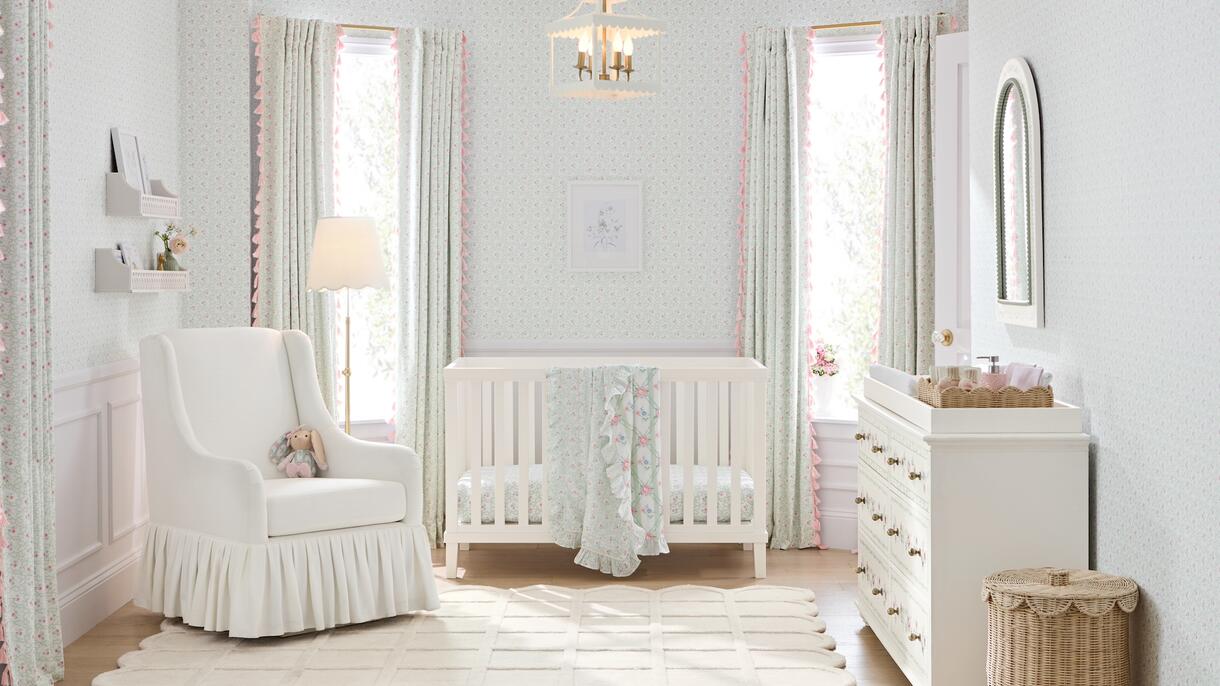
Fashion and lifestyle brand Hill House Home has teamed up with Pottery Barn Kids and Pottery Barn Teen for a collection of furnishings inspired by its romantic, whimsical design. The resulting assortment spans furniture, bedding, rugs, decor, lighting, wallpaper, nursery essentials and more, brimming with motifs like delicate florals and trellis patterns.
London-based homewares brand Abask partnered with Milanese silverware house San Lorenzo to release a last-edition collection of archival pieces conceived by Italian design icons. The discontinued items originate between 1971 and 1992, and include the sterling silver Polygonal vases designed by Afra and Tobia Scarpa; the Pannocchia sterling silver bowl by Franco Albini and Franca Helg; and a candelabra by Lella and Massimo Vignelli.
Recommended Reading
Moss—not the model, but the fuzzy green plant—was all over the runways this season, with top brands like Miu Miu, Hermès and Louis Vuitton incorporating it into their set designs during Paris Fashion Week. As Anna Grace Lee writes for Vogue, the trend seems to extend beyond fashion and into the realms of floral, interior and landscape design, perhaps reflecting a collective desire to leave the digital world and “touch grass,” as the internet saying goes.
Long gone are the days when games and puzzles were stuffed in the back of a shelf or closet. For The New York Times, Dina Cheney explores the designers and homeowners who are crafting spaces that center around play, and the brands that are helping to make it happen. Among them is home decor company Society Social, which recently teamed up with photographer Nick Mele to release the Pause Life, Play Games furniture collection.