
The US has sent Iran a 15-point plan and cease-fire proposal to end the war in the Middle East — and President Trump claims the regime has already agreed to a critical part of the peace framework: No nuclear weapons.
“They’ve agreed,” Trump said Tuesday of his biggest demand. “They will never have a nuclear weapon. They’ve agreed to that.”
The peace plan was shared with Iranian officials Tuesday via Pakistan, according to the New York Times.
The 15-point peace plan was reportedly sent via Pakistan. AFP via Getty Images
Trump’s special envoy Steve Witkoff and son-in-law Jared Kushner are reportedly seeking Tehran to agree to a monthlong cease-fire, during which the 15 points of the plan would be negotiated, according to Israel’s Channel 12.
The peace plan is believed to be based on the 15-point framework presented to the Iranian government last year, before Israel launched its 12-day war against the regime and the US bombed Iranian nuclear facilities in Operation Midnight Hammer, according to multiple outlets.
Israel is not involved in the negotiations but was given a heads up by the Trump administration before discussions to end hostilities with Iran began on Sunday, an Israeli official told Channel 12.
The outlet’s report contains 14 of the 15 demands the Trump administration has conveyed to Iran.
Iran must dismantle existing nuclear capabilities
Iran must commit never to pursue nuclear weapons.
No uranium enrichment on Iranian territory.
Iran must hand its stockpile of enriched uranium to the International Atomic Energy Agency (IAEA).
The Natanz, Isfahan and Fordo nuclear facilities must be dismantled.
The IAEA must be granted full access to Iran’s nuclear facilities.
Iran must abandon its “regional proxy paradigm.”
Iran must cease the funding, directing and arming its proxies.
The Strait of Hormuz must remain open.
Iran’s missile program must be limited in both range and quantity.
Iran must limit its use of missiles to self-defense.
In return, Iran would benefit from:
The end of sanctions imposed by the international community.
US assistance to advance its civilian nuclear program.
A “snapback” mechanism allowing for the automatic reimposition of sanctions if Iran fails to comply would be removed.
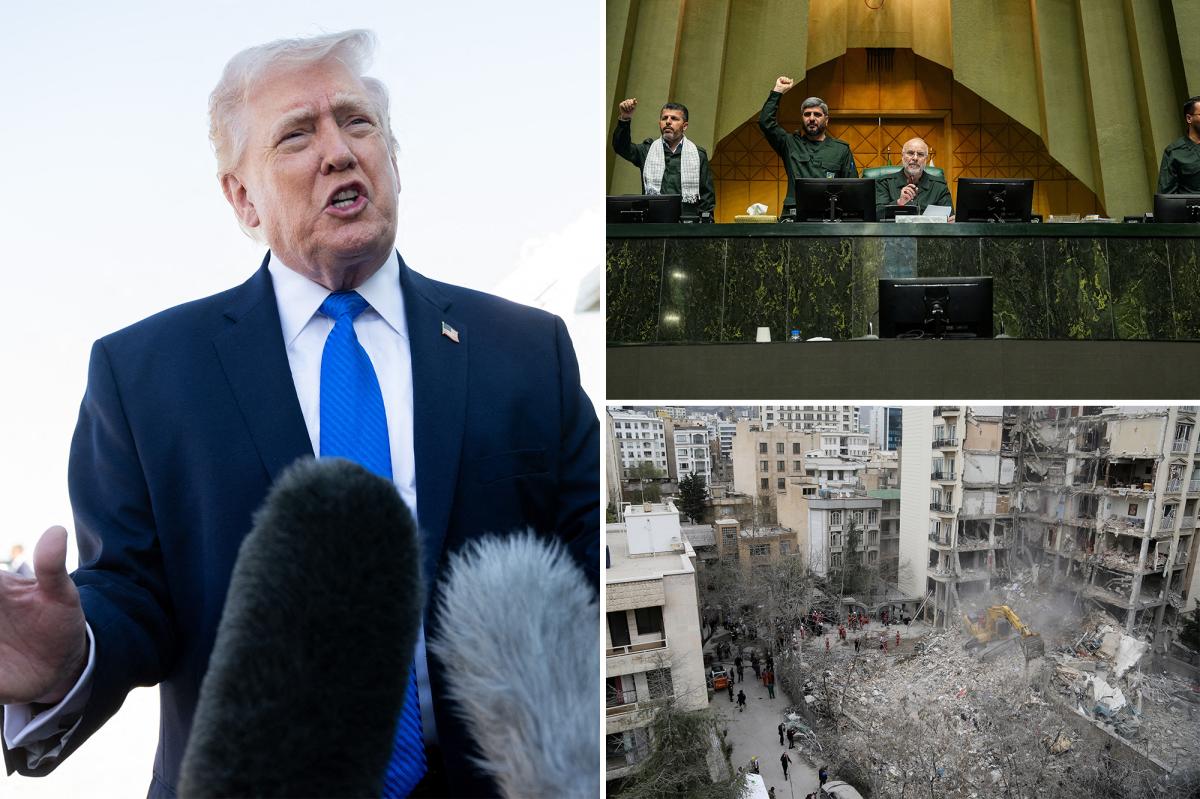
Damage from US and Israeli strikes seen in the Enderzgu district of Tehran on March 23, 2026. Anadolu via Getty Images
The White House did not immediately respond to The Post’s request for comment.
White House press secretary Karoline Leavitt signaled that the US military operations against Iran will continue until Trump’s objectives are met.
Start your day with all you need to know
Morning Report delivers the latest news, videos, photos and more.
Thanks for signing up!
“As President Trump and his negotiators explore this newfound possibility of diplomacy, Operation Epic Fury continues unabated to achieve the military objectives laid out by the commander in chief and the Pentagon,” Leavitt said in a statement to the New York Times.
Pakistan’s army chief, Field Marshal Syed Asim Munir, has been one of the key interlocutors between Washington and Tehran, according to the outlet, with Egypt and Turkey also involved.
Israeli emergency service personnel gather at the site of an Iranian missile strike in Tel Aviv on March 24, 2026. AFP via Getty Images
Munir reportedly proposed Pakistan host peace talks between the US and Iran in a recent conversation with the head of Iran’s parliament, Mohammad Bagher Ghalibaf, who is also a former Iranian Revolutionary Guards Corps commander.
Pakistani Prime Minister Shehbaz Sharif said Tuesday his country “fully supports ongoing efforts to pursue dialogue to end” the war.
“Subject to concurrence by the US and Iran, Pakistan stands ready and honoured to be the host to facilitate meaningful and conclusive talks for a comprehensive settlement of the ongoing conflict,” Sharif wrote on X.
Tehran has denied it is negotiating with the US and has not publicly stated that it has agreed to any of Trump’s demands, including ending its pursuit of nuclear weapons.
Iranian Parliament Speaker Mohammad-Bagher Ghalibaf looks on as parliament members chant in support of the IRGC while wearing military uniforms in Tehran, Iran, February 1, 2026. via REUTERS
“We’re actually talking to the right people and they want to make a deal so badly, you have no idea how badly they want to make a deal,” Trump said Tuesday.
He also expressed optimism that a deal could happen, saying Tehran was “talking sense.”
Follow The Post’s coverage of the United States’ airstrikes on Iran:
“They’re talking to us and they’re talking sense,” Trump noted.
The potential diplomatic breakthrough comes as the US appears to be gearing for a major combat operation if talks fall apart.
The Department of War is preparing to deploy thousands of troops from the Army’s 82nd Infantry Division to the Middle East, according to a source familiar with the plan.
The Pentagon is expected to announce the deployment of a 3,000-person brigade combat team from the elite North Carolina-based unit in support of the US and Israel’s war on Iran, the Wall Street Journal first reported.
One of the military’s premier rapid-response forces, the 82nd Airborne is designed to be a rapid-response team able to deploy a battalion within 18 hours — and a full brigade within 72 hours.
Emily Goodin and Caitlin Doornbos contributed to this report.