
For years, when I brought tour groups to the Brown Building (formerly the Asch Building) at Greene St. and Washington Place in Greenwich Village, I had only photographs and a story to guide me. Three modest plaques marked the site of the 1911 Triangle Shirtwaist Factory fire — one of the deadliest industrial disasters in U.S. history — but they never seemed equal to the weight of what had happened there.
That has finally changed.
When I recently returned with a group, we were met by a striking installation of steel and glass wrapping the building’s façade. Plaques bookend the memorial, while a steel band above bears the laser-cut names and ages of the victims, reflected in the dark glass below. Quotes from survivors and witnesses are etched along its edges.
A ribbon of stainless-steel traces the exterior to the roof, marking the scale of the tragedy. Designed by Richard Joon Yoo and Uri Wegman, the memorial draws the eye toward the ninth floor — where many workers leaped — while grounding the viewer in the human cost below.
The explanatory inscription in English, Yiddish, and Italian captures both the tragedy and its enduring challenge:
“This memorial inscribes the names of those who died… But it is also dedicated to the survivors, and the witnesses, and to all of those who took up the fight for basic human dignity in the workplace, and who do so to this day.”
For the first time in my 30 years of guiding visitors here, the tragedy felt fully seen, honored, and heartbreakingly human.
On March 25, 1911, fire tore through the factory’s eighth, ninth, and 10th floors. Within minutes, 146 workers — most young Jewish and Italian immigrant women and girls — were dead.
They had labored under grueling sweatshop conditions: long hours, low wages, crowded tables, and minimal breaks. Safety measures were grossly inadequate.
On a Saturday afternoon just before closing, fire broke out. Panicked employees leaped into elevator shafts, were crushed at exits, suffocated in smoke, burned, or trapped by flames.
Workers fled onto the fire escape, which quickly collapsed. More than 50 people died jumping from windows.
Firefighter ladders reached only the sixth floor; hoses fell short. Life nets failed.
It was over in just 18 minutes.
The death toll sparked reforms that shaped the modern workplace: laws improved conditions with shorter hours, stronger building codes, and better fire safety standards. Many protections workers rely on today were born from that loss.
Now, the memorial itself anchors that memory. Each life is individually remembered — just as intended when the memorial was unveiled on Oct. 11, 2023.
At that ceremony, Suzanne Pred Bass, co-founder of the Remember the Triangle Fire Coalition, spoke of her two great-aunts — one who survived, one who did not.
“My great-grandmother’s vision of a substantial monument that would honor her daughter has finally been realized,” she said. “It calls out to all who walk by… that we must not forget.”
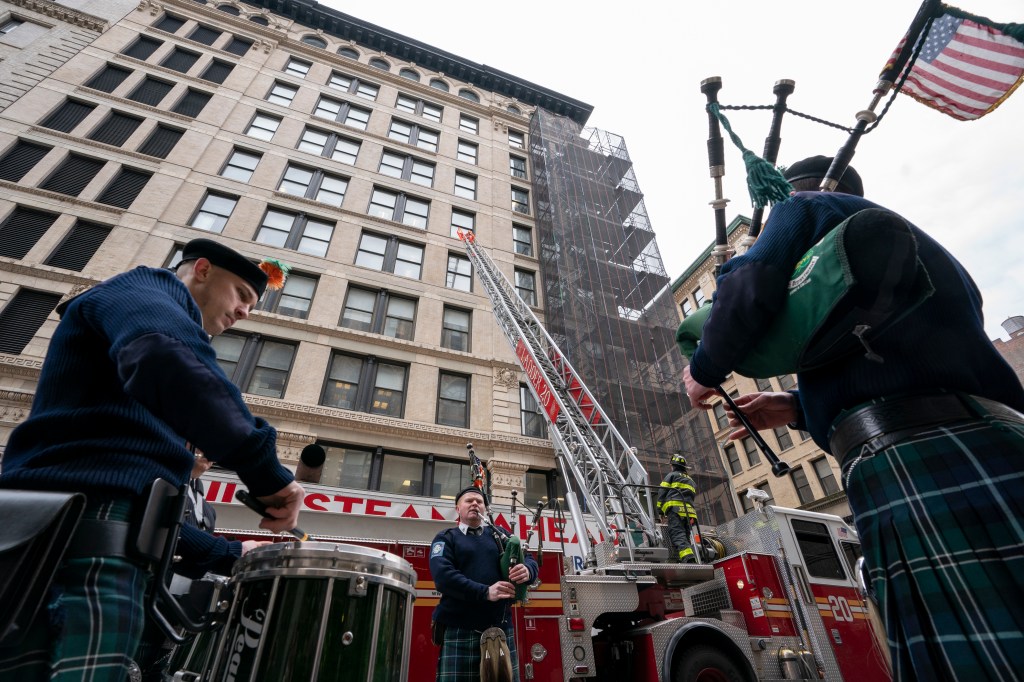
This year’s Triangle Fire Anniversary Commemoration will take place at 11:30 a.m. The ceremony will open with performances, recalling the fire through music. Community leaders and speakers will read names and lay flowers at the memorial. There will be a raising of a fire engine ladder to the sixth floor, accompanied by FDNY bagpipes.
More than remembrance, it is an act of solidarity — linking past injustice to ongoing struggles for dignity in the workplace.
One hundred fifteen years later, a memorial to the workers who died reveals itself as a reminder that workers’ rights were purchased at a terrible cost, and that the lives lost there still ask something of us.
Ray Stanton is author of “Out of the Shadow of 9/11: An Inspiring Tale of Escape and Transformation.”