
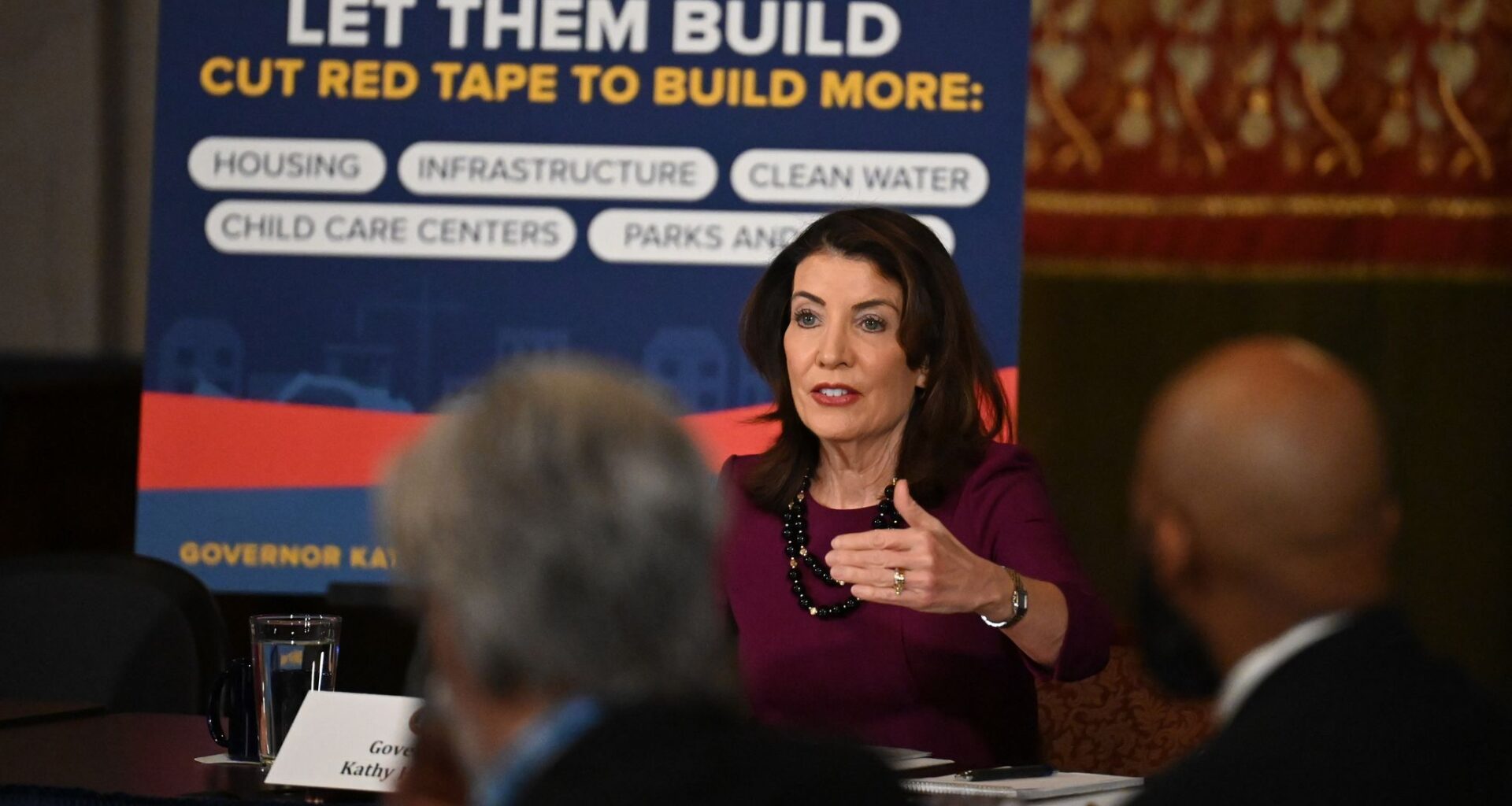
Gov. Kathy Hochul held a roundtable discussion with local government leaders on housing development on Monday.
Will Waldron/Times Union
Gov. Kathy Hochul is seeking to streamline the state’s law that requires environmental review of housing projects and other developments.
Will Waldron/Times Union
New York City Mayor Zohran Mamdani is seeking help from the state to close the city’s $5.4 billion budget gap.
Lori Van Buren/Times Union
State Sen. Liz Krueger is one of several Democrats opposed to Gov. Kathy Hochul’s proposed changes to the state’s energy and emissions mandates.
Lori Van Buren/Times Union
Gov. Kathy Hochul and lawmakers will now work toward negotiating a final state budget deal.
Lori Van Buren/Times Union
The state budget is due April 1.
Lori Van Buren/Times Union
ALBANY — New York’s state budget is due April 1 but Gov. Kathy Hochul and Democrats who control the state Legislature remain divided on several issues as that deadline looms.

Without a spending agreement by that date, Hochul and lawmakers will have to approve short-term funding to keep the state’s workforce paid while they hash out their differences in closed-door meetings.
Article continues below this ad
Hochul has more leverage over the state Legislature when budget talks run past the April 1 deadline.
Lawmakers, who each have an annual salary of $142,000, don’t get paid until a final spending plan is approved. And the longer it takes to reach a deal, the less time they have to consider other legislation before they gavel out for the year in June.
But without alignment between Hochul and lawmakers on some of the most pressing issues involved in budget talks, a late state budget is more likely than not with about a week left in the state’s fiscal year.
Make the Times Union a Preferred Source on Google to see more of our journalism when you search.
Add Preferred Source
There are at least five major issues that have yet to be resolved in budget talks between Hochul and the state Legislature, some of which may ultimately fall out of a final deal.
Article continues below this ad
1. Changes to New York’s energy and emissions mandates
Hochul unveiled a proposal on Friday to adjust New York’s law that mandates the state reduce carbon emissions from now through 2050.
She’s seeking to delay the state’s requirement to issue regulations that would create a framework for reducing those emissions. Those regulations, under Hochul’s plan, would be due in 2030.
That delay, Hochul has argued, would slow the state’s energy transition and, consequently, prevent higher costs for utility companies that would then be passed on to consumers.
Article continues below this ad
“We’re talking about approaching this with a serious vision toward how we can achieve the goals in a way that is actually doable and will not break the backs of New Yorkers,” Hochul said Monday.
Hochul is also seeking to change how the state measures its progress toward reducing its carbon emissions to a method that’s more commonly used in other states and nations.
But environmental advocates say the state’s current timeline and accounting method are achievable if the state makes deeper investments in renewable energy projects and provides relief for ratepayers at the same time.
Some lawmakers have signaled a willingness to negotiate with Hochul on her proposal, but have not said they’re open to accepting it as it is.
Article continues below this ad
Others have said Hochul should work with lawmakers on immediate actions to provide relief for ratepayers instead of imposing an ultimatum that may not have an impact on current costs.
“If reducing costs is really the governor’s goal, there are literally dozens of actions that the state can and should take that will both reduce costs and help us meet our reality-based climate targets,” said state Sen. Liz Krueger, a Democrat from Manhattan.
2. Hochul’s proposed SEQRA shake-up
Hochul held a roundtable event at the state Capitol Monday to promote her proposed overhaul of the State Environmental Quality Review Act, more commonly known as SEQRA.
Article continues below this ad
Holding such an event this close to the budget deadline suggests Hochul has been met with resistance from lawmakers on her proposed changes to the law, which is the state’s environmental review process for new development.
“I feel optimistic that the Legislature will agree and we’ll be able to get this resolved,” Hochul said during the event.
Hochul is proposing a few changes to the law this year, but chief among them is an exception to environmental review for certain housing projects and a stricter timeline for projects that would still require a review.
Her proposal would also streamline the environmental review process for clean water, green infrastructure, parks, trails and child care projects.
Article continues below this ad
Since Hochul announced her proposed changes to SEQRA in January, lawmakers in both chambers haven’t said much publicly about it in response.
3. Hochul’s proposals to combat car insurance costs and fraud
A battle of big spenders has been brewing at the state Capitol since Hochul proposed changes in law intended to lower the cost of car insurance.
Those changes are targeted specifically at staged crashes that can allow drivers to receive large payouts from insurance companies. The idea is that, if those payouts are prohibited, insurers will pass the savings on to consumers.
Article continues below this ad
New York is currently a no-fault state. That means the damages someone can receive after a crash aren’t limited if they’re determined to be at fault.
Hochul wants to limit damages for those who are found to be mostly at fault or engaged in illegal activity at the time of the crash, including if they were driving under the influence of drugs or alcohol.
She also wants to restrict what’s considered a “serious injury” after a crash to prevent someone from receiving a large payout that may not align with the cost of treating their injuries and invest more funding into fraud investigations.
The issue has pinned two powerful interests in Albany against each other. Trial lawyers, who litigate damages on behalf of crash victims, are lobbying hard against Hochul’s proposal, while car insurance companies support it.
Article continues below this ad
The trial lawyers, who earn revenue from those cases, have argued that those changes would make it more difficult for their clients to recoup their medical costs. They’ve argued that car insurance companies aren’t hurting for revenue and could already cut costs for consumers.
“There is a reason those companies resist opening up their books to the public or to regulators,” said Andrew Finkelstein, an attorney and president of the New York State Trial Lawyers Association. “That transparency would show how profitable those companies are, and how they discriminate against drivers based on their zip code and their credit ratings without regard to their driving record.”
Democrats in both chambers aren’t convinced that car insurance companies would pass on the savings generated by Hochul’s proposal to their customers.
4. Protest buffer zones around houses of worship
After protesters critical of Israel demonstrated outside Park East Synagogue in Manhattan last November, a pair of lawmakers introduced a bill to require a buffer zone for those activities outside houses of worship.
Article continues below this ad
The bill, from Assemblyman Micah Lasher and state Sen. Sam Sutton, would prohibit protests within 25 feet of houses of worship.
Language from that bill was included in Hochul’s executive budget proposal in January. It’s something she said Monday she wants included in a final spending plan. Some lawmakers have said it may fall out of negotiations.
But Hochul said Monday she wants to reach a deal on that issue as part of the state budget.
“I think it’s important we also focus on protecting individuals who are worshiping and should be able to do that free without harassment,” Hochul said.
Article continues below this ad
A similar proposal recently introduced in the state Legislature would do the same thing but instead establish a buffer zone of at least 100 feet. Lasher said that’s a nonstarter, noting that distance wouldn’t survive a court challenge.
“Something we don’t do very well up here is be honest with the people and the honest truth is that a 100-foot buffer zone would not stand a snowball’s chance in hell of surviving in a court,” Lasher said.
Civil rights groups oppose the proposal included in Hochul’s budget. Such a restriction would violate the constitutional principles of freedom of speech and assembly, they’ve said.
“No-speech zones defy basic well-established constitutional principles,” said Donna Lieberman, executive director of the New York Civil Liberties Union.
Article continues below this ad
5. Helping New York City close its $5.4 billion budget gap
New York City Mayor Zohran Mamdani is asking Hochul and the state Legislature to allow the city to raise income taxes on high-income earners and large corporations.
That’s something Mamdani wanted before he was elected last year. But he now has a new incentive. The city, according to his office, is facing a $5.4 billion budget gap.
Hochul has been staunchly opposed to raising income taxes across the board. Democrats in both the state Senate and Assembly are seeking to raise income taxes statewide on people who earn more than $5 million each year.
Article continues below this ad
That proposal from Democrats is not new. They’ve sought to raise income taxes on high-income earners for the last several years. Their statewide proposal this year mirrors what they unsuccessfully sought in last year’s state budget.
But they’re also seeking to fulfill Mamdani’s request. They’re proposing to allow New York City to raise local income and corporate taxes to help Mamdani with the city’s deficit.
That doesn’t mean Hochul is hanging the city out to dry. She announced in February that she wants to allocate an additional $1.5 billion in aid for the city in this year’s state budget.
Article continues below this ad
That’s subject to approval from lawmakers in the state budget. Either way, Hochul said Monday she wants to find a solution for Mamdani.
“We’ll also find a path to help the city,” Hochul said.