
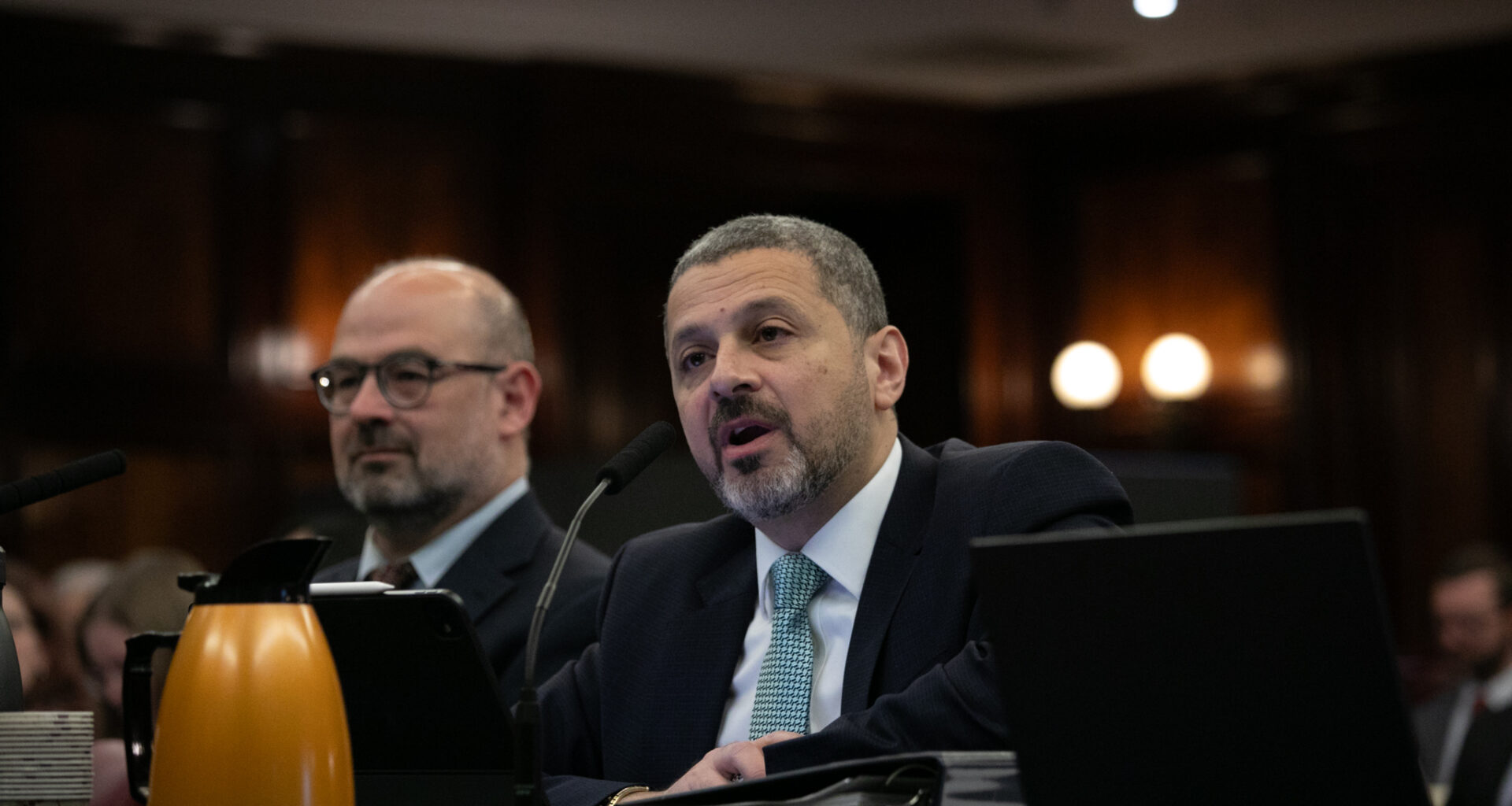
New York City’s budget director testified Wednesday in front of the City Council about the city’s $5.4 billion budget deficit and faced questions on a proposal to raid the city’s “rainy day” fund — which has never been done before.
Speaker Julie Menin said the Council was “deeply concerned” about the mayor’s plan to take $980 million out of that savings account to help fill the budget hole. The mayor also plans to take $229 million from a retiree health benefit trust fund in the next fiscal year.
Doing so would force the city to pay more interest later on and would hurt the city’s credit rating, Menin warned.
“We have from the beginning stated our concern,” she said, especially after several ratings agencies — including Moody’s and Fitch — revised the city’s credit outlook from “stable” to “negative,” a step toward a downgrade that would increase the cost of borrowing money.
Sherif Soliman, the city’s budget director, said they didn’t have many other options towards balancing the budget, which is required by law.
“We want to replenish reserves and we want to grow reserves,” he said. “This was out of necessity for what was an inherited significant budget challenge that stems from underbudgeting.”
During his hours-long testimony, Soliman laid out the “unprecedented levels of expense” after what he said was years of underbudgeting by the administration of former Mayor Eric Adams that created a $5.4 billion deficit in the coming fiscal year that now needs filling.
Cash and rental assistance programs were underbudgeted by $3.3 billion, he said, and MTA subsidies were budgeted at $2.2 billion while the known expenses were $3 billion.
But those are the largest undercounted items. The biggest upcoming costs come from health insurance, the state’s mandate to reduce the size of public school classes and Medicaid funding. All that, Soliman said, has contributed to $6.7 billion in “unfunded cliffs and mandated spending” over the next two fiscal years, Soliman said.
Soliman stuck to Mayor Zohran Mamdani’s messaging around the budget gap and proposals to raise necessary money to fill it. This includes a campaign pledge to raise taxes on the wealthiest New Yorkers and corporations, which would require approval from the state legislature and governor.
The mayor’s recent suggestion that he would have to raise property taxes — the one key revenue source the city doesn’t need the state’s permission to tap — has been opposed by nearly every lawmaker, and likely wouldn’t pass in the City Council as required.
Soliman said the Mamdani administration didn’t really want to raise the rate and remains committed to the mayor’s campaign pledge to reform the notoriously regressive system — but had few options except for an across-the-board hike in property taxes if more money wasn’t forthcoming from Albany.
“Rather than increase property taxes, our administration wants to finally reform the broken property tax system to make it more equitable, transparent and rational,” he said.
At a separate press conference Wednesday, Mamdani continued to stress what he said is the precarious fiscal position he inherited.
“While we all predicted that it would be a difficult fiscal situation that we would find in January, there are very few who believe that it would be at the scale that we have found,” he said. “This is a fiscal crisis that has been entirely created within city government as opposed to one that can be blamed on external factors as we’ve seen in 2008.”
Andrew Rein, the president of the independent Citizens Budget Commission, noted that the mayor can’t reach his ambitious affordability goals without getting the city’s finances in order.
“An efficient government is an affordable one,” he said.
Mamdani previously ordered all city agencies to appoint a “chief savings officer” to find ways to cut costs, releasing details on some of these efficiencies on Wednesday.
They found more than $1.7 billion in potential savings, cutting the current deficit down to what he’d said was a $7.1 billion hole. The mayor’s office didn’t release updates on any new efficiencies, but said there will be more cuts.
What they did share in a press release varied. The Taxi and Limousine Commission canceled a Slack messaging subscription, saving $20,000; the Office of Labor Relations conducted a full audit of eligible dependents on employee health plans, which could save around $100 million.
Marianne Pizzitola, the president of the NYC Organization of Public Service Retirees, said that those audits should be happening more regularly, and that the city “should be responsible for managing its own program and making sure the rolls are up-to-date and accurate.”
“This is only a ‘savings’ because it’s a corrective measure,” said Pizzitola.
The brutal winter weather also added more costs to the city’s budget, Soliman said. It spent $100 million more on snow removal, $24 million for mobile outreach to street homeless, and $5 million for warming centers than expected. The city also added $54 million to triple the baseline funding for emergency food programs after federal cuts.
Samantha Maldonado and Claudia Irizarry Aponte contributed to this report.
Related