
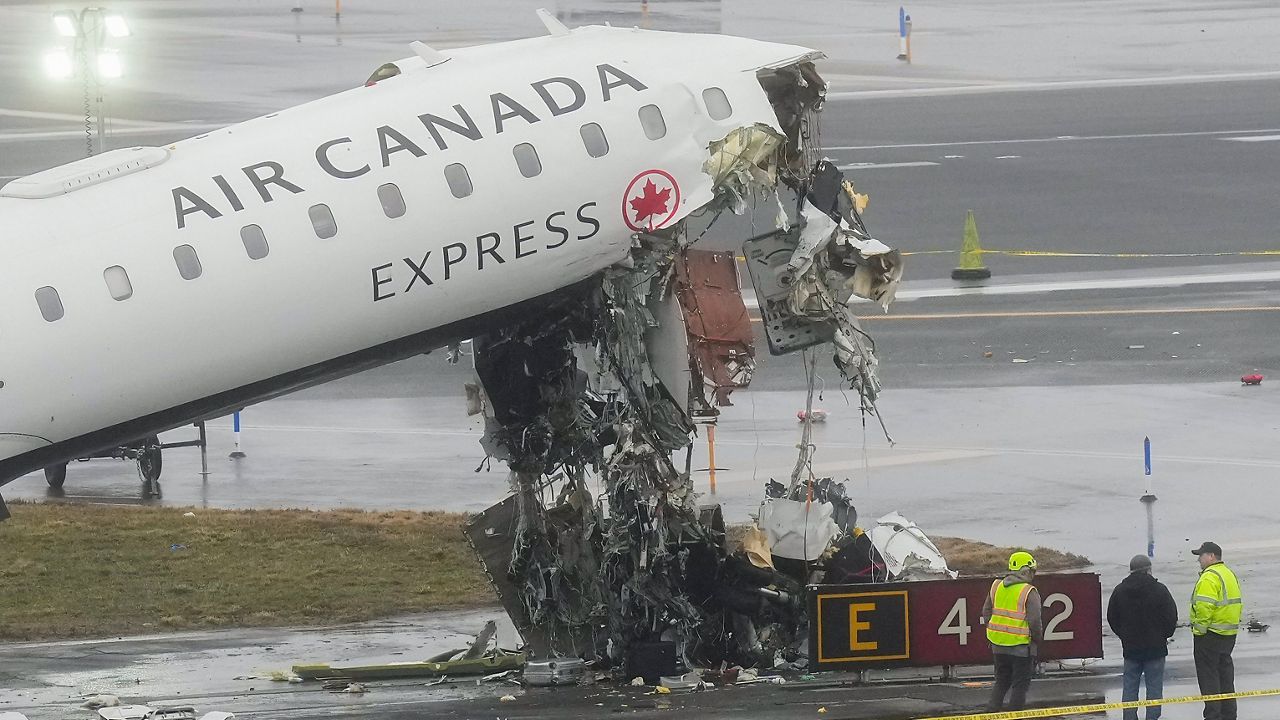
In the wake of Sunday’s runway collision at LaGuardia Airport that killed two pilots, officials noted it was the first fatal incident at the airport in 34 years.
But there have been near-misses.
What You Need To Know
The fatal runway collision at LaGuardia Airport on Sunday has put a spotlight on safety issues, including a chronic shortage of air traffic controllers
New York’s crowded airspace and LaGuardia’s intersecting runways create unique challenges
The collision was the first fatal incident at LaGuardia in 34 years, but the airport has a history of runway incursions and near-misses
“There have been a slew of close calls, specifically between aircraft and ground vehicles at LaGuardia Airport,” Will Guisbond, senior reporter at The Air Current, an aviation news service, said.
The Air Current this week catalogued the history of near-misses at LaGuardia in the 1990s.
“Safety reports in public databases show a long history of runway incursions and near-collisions on the ground at the geographically constrained New York City airport,” Guisbond wrote.
Aviation experts say the geography of LaGuardia poses special challenges.
“It’s on a very small footprint,” former air traffic controller Stephen Abraham said. “There’s a lot of traffic in a very confined space.”
Not only does it operate in some of the world’s busiest airspace, LaGuardia — constructed in the 1930s — was built for another era. It features unusually short runways and a layout that creates conflict, according to air traffic expert Michael McCormick.
“There’s a little bit more risk of incursions at an airport like LaGuardia than there would be at a JFK Airport. And that’s because the runways intersect,” said McCormick, who held senior roles at the Federal Aviation Administration and is now a professor at Embry‑Riddle Aeronautical University.
Sunday’s collision has also drawn attention to an air traffic control system stretched thin. A national shortage of air traffic controllers, dating back years, means those on the job are often overworked.
But U.S. Transportation Secretary Sean Duffy said Monday that the shortage is not acute at LaGuardia, which has 33 certified controllers — just four positions shy of its target headcount. Seven more controllers are in training, he said.
“As airports go, LaGuardia is a well-staffed airport,” Duffy said.
Because Sunday’s crash occurred during the midnight shift, just two air traffic controllers were on duty, performing multiple roles. The National Transportation Safety Board says that’s standard procedure, but one that may be problematic.
“The midnight shift, as a reminder, is one that we have many times at the NTSB raised concerns about with respect to fatigue,” NTSB Chairwoman Jennifer Homendy said at a news briefing Tuesday.
But experts are also quick to point out that while LaGuardia’s complexity poses challenges, it’s no reason to think twice about flying.
“The system is safe. And statistically, aviation is still by far the safest way to travel in this country and in the world,” Guisbond said.
“There are probably more fatalities on the LIE than there are in the airports in New York in the last 20 years. And I’m sure that ratio is pretty skewed,” Abraham said. “I don’t think you’ll talk to anybody who’d say they’re afraid to drive their car on the Long Island Expressway.”