
On June 17, 1885, the Statue of Liberty arrived in New York Harbor. Shipped from France in 350 pieces and packed in over 200 crates, the iconic monument made its grand entrance in America. That year was also when a law took root that has since shackled New Yorkers to high and unnecessary housing and construction costs for over 140 years.
As an affordability crisis continues to challenge the New York housing market and the regional cost-of-living surges, the construction industry — a major leg of the economic stool — is losing billions of dollars each year that must be planned and dedicated specifically to countless slip and fall legal claims.
SEE ALSO: The Plan: Quiet on Set at Pier 94 Studios Near Hudson River Park
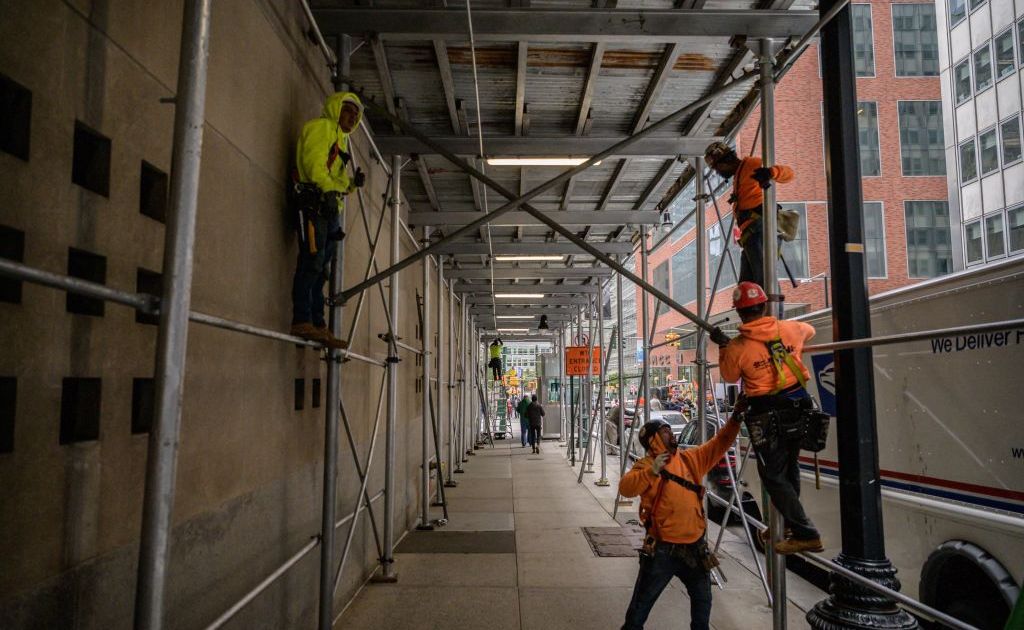
The underlying reason for this is simple: New York Labor Law Sections 240 and 241, also known as the Scaffold Law, holds all property owners, general contractors and subcontractors responsible for all injuries resulting on a job site, regardless of who is to blame.
 Michael Coffey.
This outdated law, which hasn’t truly been modernized since Grover Cleveland was inaugurated as the first Democratic president since the Civil War, was crafted with good intentions back in the 1800s. However, it has negatively affected not only the cost of construction and housing affordability, but also the ability of the next generation of entrepreneurs to afford liability insurance coverage.
A recent study from the Buildings Trade Employers’ Association (BTEA) found that insurance premiums in New York are 200 percent to 500 percent higher than those of states of similar size and population.
This surge is because the Scaffold Law dictates that if there is an accident that results in injury, even if due to the negligence of the worker or another party, the contractor and property owner or developer is still ultimately held responsible. Therefore, the question does not become who is at fault, but rather how much will it cost in a payout.
Despite calls from elected officials, including U.S. Rep. Nick Langworthy, to change the long-outdated law, New York continues to place complete and total liability on developers and contractors.
As a result, housing projects across New York — including those ultimately meant to be affordable housing — are seeing 8 percent to 10 percent of their development costs go directly toward insurance premiums, according to the BTEA analysis.
By comparison, across the river in New Jersey, that legal calculus determines that only 2 percent to 4 percent of development costs must be spent on legal and insurance coverage thanks to their “comparative negligence” standard. That means developers in the Garden State can purchase more bricks, hire more construction workers, and, in the end, sell or rent their properties at lower rates.
After all, every other state has their own form of “comparative negligence” that shares liability of the parties in proportion to their responsibility for the injury.
So, what is stopping New York from changing this outdated law to still provide protections, without straining the state’s economic growth?
The shared liability laws in states with comparable markets directly result in far more affordable underwriting terms for construction and infrastructure projects, making them a more ideal place to build.
As the Scaffold Law continues to be abused, countless housing, infrastructure and other vital construction projects are being delayed, scaled down, or even prevented altogether in the state of New York. This is something that can be fixed and should be corrected, because it is costing everyone in New York and sapping our economy.
In a 2022 interview with Commercial Observer, former BTEA President and CEO Lou Colletti said, “With the Section 240 Scaffold Law, New York state has the highest insurance rates of any state in the nation. … It just becomes easier to build somewhere else. That is what I believe is the major threat to the city’s economic viability.”
Coletti’s own concerns and viewpoints are as relevant now as they were five years ago, just as the outmoded law he referenced hasn’t changed in the last century and a half.
New Yorkers are burdened today with a law designed to adapt to issues in 1885. It is long overdue, for the sake of every New Yorker, for this law to receive a much-needed upgrade.
Michael Coffey is the founding partner of Coffey Modica, an insurance litigation firm. He previously served for two years as zoning commissioner for the City of Norwalk, Conn.