
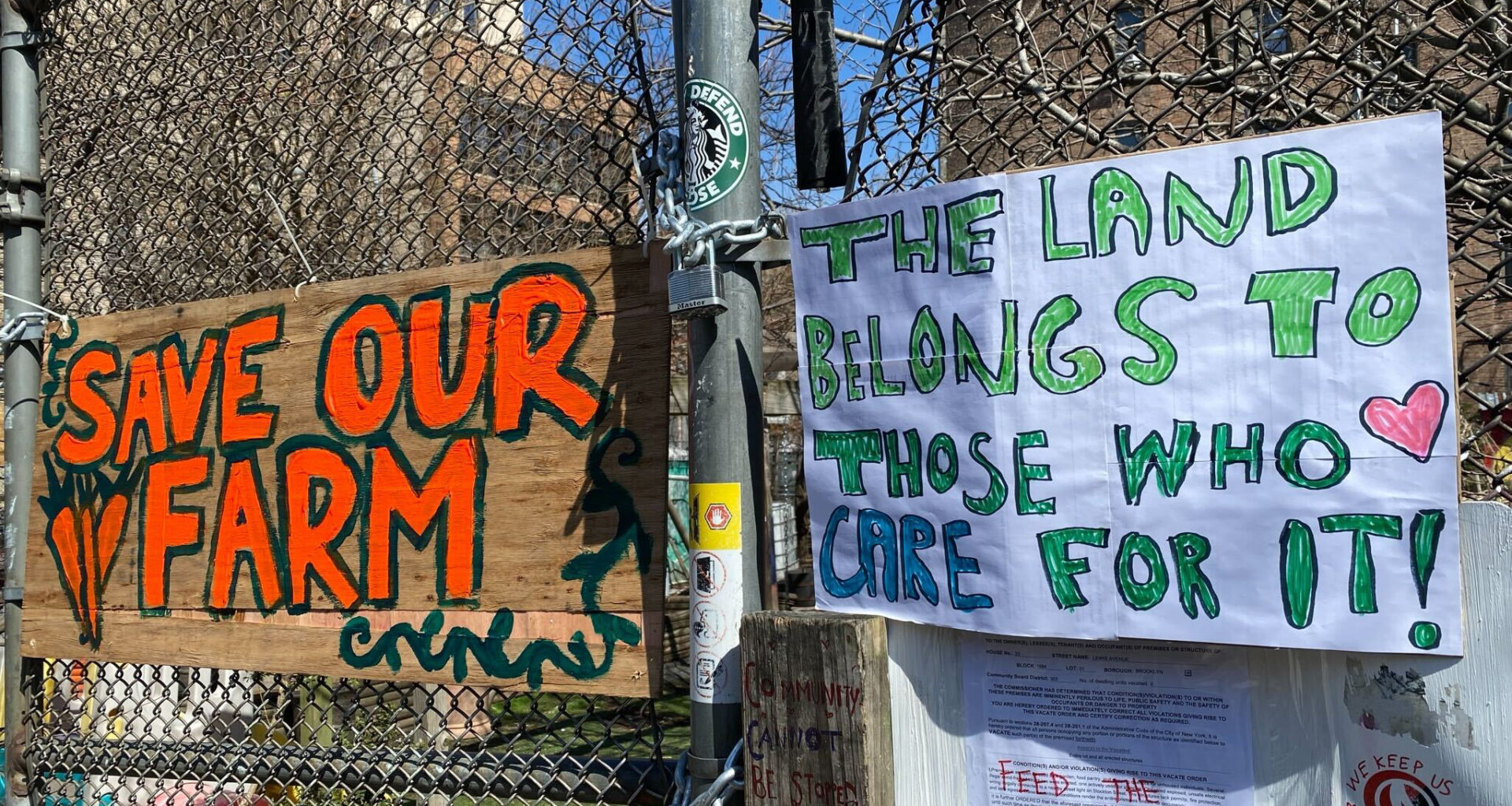
After 15 years, volunteers at a Bushwick farm found themselves locked out of the green space that has fed thousands over the years, and lately became a temporary home for asylum seekers. The property owner told them he doesn’t want “any headaches” — and now, the gardeners are hoping the city will move to make it an official, protected community space.
“We were really unaware that the situation had changed until Wednesday, when he showed up quite upset,” Spike Appel, a longtime volunteer of Bushwick City Farm, said of the property owner, Faramarz Roshodesh. “He grabbed our lock and threw it in his car.”
The closure follows numerous problems on the property in the last few years. Following former Mayor Eric Adams’ order in late 2023 that limited how long migrant families could stay in a city shelter, asylum seekers were routinely sleeping on the farm grounds.
“The city put out a lot of people into the street and we were kind of left with a handful of guys that kept hopping the fence to sleep,” Appel said. “I personally kicked them out probably a hundred times, waking them up in the morning.”
Farm volunteers had testified repeatedly to the City Council, urging agencies to help the migrants find permanent housing.
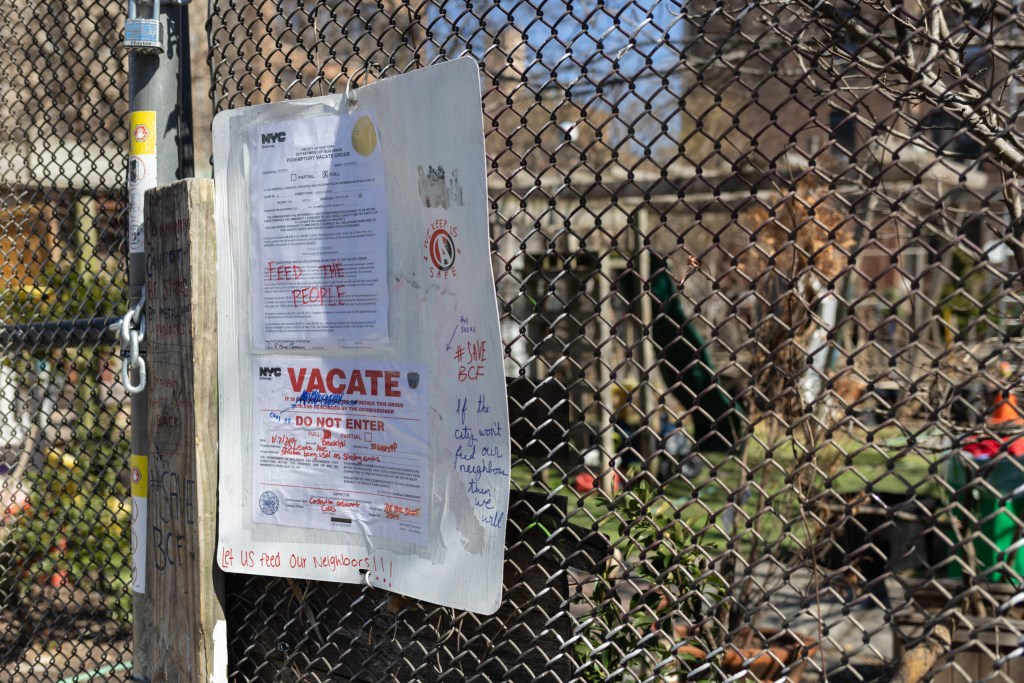 The Bushwick City Farm community garden in Brooklyn was under threat of closing after getting vacate orders from the Department of Buildings, March 24, 2026. Credit: Ben Fractenberg/THE CITY
“BCF is now overrun with rats and trash, and it has been difficult to maintain the space clean and safe for everyone to use,” the volunteers wrote in a November 19, 2024 statement to the City Council Committee on Immigration and Welfare.
“The space does not have enclosed structures … so during the winter months it’s inhospitable, but asylum seekers who find no better option end up sleeping in there,” the testimony continued.
Beginning in 2011, volunteers have transformed the two combined vacant lots into a garden at the corner of Lewis Avenue and Stockton Street, where two dozen chickens, 60 raised beds for vegetables, an aquaponics system, and a communal space providing free food for the community.
“It takes a long time to build what we built there, you can’t just pick it up and move it,” Appel added.
Over the last three years, hundreds of asylum seekers have entered the farm, finding food, water, clothes, community and resources. It’s also been a place where Club A Kitchen, a mutual aid group, has distributed thousands of free meals to the community, including up to 1,800 a week during the COVID-19 pandemic, according to the group.
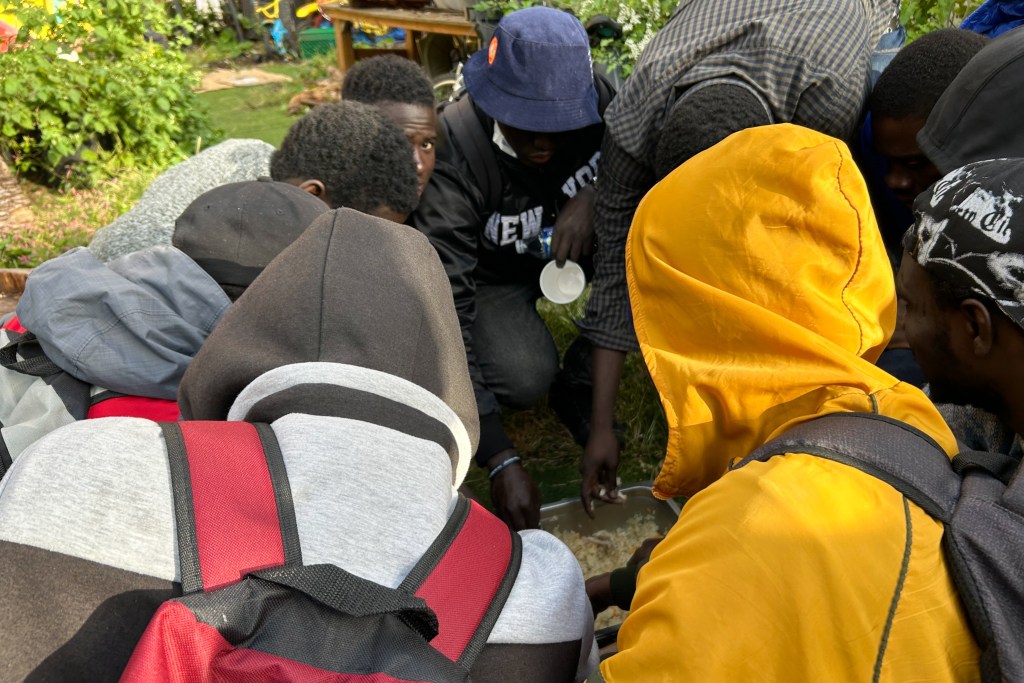 Migrants gathered for free meals at Bushwick City Farm in 2023. Credit: Gwynne Hogan/THE CITY
But the farm has never had a formal agreement or lease with Roshodesh, the owner, to use the space, complicating its status.
It isn’t the first time the farm has faced eviction. In 2017, Roshodesh sent a letter telling volunteers it had days to shut down, but after a protest and public outcry, he eventually decided to allow the farm to stay open.
That’s why, since 2017, longtime volunteers, like Mariel Acosta, have spoken at City Council hearings and reached out to local politicians, pushing the city to step in. Ideally, the group wants GreenThumb, the community garden operator for NYC Parks and Recreation, to take over the space.
“It’s confusing and convoluted, and I guess that’s the nature of bureaucracy, paperwork, going to meetings, and trying to get in touch with politicians,” said Acosta. “It’s just painstaking, and it shouldn’t be taking this long.”
A spokesperson for the Parks Department said GreenThumb met with Bushwick City Farm leaders in 2025, but said there is currently no active discussion or plan for the city acquiring the farm.
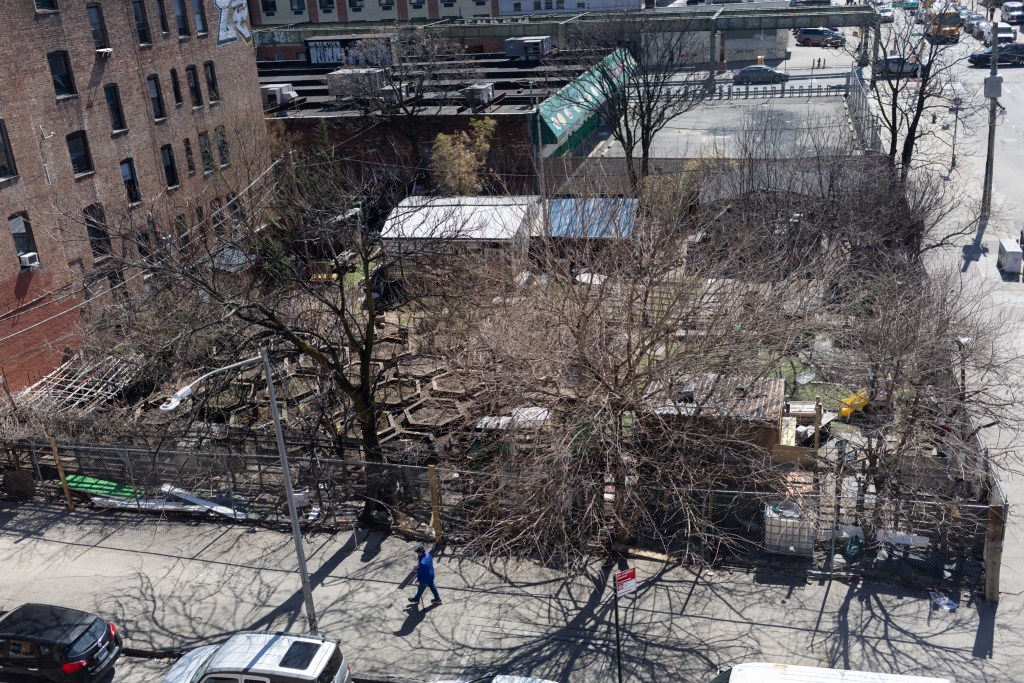 The Bushwick City Farm community garden provided fresh vegetables and a place of respite for people living around the intersection of Bed-Stuy and Bushwick, March 24, 2026. Credit: Ben Fractenberg/THE CITY
For the city to buy the farm, Roshodesh, who did not respond to THE CITY’s requests for comment would have to agree to sell it. Then funding for the purchase would have to be secured — likely from a mix of public sources. The property would also have to go through the city’s lengthy Uniform Land Use Review Procedure (ULURP) process, according to the spokesperson.
“I just don’t want any headaches,” Roshodesh told volunteers last week as he locked the farm gates. “This is too much. I’m done!”
Fines and Taxes
In recent months, the farm hit an impasse as volunteers struggled to prevent people from sleeping on the grounds overnight, they said.
Gardeners said that after weeks of reaching out unsuccessfully to the Department of Homeless Services about helping the men find shelters or housing, Appel said members of the local precinct council suggested getting a vacate order to prevent them from sleeping on the property.
But when officials from the city Department of Buildings conducted their inspection, they fined the owner for having structures, including a gazebo, that were over 7 feet tall without a permit.
That joint inspection with the New York Police Department and the Department of Sanitation resulted in multiple violations on the farm and its neighboring lot, 23 Lewis Ave., according to DOB records.
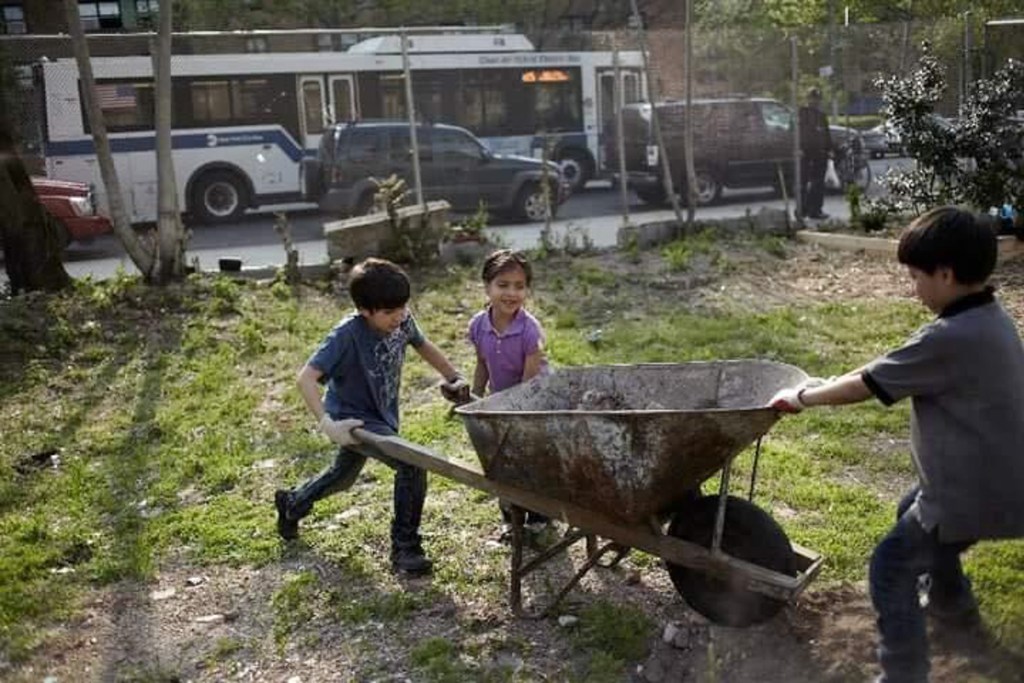 Children help do gardening work inside Bushwick City Farm. Credit: Courtesy of Bushwick City Farm
Inspectors reported two violations, fining Roshodesh and his company, Arrow Property, $1,250 for a 10-foot-tall gazebo that was used to distribute food without a permit, according to Department of Building records, and $2,500 for electrical wiring that took power from a public streetlight for use on the privately owned lot.
Roshodesh is set to appear at an April 15 hearing with the city’s Office of Administrative Trials and Hearings to address the violations.
The fines come as Roshodesh owes the city more than $550,000 in property taxes — $285,865 for the 23 Lewis Ave. lot and $267,771.20 for the 354 Stockton St. lot, according to Department of Finance records.
Councilmember Chi Ossé, who represents the area, said he’s working with city officials, Roshodesh and the site’s volunteers to find a solution.
“We are looking into the citation, speaking to all parties involved and see how we can chart forward,” Ossé told THE CITY. “I think community gardens are integral to this district, to this community and social opportunities for people at a time when things are very divisive.”
For Acosta, the farm is important because of what it represents.
“It’s been a space of pedagogy, of transmission of knowledge from elders in the community to us, who are like older millennials, to the youth who were little kids,” she said. “It’s very meaningful and a space of respite for an area that doesn’t have many green spaces.”
Related