
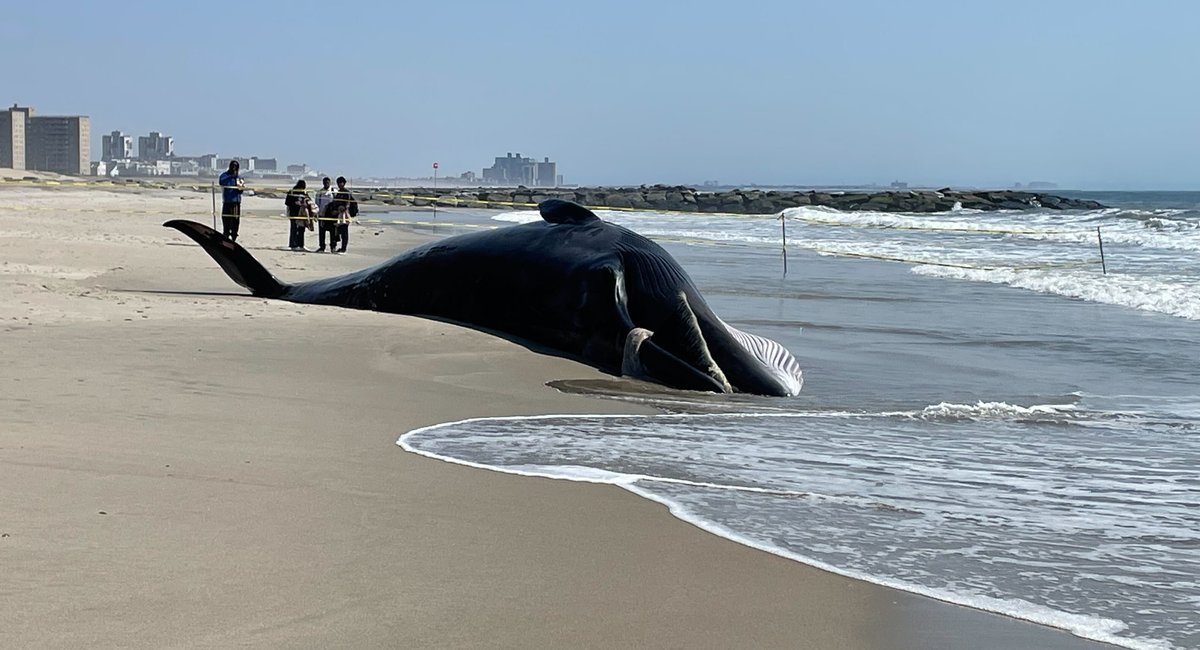
Rockaway residents woke up to the putrid smell of decaying flesh as New York recorded its first whale fatality of the year.
It’s the second death of the year in New York Bight, which stretches from Montauk to Cape May, New Jersey, according to Atlantic Marine Conservation Society. On Wednesday night, a sei whale, approximately 30 to 40 feet in length, was reported floating in the water and eventually washed up on 95th Street beach in the Rockaways, according to the conservation society.
Local residents reported the dead marine mammal Thursday morning to the Atlantic Marine Conservation Society, a nonprofit that performs the necropsies and coordinates the removal of the carcass with the city’s parks department. The National Oceanic and Atmospheric Administration said the whale was male.
“Whales have been washing up on our beaches for decades and centuries,” said Rob di Giovanni, executive director and chief scientist at the Atlantic Marine Conservation Society. “Everybody would rather see a live whale swimming as opposed to seeing a dead whale on the beach.”
The sei whale is an endangered species, according to the NOAA, with a global population of around 80,000. Each day, the dark-colored baleen whale eats an average of 2,000 pounds of food — consisting of plankton, small fish, and cephalopods such as squids.
Rescue workers haven’t determined what caused the whale’s death. Scientists will begin the necropsy on Friday, and it may take several months before the findings are available. After the samples are taken onsite for the necropsy, they will either bury the whale on the beach or transport it offsite. The dead whale weighs approximately 30 to 40 tons, according to di Giovanni.
As of Thursday afternoon, the carcass is located on the shoreline very close to the water. State and parks police set up a perimeter around it with stakes and caution tape. The scene has attracted local residents, who described it as sad and concerning. They also noted that the odor is very pungent, reminding them of a similar incident that occurred nearly a year ago when a humpback whale washed up in the same area.
“This is not the first whale we’ve seen here. It happens annually,” said retired local resident Alice Ostrowsky. “The beauty of living here is seeing the dolphins and seeing them when they’re alive.”
“I want to know what’s causing the whales every year to die on our beach,” said Steven McClernon, 28, who saw a post on Instagram about the whale and walked to the beach with his 4-year-old son. “Obviously something is going on in the water out there.”
The Rockaways are a hot spot for whales of many species. The large marine mammals come for their favorite food: menhaden. But the delicacy comes with the risk of entanglements in fishing gear and getting hit by a large shipping vessel. The New York Bight, which stretches from Montauk to Cape May, has the largest volume of boat traffic on the Atlantic Ocean.
Last year, the New York Bight had 10 whale fatalities, according to the conservation society.
Members of the public can report marine mammal strandings to the New York State Stranding Hotline at 631-369-9829.
“We have to go out and do this work in order to be able to have these animals tell their story and tell us what we’re seeing in the environment,” di Giovanni said.