
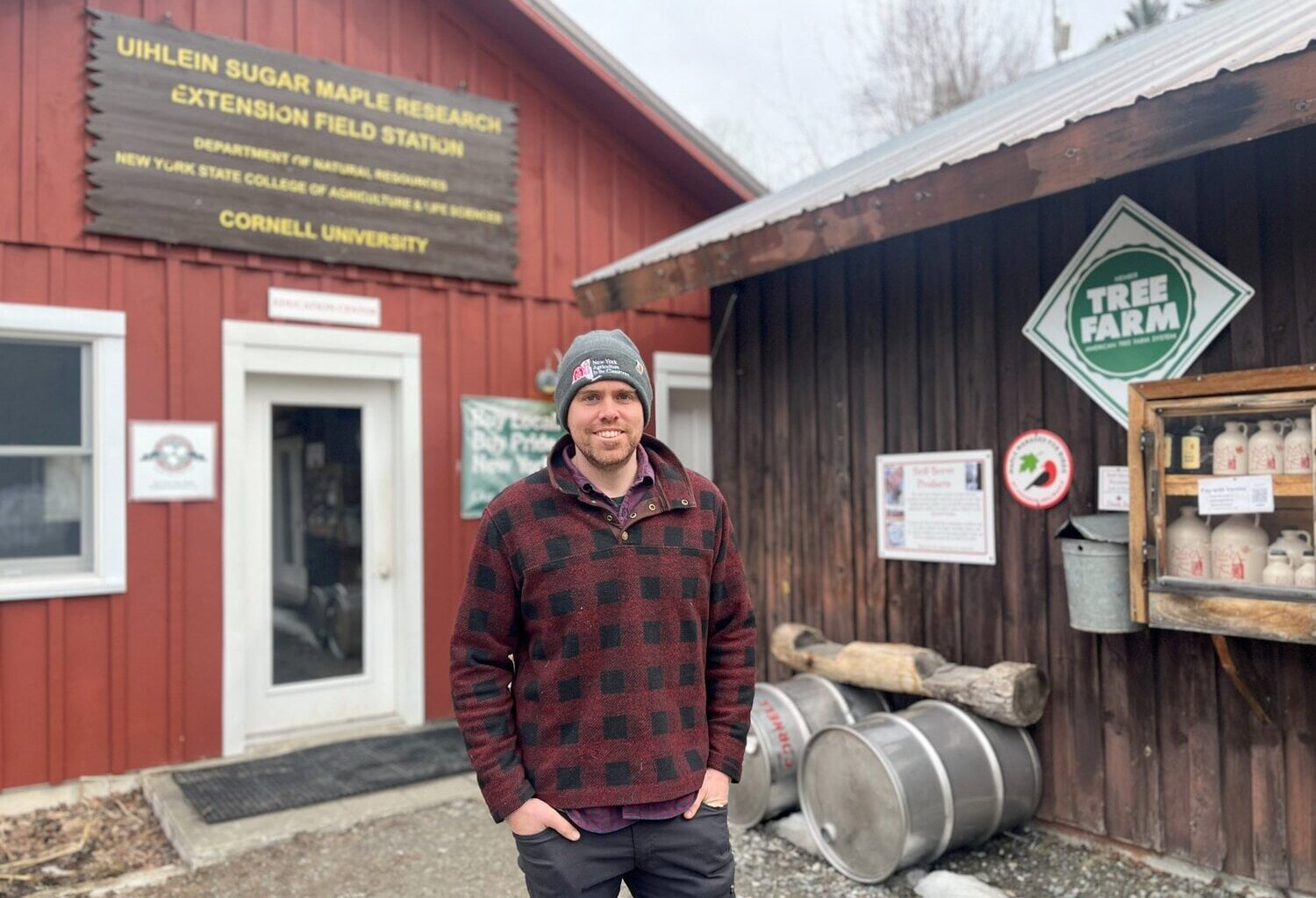
This weekend is the second and final Maple Weekend of the year. Farms and sugarhouses across New York State are offering tours and tastings, including many in the North Country. Find a list of participating producers at MapleWeekend.com.
Adam Wild is the director of Cornell University’s Uihlein Maple Research Forest in Lake Placid and spoke with Emily Russell about what’s on tap for this Maple Weekend, which is Saturday and Sunday from 10 am until 4 pm.
Emily RussellWhat’s on tap for the final Maple Weekend in the North Country

Adam Wild is the director of Cornell University’s Uihlein Maple Research Forest in Lake Placid. Photo: Emily Russell
ADAM WILD: Some of them do a pancake breakfast, which is always fun, some of them have different types of treats and maple candies, and other things. A lot of sugar houses will probably be boiling, which is always fun to come get a fresh sample of maple syrup and see the evaporator running and how maple syrup’s actually made.
EMILY RUSSELL: What can people expect to see here in Lake Placid when they come during Maple Weekend? What’s on the schedule?
WILD: We do guided tours from 10 am until 4 pm on both days. So we have our own staff, plus some volunteers who come in, and we’ll do guided tours looking at how we collect the sap and talk about what weather is needed for sap flow, the mechanisms for sap flow, to collecting the sap and processing it down into finished maple syrup.

A plume of maple steam rises from Cornell University’s Uihlein Maple Research Forest, near Lake Placid. Photo: Adam Wild
We’ll hopefully be running the evaporators and making maple syrup that day so you can have fresh samples and see that whole production, but within that seeing the whole production, trying to look at all the equipment that’s involved and the technology that is involved and how the maple industry has evolved over the years to try to make it a little bit more efficient for producers. Also, if people are just backyarders, we like to talk to those people as well. If they have questions, they’ll learn about maple production, even do it on a small scale.
In addition to the tours, we do tastings of different grades of maple syrup. We make birch syrup, and we like to do a tasting of that as well. We will also probably be doing sugar on snow, which is always a fun treat, too, if you’ve never had sugar on snow, that’s always great to have. The kids especially enjoy that.
RUSSELL: It’s like a little snow cone but with maple syrup. Is that right?
WILD: It’s kind of like a maple lollipop. We cook maple syrup so it’s a little bit thicker, and then we pour it onto packed snow or shaved ice. We usually use shaved ice, so it’s a little more food-safe. So we pack it out into a trough, and then you take a popsicle stick and push it in one end, and then you roll it up so you get some chunks of the icy snow on the outside and then you have this kind of gooey maple lollipop, which is really delicious.

RUSSELL: I wonder if there’s something that people are always surprised to learn about maple sugaring when they come to these weekends. Like, is there something that people are always like, “Oh my god, I didn’t know that this is how you did X Y or Z”?
WILD: I think the amount of work that it takes, everybody’s always surprised by how much work is involved in actually making maple syrup, and the time that it takes. Sometimes I think people are surprised by the scale and the technology that is involved now. I think when people envision maple syrup production, they think about people in flannel shirts just sitting around a wood stove with a few buckets of sap that they collected and making some maple syrup. And there are people still doing that, and that’s a great aspect. I encourage families to tap a tree in their backyard and make maple syrup. But I think when it comes to the commercial scale, people are surprised by the size of the tanks.
When you look at our big collection tanks, I think they’re just surprised at how big those are, and the reverse osmosis machines and all the technology like vacuum sensors that we have in the woods and different things that we can do right from our phone now. So, I’d encourage you to check out even more than one sugar house this weekend. Don’t just go to one, but check out two or three that might be near you or go for a little drive. It’s a good time of year to get out and visit different sugar houses and see how different ones do it. It’s always fun because everybody does it slightly differently.