
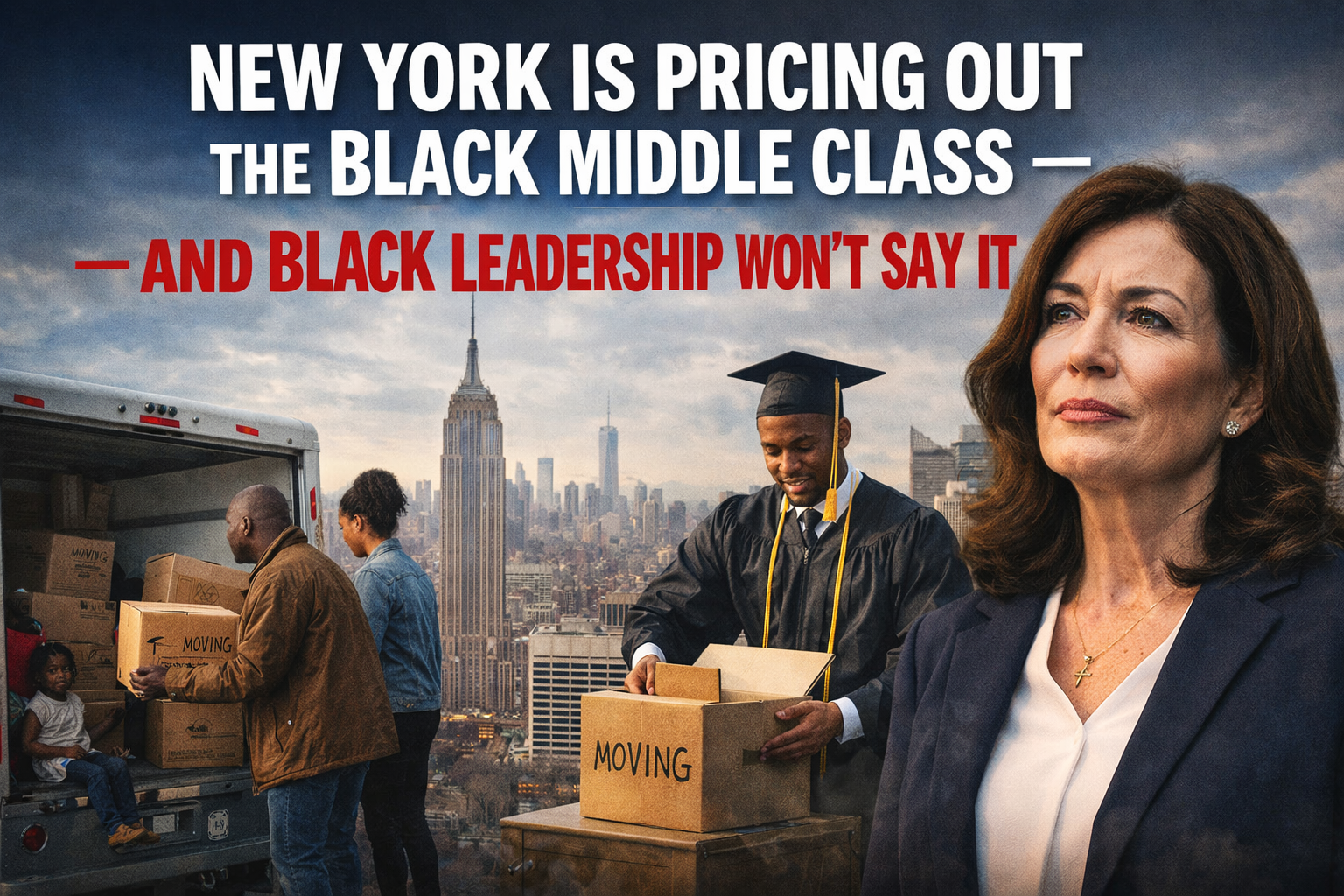
New York is pricing out the Black middle class — and Black leadership won’t say it, despite the clear impact on social justice and economic equity.
Intentions often judge public policy. It is better judged by results.
By that standard, New York is failing its Black middle class.
This is not a matter of rhetoric. It is measurable.
Households earning between $75,000 and $150,000—traditionally considered middle class—now fall into a gap in New York’s economy, making homeownership and stability harder for Black families.
The cost structure explains why.
Recent estimates show that a single adult in New York City needs roughly $180,000 annually to live comfortably. A family of four requires well over $250,000. Black households, with lower average incomes, face an even wider gap between earnings and expenses, which should inspire concern for racial equity.
Housing is not just a cost issue. It is a wealth issue.
The data makes that clear.
Black homeownership in New York State is approximately 32 to 34 percent. In New York City, it drops even lower, ranging from roughly 26 to 30 percent. Nationally, Black homeownership is closer to 44 to 45 percent.
That is not a marginal difference.
It is a structural gap.
New York is not just below the national average—it is near the bottom in overall ownership. The state’s total homeownership rate, across all races, is roughly 51 percent, the lowest in the country. By comparison, many Southern and Midwestern states report homeownership rates between 65 and 75 percent or higher.
The contrast is not accidental.
States such as Texas, Georgia, Florida, and South Carolina tend to have higher Black homeownership rates, greater availability of single-family housing, and fewer barriers to entry. Lower costs, more land, and less restrictive development policies expand access to ownership.
New York produces the opposite outcome.
High prices, limited supply, and regulatory constraints reduce the number of people who can buy. The result is fewer homeowners and more long-term renters.
Ownership is not simply a preference.
It is the primary mechanism for building equity and transferring wealth across generations. When ownership rates remain low, wealth accumulation remains limited.
This is not a housing issue in isolation.
It is a wealth gap reinforced by policy outcomes.
Migration patterns confirm it.
New York has experienced significant domestic outmigration over the past several years, losing hundreds of thousands of residents to states like Texas, Florida, Georgia, and North Carolina. This pattern, driven by policies that favor lower costs elsewhere, should motivate the audience to consider the long-term consequences for the city’s Black communities.
People relocate to environments where their income retains value.
New York increasingly fails that test.
The explanation lies in policy design, which directly influences housing affordability, energy costs, and economic mobility for Black middle-income families.
Housing policy has focused heavily on tenant protection. The Housing Stability and Tenant Protection Act of 2019 expanded rent regulations and strengthened tenant rights across the state. These measures may reduce displacement in the short term, but they also reduce incentives to build and maintain housing at scale.
When supply is constrained, and demand remains high, prices rise.
This is not ideological. It is arithmetic.
At the same time, zoning restrictions and lengthy approval processes increase the cost and time required to build new housing. Developers respond accordingly—by building less, or by building at higher price points where margins remain viable.
The intended goal is affordability.
The observed outcome is scarcity.
Property taxation adds another layer of pressure that is often overlooked in public discussion.
New York already ranks among the highest in the nation in property taxes, particularly in downstate regions such as Westchester County and parts of New York City. For homeowners, these are not optional costs. They rise regardless of income growth, and they compound over time.
In addition, proposals to increase or expand estate-related taxes introduce further uncertainty for families attempting to build and transfer wealth. A home is often the largest asset a family owns. When the cost of holding that asset continues to rise—and the cost of passing it down is threatened—long-term ownership becomes more difficult to sustain.
The effect is predictable.
Higher property taxes increase monthly carrying costs, pricing out potential buyers and straining existing homeowners. Over time, this leads to forced sales, reduced ownership stability, and the gradual loss of generational assets.
One of the least discussed drivers of wealth loss is property tax foreclosure.
For many older homeowners—particularly Black seniors—property taxes become the final pressure point. Homes that were owned outright for decades can still be lost, not because of a mortgage, but because of unpaid taxes, penalties, and interest. In many jurisdictions, property tax foreclosure has been a leading cause of involuntary property loss, disproportionately affecting elderly homeowners on fixed incomes.
The consequence is severe.
A home that took decades to pay off can be lost over a relatively small tax debt. In those cases, families do not just lose housing—they lose equity. They lose the primary asset that could have been passed down to the next generation.
This is not a marginal issue.
It is one of the most direct ways generational wealth is erased.
A system that makes it difficult to acquire property—and more difficult to keep it—is not expanding ownership. It is quietly reversing it.
Energy policy produces similar results.
New York has moved to phase out certain forms of reliable energy production while transitioning toward renewable sources. However, replacement capacity has not fully matched the reliability or scale of what has been removed. As a result, energy costs remain among the highest in the country.
Energy is not an isolated expense.
It affects rent, transportation, food prices, and business operations. When energy costs rise, those costs are passed through the economy. Landlords raise rents. Businesses raise prices. Consumers absorb the difference.
The burden falls most heavily on those without excess income.
In other words, the middle class.
New York’s energy policy also raises a forward-looking concern about competitiveness.
As electricity demand increases—driven in part by data centers and the rapid expansion of artificial intelligence—states are prioritizing reliable, large-scale power generation. Several are expanding nuclear capacity or exploring advanced reactor technologies to meet that demand. Nuclear energy provides consistent baseload power at scale, something intermittent sources alone have not yet matched.
By contrast, New York has reduced its nuclear footprint and is pursuing a transition that has yet to replace that lost capacity with equally reliable alternatives fully. If electricity remains both expensive and constrained, industries that depend on a large, stable energy supply—including AI infrastructure—will continue to locate elsewhere.
Over time, this is not just an energy issue.
It becomes an economic one.
States that can generate affordable, dependable power will attract investment, jobs, and technological growth—those who cannot will fall behind.
Reliable energy is not a luxury in a modern economy. It is a prerequisite for participation.
This extends beyond households.
Black-owned small businesses—barbershops, restaurants, service providers—operate on thin margins. Rising rent, rising utilities, and increased compliance costs further reduce those margins. Some raise prices. Others close. Many relocate.
When businesses leave, economic ecosystems weaken.
The issue is not whether these policies are well-intentioned.
The issue is whether they produce the intended results.
New York’s policy framework provides significant protection for renters. It provides far less support for becoming owners. There is no comparable legislative push to scale up the transition of middle-income families from renting to ownership.
Stability without mobility is not progress.
It maintains conditions without improving them.
The political dimension is equally clear.
Black voters in New York have consistently supported one party at high levels, often exceeding 85 to 90 percent. That level of alignment has contributed to sustained control of city, county, and state governments by that party.
In such an environment, accountability is not diffuse.
It is concentrated.
When outcomes deteriorate under unified control, those outcomes cannot be attributed elsewhere. They reflect the policies in place.
Yet the public conversation often avoids this conclusion.
Discussion centers on intentions—equity, fairness, protection—rather than results. Meanwhile, the measurable indicators move in the opposite direction: rising costs, declining ownership, and increasing outmigration.
The consequences are cumulative.
As middle-income Black families leave, they take with them income, skills, and long-term investment potential. They take future homeowners, business owners, and community anchors. Population loss reduces political influence. Reduced ownership limits wealth accumulation.
Over time, this is not simply displacement.
It is a contraction.
A system that cannot retain its middle class is not expanding opportunity. It is narrowing it.
If current trends continue, the long-term effects are straightforward. The Black middle class in New York will shrink. The gap between renters and owners will widen. Economic mobility will decline.
None of these outcomes is accidental.
They follow directly from the incentives created by policy.
The question is not whether the goals sound reasonable.
The question is whether the results justify the approach.
So far, the answer is evident in the numbers—and in the growing number of families choosing to leave.