
Sign up for the Slatest to get the most insightful analysis, criticism, and advice out there, delivered to your inbox daily.
At 2:30 a.m., the line was already forming.
Terminal 4, the largest at John F. Kennedy International Airport in New York, services roughly 74,000 travelers a day. It is always busy. But not like this.
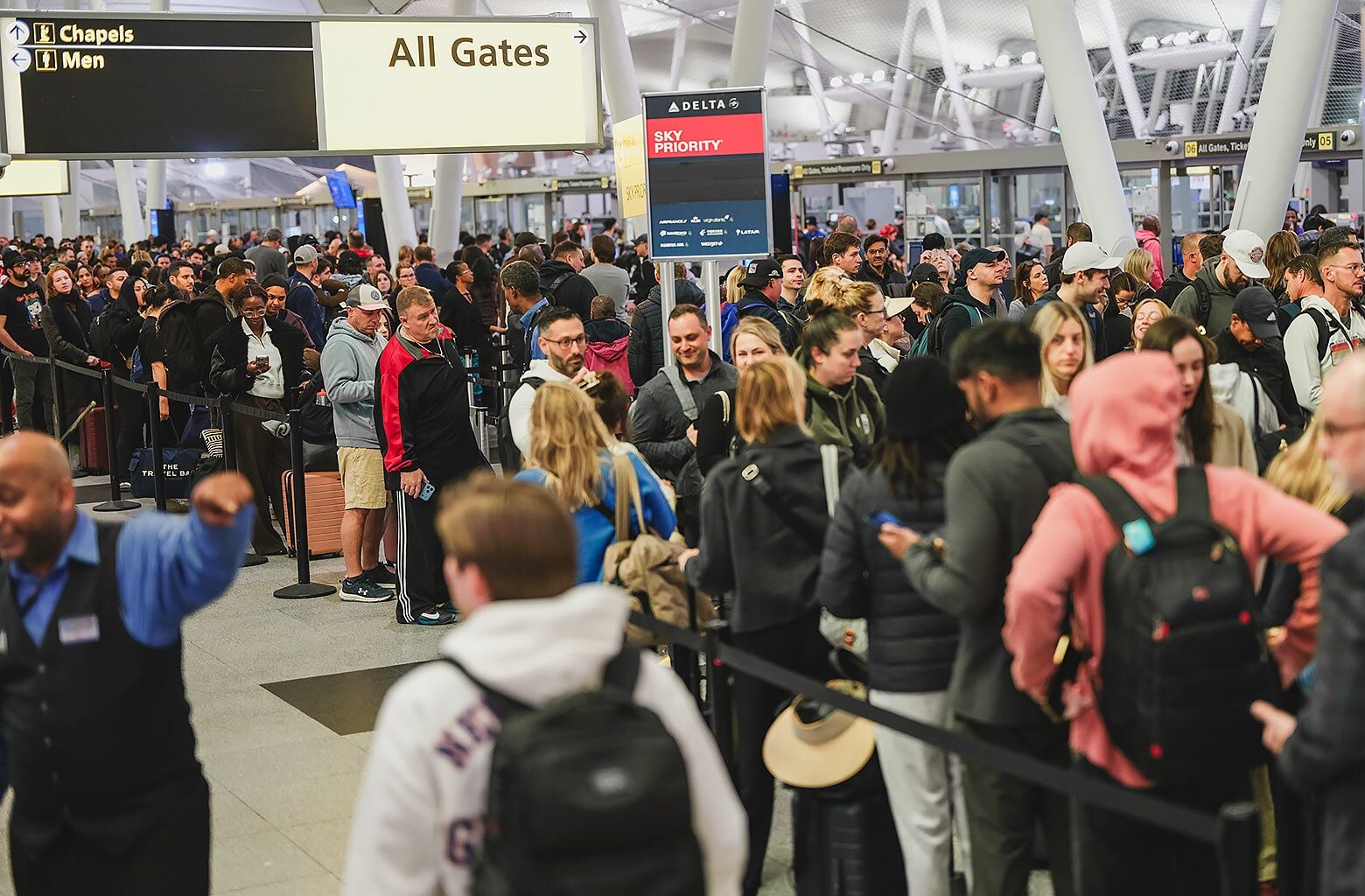
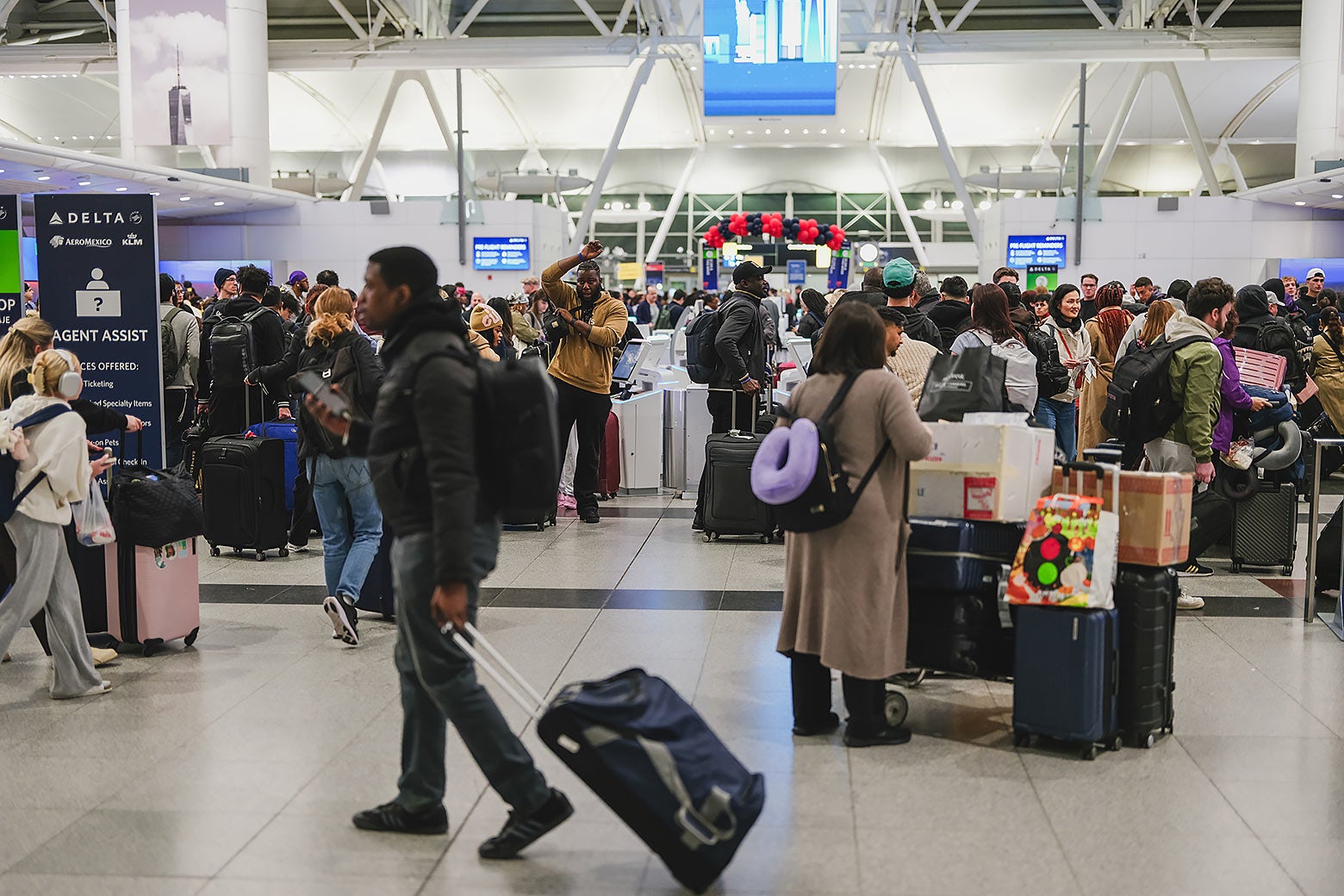
People stood in clusters with their luggage, chatting, sitting on the floor, scrolling on their phones, leaning against the stanchions, staring into the void, and even sleeping as they waited to enter a terminal that wouldn’t even open until 4 a.m.
One person I spoke to, Alyx, had seen videos online that showed TSA lines out the door and hoped to avoid that entirely by being the first in line. She had left home at 1 a.m. “We’ve been up for a full day,” she said of herself and her traveling companion. Others had apparently had the same idea: The TSA line had already wrapped around itself four times hours before anyone had even begun moving.
I loitered in the terminal for several hours, watching as the checkpoint inflated with bodies and stress, the visible edge of a political standoff that had been building for weeks. The Department of Homeland Security, which oversees the Transportation Security Administration, has been at a funding impasse that may be about to reach a conclusion, if Senate Republicans get their way. But hundreds of screeners have quit, and many of those still on the job were working without pay, prompting unusually high callout rates and thinning already-stretched staffing levels.
This is also among the busiest travel seasons of the year. Alyx was headed to Puerto Rico, along with many other travelers who were taking long-planned trips for spring break. Together, these conditions have produced the longest TSA wait times in the agency’s history. Along with airports in Houston and Atlanta, JFK has emerged as a flash point in the current disaster, with Reddit and other sites flooded with photos and anger.
Though Immigration and Customs Enforcement has been deployed to assist with the long lines, I didn’t see any federal officers present at Terminal 4. Alyx said her group had initially avoided taking an Uber to the airport because they had heard that ICE agents might be stationed outside JFK, checking IDs. They opted for public transit instead.
By 4 a.m., hundreds, if not thousands, had already lined up. When movement finally began, it resembled not so much order as managed improvisation. Staff shouted directions—PreCheck this way, no, that way—while passengers tried to interpret them in real time. Questions repeated every few seconds: Where is Clear? How long will it take to get through? Will I make my flight? The answers, when they came, were partial or inconsistent.
Aymann Ismail
One traveler, Travis, had a flight scheduled to depart for Salt Lake City at 6:15 a.m. He gestured across the terminal. “It’s worse than I expected,” he said. Another traveler, departing for Jamaica at 6 a.m., offered one word to describe her experience: terrible.
At one point, travelers were being redirected across lines, instructed to bypass one queue for another, then stopped again. “Bottlenecks,” one person told me, describing how people were being shuffled forward and sideways without clear explanation.
A security guard, watching the flow, offered a relaxed smile as the travelers grew more agitated: “They’re short-staffed. Please be patient.”
That advice was not universally heeded. One traveler rushed toward the exit, telling their companion they’d given up. They were going to reschedule their flight for another day.
For Alyx, the 1 a.m. plan worked, at least initially: When the terminal opened, she was among the first waved through. But inside the airport, the disruptions continued. After clearing security, her group went to their assigned gate—only to discover that it was for a different flight. They checked the board. Their departure had been moved to a gate clear across the terminal, requiring another 10-minute walk and a shuttle bus.
Two people next to her, she said, were on their second or third attempt to leave the city. Their flight had first been delayed, then rescheduled—then moved earlier without notice. They had missed it because of the lines. Now they were back again, trying one more time.

Alex Kirshner
One of the Most Absurd Changes to Air Travel Has Become So Common You Barely Even Notice It. You Should.
Read More
“Chaos,” she wrote.
Alyx and others I spoke to stressed that it was clear the TSA agents were doing everything they could under the circumstances. And they were trying to be calm, to weather the situation together. The frustration was broader, an ambient sense of national failure in the air.
This Content is Available for Slate Plus members only
When the New Neighbor Arrived, They Were Excited. It Turned Into a Seven-Year Nightmare That Had Liberals Losing Their Minds.
A Self-Published Book Became the Bestselling Novel in America. After Reading It, I Think I Know Why.
Sonia Sotomayor Just Issued a Stirring Defense of One of Trump’s Biggest Targets
Sam Altman Is Finally Admitting Something No One Else Wants To
Even if Congress cuts a deal, a return to normal would not be immediate. TSA’s leadership has said the damage is cumulative: More than 480 screeners have already left, replacements take roughly four to six months to train and certify for checkpoint work, and union officials have warned that repeated shutdowns have made recruiting harder by turning a difficult, public-facing job into one that is now financially unreliable. Even after funding resumes, workers may wait weeks for back pay, which means that callouts and resignations won’t disappear overnight.
And there’s another thing. The United States is less than three months from the start of the World Cup, which TSA expects will bring millions of additional passengers through airports. Ha Nguyen McNeill, the agency’s acting administrator, described that convergence as a “perfect storm.” The challenge of rebuilding a depleted workforce, restoring morale, and doing it under deadline, with another busy travel season and a major global event already bearing down, seems to be building every day.
By the time I got home at 7:30 a.m., Alyx had boarded. “We did it,” she texted me. The line she had stood in hours earlier was still there, longer now. From where she started, it hadn’t seemed so bad. From where others stood, it wasn’t clear they’d be traveling that day at all.

Sign up for Slate’s evening newsletter.