
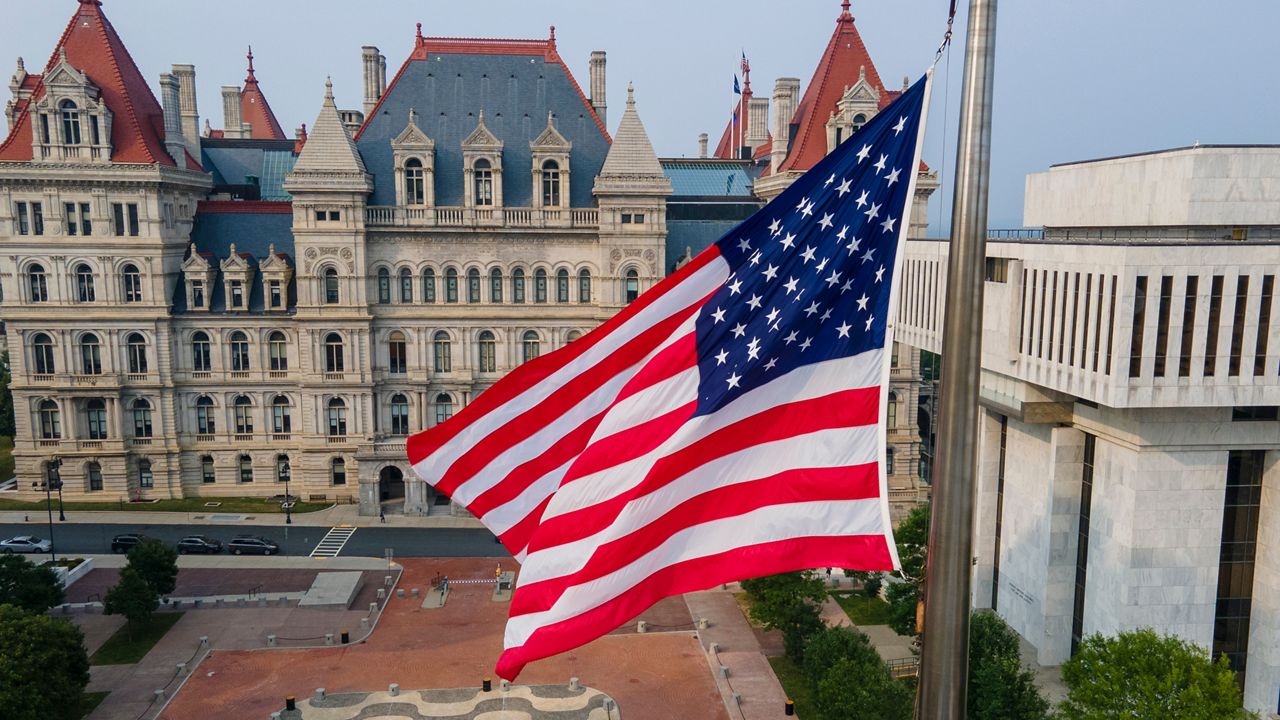
As advocates and some Democratic state lawmakers sat in the middle of State Street in front of the Capitol in Albany on Tuesday, bearing a banner emblazoned with support for the New York for All Act, inside the building, conversations around a package of immigrant protection bills have dragged on longer than almost anyone involved would have liked.
“I am hopeful we will get through this, and it just needs a little bit of time, like anything else in the budget,” state Sen. Pat Fahy said while attending the rally.
Both Gov. Kathy Hochul and legislative leaders in the state Senate and Assembly have said for weeks they want to come up with something “sooner rather than later,” and ideally before the rest of the state budget is finished. Two months after that process began, “sooner” is looking more and more out of reach.
This week, Hochul signaled the package could come as part of the broader budget package after all.
“Either outside or within the budget, that’s something we’re taking very seriously, recognizing that we still have ICE, which is out of control,” the governor said.
Last week, Senate Majority Leader Andrea Stewart-Cousins described the potential for a deal either in the budget or out of the budget as “on parallel tracks.”
Some of Hochul’s immigration-related proposals were included in her executive budget and started as part of the regular budget discussion, including protecting certain sensitive locations from ICE intrusion and opening up legal avenues in cases where individuals’ constitutional rights are violated. In late January, in response to the evolving nature of ICE presence in U.S. cities and the deaths of U.S. citizens Alex Pretti and Renee Good in Minneapolis, Hochul proposed ending formal partnerships between ICE and local governments, or 287(g) agreements.
The state Senate’s Democratic majority in particular has made a point of stepping out on its own, creating a working group to formulate a package of legislation last month anchored by the New York for All Act, which strictly limits cooperation between ICE and state and local governments and is favored by many progressive lawmakers because it covers blind spots created by simply banning 287(g) policies. For weeks, it was unclear how that legislation would move forward until it became apparent that it would be used to inform the elusive three-way deal with Hochul and Assembly Speaker Carl Heastie.
How to handle ICE cooperation is at the center of the debate, and specifically how to address cooperation relating to those who commit serious crimes.
While rallying outside the Capitol, state Sen. Julia Salazar told reporters it is her understanding that the debate is hinging on carve-outs for when ICE cooperation can move forward.
“At what point, if somebody is charged with a crime, would it warrant local governments sharing those individuals’ immigration status or citizenship status with the federal government?” she said, adding that she personally believes immigration enforcement should remain a civil matter.
Deputy Senate Majority Leader Mike Gianaris seemed to indicate that the package will likely be absorbed into the rest of the budget discussion at this point.
“Seems that way,” he said, adding that he envisions an overall budget deal coming “not too far past the deadline.”
Gianaris also appeared to blame the infusion of non-budget-related policy into the overall budget conversation — typical of Albany’s executive-driven budget process and perennially drawing the ire of state lawmakers — for taking up energy which he argued could otherwise be devoted to the immigration debate in a world where state budgets were just numbers.
“Everything is just getting jumbled together, and that’s always the problem with conflating non-budget issues with the actual budget. It holds up the nuts and bolts of running the state,” he said. “We get into this process of passing extenders to keep the government open while we’re negotiating things that technically have nothing to do with the budget.”
In response, the governor’s office said Hochul introduced her most substantial immigration-related policy outside of her budget proposal and was prepared to move forward at that time.
“The governor proposed these bills in January — outside of the budget process — and was clear that she would be willing to sign them into law immediately. Now is the time to act,” the statement read.