
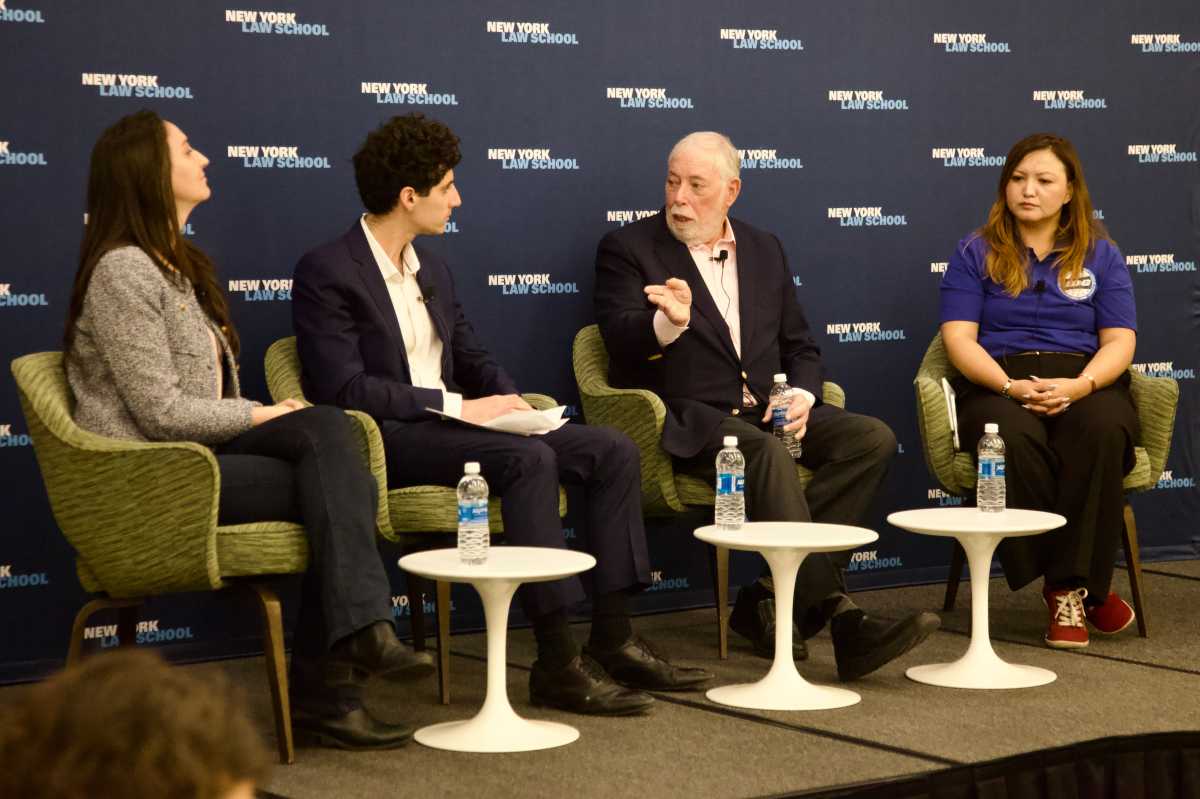
From left, Sara Lind, co-executive director at Open Plans; reporter and moderator Mark Chiusano; Sam Schwartz, a transportation researcher at Hunter College; and Dinara Zhanpeissova, a for-hire vehicle driver and Independent Drivers Guild organizer discuss the future of AVs in New York.
Photo by Max Parrott
It could be years away, but it’s on the horizon: fully driverless cars on the streets of New York. In the meantime, experts say we need better data to craft regulations that work for the city and state.
Though Waymo operates fully driverless robotaxis services in major metropolitan cities like Los Angeles, Atlanta and Dallas, a panel at the New York Law School on Wednesday agreed that the chaotic nature of New York City streets poses unique regulatory challenges.
“The industry is incredibly opaque,” said Sam Schwartz, a transportation researcher at Hunter College, adding that “the right way to do it is to have independent entities that have no funding whatsoever from any of these companies.”
Schwartz joined Sara Lind, co-executive director at Open Plans, and Dinara Zhanpeissova, a for-hire vehicle driver and Independent Drivers Guild organizer to explore the major policy, legal and social consequences that come with unleashing autonomous vehicles in New York.
Schwartz is a former cab driver and city transportation official who is known for inventing the term “gridlock” in the 1980s. He gave a presentation that laid out what he perceived as possible benefits and pitfalls for autonomous vehicles. In New York, it’s going to be key for autonomous vehicle companies to integrate with mass transit, steer funding into city road infrastructure and even introduce counter-terrorism measures so that driverless cars can’t be used as a weapon.
“Obviously the data sharing is super important. [AV companies] are focused on safety, but there’s so many other things.”
The policy considerations for the new technology are a thorny patchwork of social values including concerns around safety, traffic, labor and equity for low-income and disabled New Yorkers.
“There are things that work elsewhere but they don’t work here,” Schwartz said.
Though there’s a lot of room for error, Schwartz maintained a lot of good things could happen if the state properly regulates the new technology: congestion could diminish. Crashes, injuries and deaths could plummet.
On the other hand, he said, without proper rules the total amount of traffic miles generated from constantly roaming vehicles could soar, increasing congestion — and, of course, it will jeopardize the job security of the taxicab labor force.
Zhanpeissova stressed that any robotaxi legislation should come with an education program that would allow taxi drivers transition to other careers.
“A lot of drivers are immigrants, and it’s going to be very hard … if, let’s say, they don’t have a job anymore. I don’t know where they’re gonna go,” she said.
In February, New York Gov. Kathy Hochul reversed course on a proposal to allow robotaxi companies to operate commercially without human safety drivers in parts of the state outside New York City. But there are other pieces of existing legislation to push the needle forward on the technology.
State Assemblymember Brian Cunninham, who had to drop off the panel at the last minute, has introduced a bill that would establish a framework for autonomous vehicles on state roads involving safety protocols and insurance.
“What I would like to see in the legislation is the revenue that goes towards the infrastructure that these vehicles will rely on,” said Schwartz. “And also to help build the infrastructure that makes these vehicles even smarter, so the vehicles will talk to each other, but they can also talk to a traffic signal.”
Lind said that though the bill has been proposed for several years, this is the first year where it felt like there was real momentum. In talking to legislators, though, she said it became clear that there were a number of regulatory issues they have yet to tackle.
“New York has the opportunity to do it right from the beginning,” Lind said.