
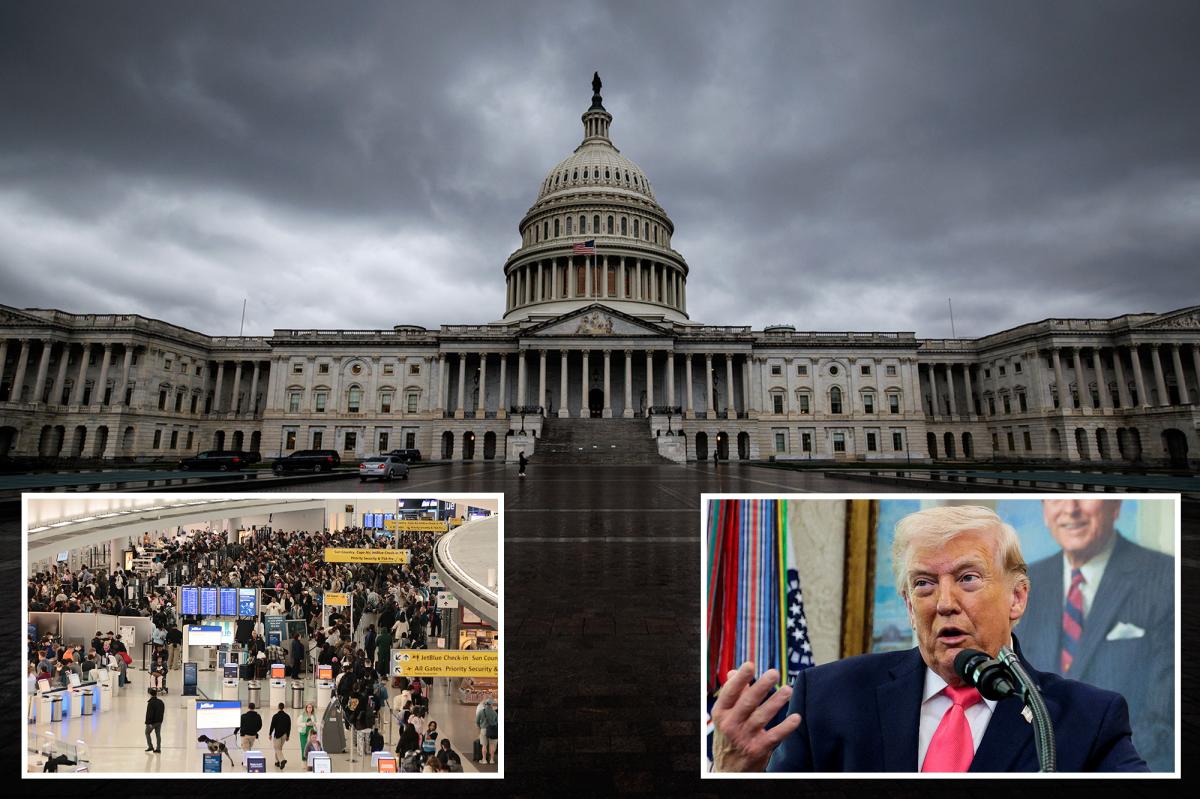
WASHINGTON — House Republicans rejected a Senate-passed funding bill to reopen most of the Department of Homeland Security Friday, prolonging a six-week shutdown as they sought to fully reopen the agency.
House Speaker Mike Johnson (R-La.) told reporters his chamber would move “as soon as possible” on a stopgap measure funding DHS for 60 days after federal immigration enforcement got “zero” dollars in the Senate version of the bill.
“It is unconscionable to me that the Democrats would force some sort of negotiation at three o’clock in the morning and try to foist this upon the American people and then get on their jets and go home for their holiday — and pretend and think that we’re going to go along with that,” Johnson fumed.
President Trump said he would sign an executive order to fund TSA agents. REUTERS
House Speaker Mike Johnson held a meeting with House Republicans on the Senate measure passed on Friday morning. REUTERS
“It can’t be the case that every Senate Republican read this bill,” he added.
Johnson said President Trump had expressed support for the move, and is in the process of separately implementing an executive order to pay Transportation Security Administration agents in full to end weeks chaos at America’s airports.
Rep. Chip Roy (R-Texas) told The Post earlier Friday that the Senate compromise was “not going to pass as it is,” adding that it was “absolutely offensive” to his constituents in Border Patrol and other agencies who have missed paychecks.
Another House GOPer griped that the Senate “shouldn’t have left town” for its two-week Easter and Passover break before the bill reached President Trump’s desk.
“PSA to senate schedulers: may want to book a return flight for your boss,” Rep. Lauren Boebert (R-Colo.) posted on X. “Our work here isn’t finished.”
The Senate-passed measure would fully fund DHS agencies except Immigration and Customs Enforcement and Border Patrol.
The US Capitol seen on March 27, 2026. The Senate passed a DHS funding measure early Friday. Getty Images
Republicans already secured billions in funding for those agencies in President Trump’s One Big Beautiful Bill this past July, though several are hopeful that additional spending can be tucked into a second reconciliation bill in the near future.
Senate Democrats have held up the funding for 42 days in protest of the ICE and Customs and Border Protection-involved fatal shootings of Renee Good and Alex Pretti in Minnesota earlier this year.
“They ended up getting no reforms but, you know, we’re going to have to fight some of those battles another day,” Senate Majority Leader John Thune (R-SD) said of his Democratic colleagues.
Start your day with all you need to know
Morning Report delivers the latest news, videos, photos and more.
Thanks for signing up!
Trump began placing ICE agents at airports Monday to backfill missing Transportation Security Administration personnel. He announced Thursday that he was planning an executive order to pay TSA agents through emergency powers.
Senate Minority Leader Chuck Schumer (D-NY) declared victory and said Democrats “held the line” to prevent a “blank check” from going to “lawless” ICE and CBP.
Travelers wait in long TSA lines at JFK Airport on Friday, March 27, 2026. Getty Images
Airports are experiencing long TSA line waits due to shortage of staff. Getty Images
More than 480 Transportation Security Officers (TSOs) have quit and as many as 50% of staff at individual airports were calling out of work as the shutdown dragged on, a top TSA official testified to Congress Wednesday. The lack of pay had some TSA agents selling their blood and sleeping in their cars to make ends meet.
Passengers have been suffering the highest wait times in the agency’s 25-year history, the official also told lawmakers, and if the funding fight continued, smaller airports were under threat of having to close down.
Even former Attorney General Bill Barr was photographed Wednesday waiting among thousands of others trying to catch flights out of George Bush Intercontinental Airport in Houston — which saw some of the worst delays with recorded wait times of four hours or more.