
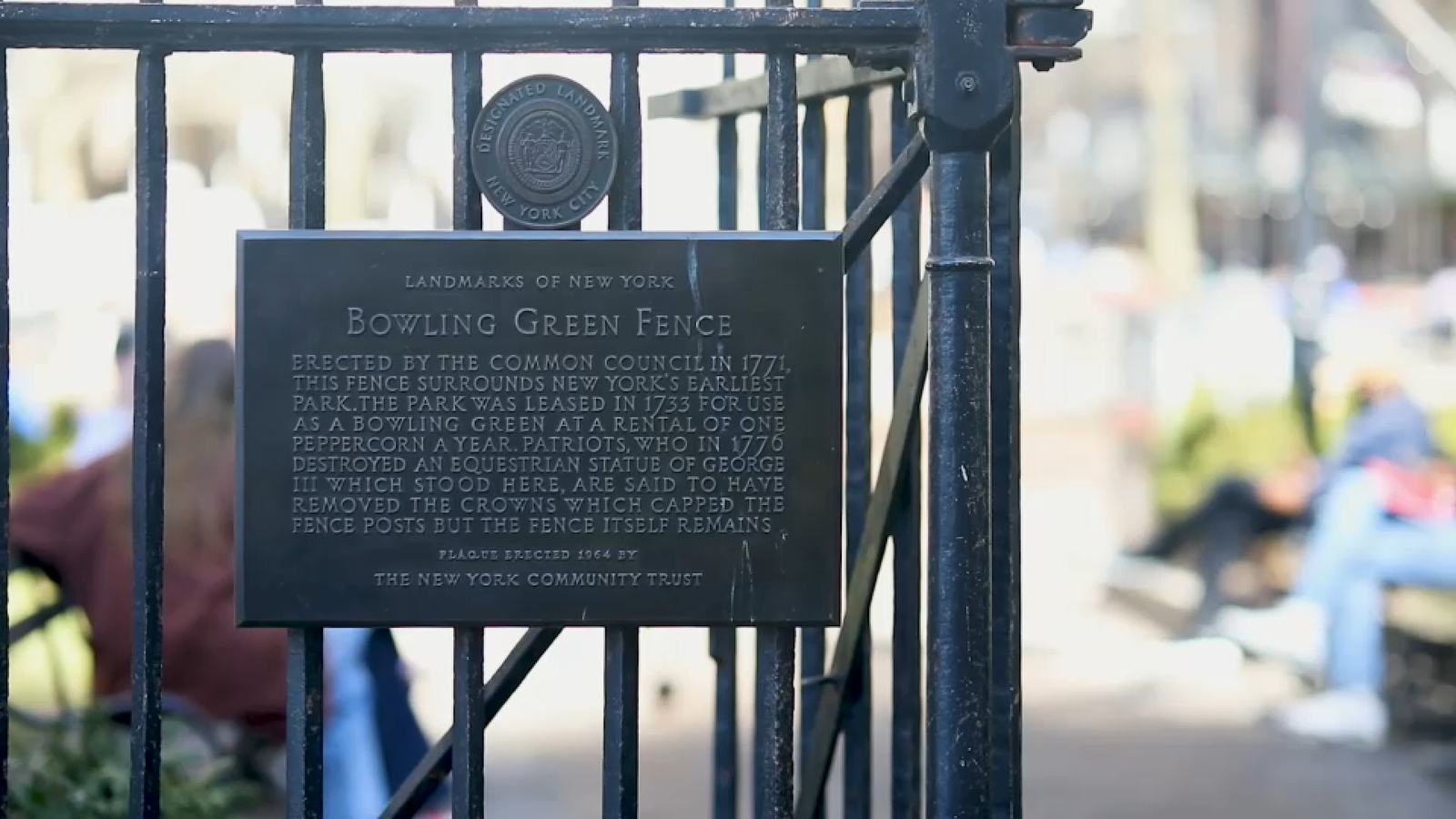
LOWER MANHATTAN (WABC) — A piece of American history still stands today within the iron fence at Bowling Green Park in Manhattan.
Its original purpose centuries ago was to protect a statue of Great Britain’s King George III, but 250 years ago, that would change.
The American Revolution happened and crowds came to tear it down. As we prepare to celebrate 250 years of America, Eyewitness News is sharing the history the fence endured and echoes of rebellion long after New York City rose around it.
On July 9, 1776, news of the signing of the Declaration of Independence reached New York City. The document was read aloud, and that night, a group of patriots gathered at Bowling Green.
There stood a massive equestrian statue of King George III, erected just six years earlier.
Under the cover of darkness, the group got to work. The statue weighed 4,000 pounds but eventually, they pulled it from its pedestal – sending it crashing to the ground. They tore it apart, parading the king’s head through the streets as if it were real.
Then, they melted it down – turning the lead into musket balls to fire back at British troops.
Much of the statue was transported to Connecticut. But along the way, pieces disappeared – likely taken by Loyalists — and scattered across fields, basements, and even swamps.
Over time, fragments began to resurface. Farmers found them while plowing. Others turned up in homes across the region.
In the 1970s, a metal detectorist named Louis Miller uncovered a 20-pound piece in Wilton, Connecticut.
Today, a fragment believed to be part of the king’s cape is housed at the Museum of the City of New York.
The statue itself had been highly ornate – depicting King George as a Roman emperor, adorned with gold leaf, a symbol of power and prestige.
Its destruction became something else entirely: a powerful image of rebellion – ordinary people pulling down a king and turning his symbol of authority into weapons.
One mystery remains: what happened to the king’s head? It was paraded through the streets, later recovered by American soldiers, then reportedly taken back by the British.
At Bowling Green, another piece of history still stands.
The iron fence surrounding the park was also damaged that night. Its decorative finials were knocked off – some said to resemble crowns.
The fence survived for more than a century, before being partially relocated to Central Park around the time of World War I.
In 1938, the Parks Department reinstalled the fence down at Bowling Green.
Today, sections remain at Bowling Green – considered the oldest fence in New York, surrounding the city’s oldest park.
“So little of the environment of the revolutionary period survived in New York. We can go see the sights, we can go see some wonderfully preserved examples, but we don’t have that feeling of being able to walk in the revolutionary city without some assistance,” Sarah Henry, co-director of Occupied City Project, Museum of the City of NY said. “And the fence at Bowling Green is an exception. It’s something we can actually make a pilgrimage to.”
In a place where so little of the Revolutionary era still exists, Bowling Green offers something rare: a tangible connection to the moment a king was brought down… and a revolution took hold.
The Museum of the City of New York and the Gotham Center for New York City History will present The Occupied City: New York and the American Revolution, a new exhibition opening on May 1, 2026.
You can also learn more by visiting the Wilton Historical Society in Connecticut.
———-
* Get Eyewitness News Delivered
* Download the abc7NY app for breaking news alerts
Submit a tip or story idea to Eyewitness News
Have a breaking news tip or an idea for a story we should cover? Send it to Eyewitness News using the form below. If attaching a video or photo, terms of use apply.
Copyright © 2026 WABC-TV. All Rights Reserved.