
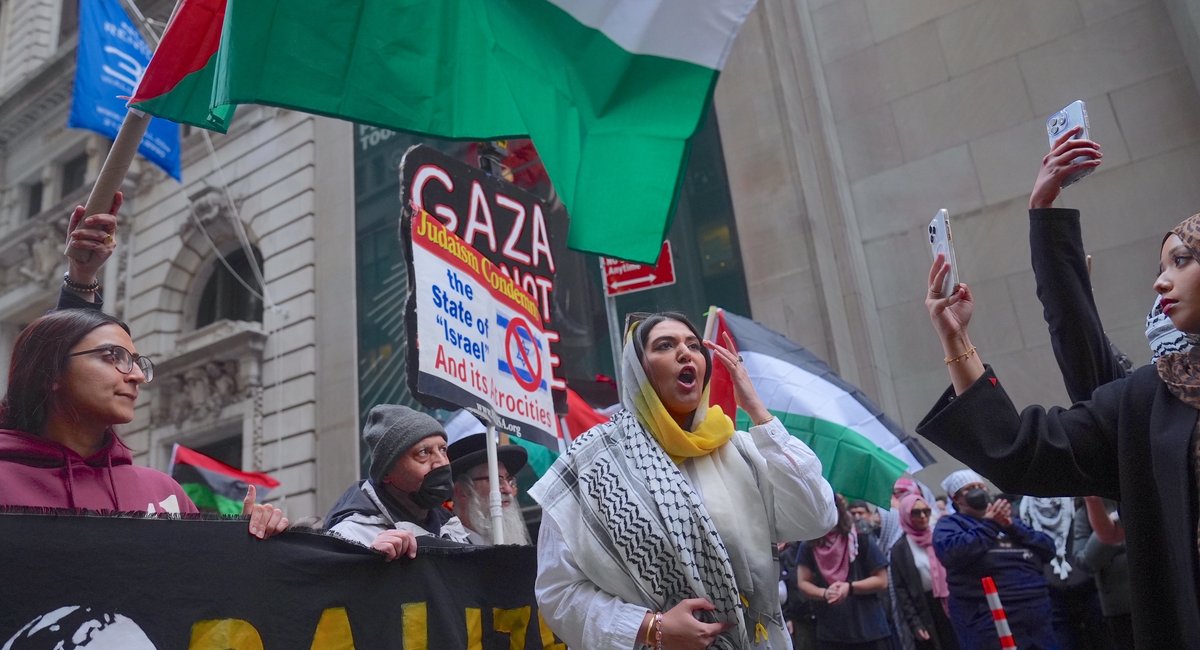
A New Jersey man is facing federal firearms charges after prosecutors say he plotted to assassinate a prominent Palestinian American activist.
The U.S. attorney’s office in New Jersey charged Alexander Heifler, 26, on Friday with unlawful possession and making of firearms, according to a criminal complaint. The NYPD and FBI arrested Heifler in connection to a plot against Palestinian activist Nerdeen Kiswani after he allegedly shared his plans with an undercover NYPD officer monitoring a group messaging forum, according to a department spokesperson, who declined to name the platform.
Heifler’s arrest comes as the NYPD says it’s closely watching a rise in online extremism, particularly among young people. It follows a separate thwarted terrorist attack earlier this month, when federal prosecutors say two teens who allegedly professed support for the Islamic State attempted to ignite homemade explosive devices outside Gracie Mansion.
An NYPD spokesperson said Heifler proposed throwing Molotov cocktails at her Staten Island home and car. The group chat was monitored by an NYPD investigator who specializes in extremism. The criminal complaint does not specify what platform the group was using to communicate.
Kiswani, founder of the pro-Palestinian group Within Our Lifetime, said in a statement that “Zionist organizations like Betar” — which the New York attorney general’s office has deemed an extremist group — and politicians have been encouraging violence against her and her family for months.
“I will have more to say as additional details come to light,” she said. “I will not stop speaking up for the people of Palestine.”
Attorney information for Heifler was not immediately available. The FBI did not return a message for comment. Betar denied any connection to the incident.
Mayor Zohran Mamdani said in a statement that Heifler is a member of an offshoot of the Jewish Defense League, which he said is designated by the FBI as a “known violent extremist organization.” He said the plot “comes amidst an alarming rise in threats and violence across the country targeting Palestinian human rights advocates.”
“Let me be clear: We will not tolerate violent extremism in our city. No one should face violence for their political beliefs or their advocacy. I am relieved that Nerdeen is safe,” Mamdani said. “Our city must meet hate with solidarity, and meet fear with an unshakable commitment to justice and to one another.”
Heifler first proposed attacking Kiswani in a Feb. 10 video call with the undercover officer, according to the complaint.
The NYPD investigator who had been monitoring the chat then suggested to Heifler that they speak privately. On March 4, an NYPD spokesperson said, Heifler and the undercover officer met in person, drove to Kiswani’s house and came up with an escape plan involving a fake license plate and steps to obscure their DNA evidence.
The mayor said Heifler’s plan was to flee to Israel after the attack.
An NYPD spokesperson said Heifler was unknown to the department before the online threat.
On March 23, Heifler texted the undercover officer that he planned to make the Molotov cocktails this week, telling the officer “yeah Thursday [March 26, 2026] night would be best to bake,” according to the complaint.
The NYPD spokesperson said Heifler was arrested on Thursday in his home while preparing the Molotov cocktails with the undercover officer. His plan, according to the spokesperson, was to surround Kiswani’s house and car with the devices that evening.
“Our undercover officer identified and tracked the threat — first online and then in person — allowing us to disrupt the planned attack, take Heifler into custody, and ensure that no one was harmed,” Police Commissioner Jessica Tisch said in a statement.
“This is exactly how our intelligence and counterterrorism operation is designed to work — a sophisticated apparatus built to detect danger early and prevent violence before it reaches our streets,” Tisch said.
An NYPD spokesperson said the undercover officer worked for the department’s Racially and Ethnically Motivated Extremism unit, which investigates groups such as violent white supremacists, antigovernment extremists and other ideological extremist groups.
Rebecca Weiner, NYPD deputy commissioner of intelligence and counterterrorism, told Gothamist in a recent interview that young people across the ideological spectrum have been increasingly radicalizing online since the pandemic and the start of the Israel-Hamas War. She said social media platforms have normalized violence and created an “echo chamber” for people with similar beliefs to become more extreme.
Kiswani is a Palestinian and U.S. citizen who was born in Jordan and came to America as a refugee when she was a year old, according to court records. She founded Within Our Lifetime in New York City in 2015 to organize “demonstrations, boycotts, and pressure campaigns against Israel and its occupation of Palestine,” those records state.
Within Our Lifetime describes itself an anti-Zionist organization on its website. It calls for the “liberation of Palestine” through “all forms of Palestinian resistance” and the right of all Palestinian refugees to return to the land between the Jordan River and the Mediterranean Sea.
Critics have accused Within Our Lifetime and Kiswani of antisemitism, including the Anti-Defamation League, which calls the group “radical” on its website. A lawsuit filed last year in the Southern District of New York by a group of Israelis and Jewish Americans affected by the October 7th attack accused Kiswani, Within our Lifetime and other organizations on Columbia University’s campus of violating U.S. antiterrorism laws — allegations Kiswani has denied in court papers.
Kiswani filed her own federal lawsuit last month accusing Betar — a self-described “Zionist activist organization” — of orchestrating people to stalk, harass and threaten her, including by handing her a beeper reminiscent of the kind Israel used to attack members of Hezbollah. She sued Betar under the Ku Klux Klan Enforcement Act of 1871, arguing the group has subjected her to “a coordinated and sustained campaign of racial violence.”
The New York attorney general’s office recently found Betar has “engaged in bias-based acts of violence, intimidation and harassment” and violated New York civil rights laws. The office demanded that the group stop instigating violence against Palestinian, Muslim, Arab and Jewish people.
Betar spokesperson Daniel Levy said in a statement that the group knew nothing about the threat against Kiswani, has had no contact with law enforcement about the incident and does not operate in New York.
This story has been updated with additional information.