
The Enduring Legacy of Judith S. Kaye
3.27.2026
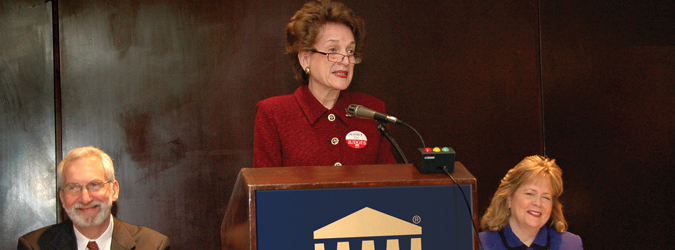
Judith S. Kaye passed away on Jan. 7, 2016. Her death caused a statewide lament. Flags flew at half-mast on government buildings. The media paid homage to her life and legacy. Fifteen hundred people crowded into Lincoln Center to attend her funeral. Lawyers and laypersons alike – some who had never met Judith Kaye – mourned her passing.[1]
Almost immediately a flood of academic commentary and scholarship appeared in law reviews praising her career.[2] Her previously unpublished memoir came out in 2019 in a book that included select judicial opinions and articles.[3] Not since the death in 1938 of the legendary Benjamin Cardozo had New Yorkers seen such a response to the death of a jurist.

For a quarter century – from 1983 to 2008 – Judith Kaye sat on the New York Court of Appeals. She was the first woman associate judge and chief judge of the Court of Appeals. She was the longest serving chief judge in New York history. She authored more than 600 judicial opinions, many of which spawned state and national trends. She was the most accomplished court administrator of her time, rewriting “the script for how a twenty-first century chief judge can lead the courts in delivering justice.”[4] All the while she found time and energy to publish over 200 extrajudicial writings – on a “kaleidoscopic range of topics”[5] – “confront[ing] as educator, scholar and advocate many of the most important issues facing our country.”[6]
Even now, 10 years after her death, Judith Kaye’s imprint on the law – and on those who knew her well or at a distance – is as large as ever. But why was she so admired? Why has her stature remained undimmed? To find the answers one must realize that there are two Judith Kaye stories, and both are inspiring.
Two Stories of Judith Kaye’s Life and Career – in a Nutshell
The first story begins when young Judith – the daughter of immigrants who fled religious persecution in Eastern Europe – graduated from Barnard College and embarked on what she hoped would be a career in journalism. She soon realized, however, that journalism was a male bastion. The best job she could find was as a “social reporter” for a newspaper in New Jersey.
Undaunted, she enrolled in New York University Law School, attended classes at night, and graduated sixth in her class in 1962. Once again, she embarked on a career path only to find that few if any law firms were willing to interview a woman, much less offer a job. After scores of rejections, however, a door opened: Sullivan & Cromwell hired her as a litigation associate. That was all she needed. It didn’t take long for her colleagues to recognize her brilliant legal mind, and in 1975 she became the first woman partner of Olwine, Connelly, Chase, O’Donnell and Weyer.
The second Judith Kaye story begins in 1983, when she is thriving in private practice as a commercial litigator and comes to the attention of Gov. Mario Cuomo, who is looking to appoint a woman – the first – to the Court of Appeals. He appoints her. And the rest is history.
Coming to the bench directly from private practice, Judge Kaye spent her first years transitioning from the “fundamentally different roles” of lawyer to judge, advocate to arbiter. She once joked that “[f]or a long time after my appointment to the Court of Appeals I marked every passing week as a triumph of survival – my own as well as the law of the State of New York.”[7]
The self-deprecating humor notwithstanding, she quickly mastered the craft of judging, writing opinions in high-profile cases, such as one her first year on the court striking down New York’s mandatory death penalty for murder committed by an inmate already serving life imprisonment.[8] “Limited only by the human imagination,” the court’s docket – roughly 60% civil and 40% criminal – was extraordinarily diverse.[9] “Lawyer heaven” is the phrase she used to describe the experience of deciding the novel and challenging issues that came before her.[10]
Through opinions and scholarly articles, she earned a national reputation as a forceful advocate for independent state constitutional adjudication – the doctrine that state courts should look to their own constitutions instead of limiting their decisions to analysis under the U.S. Constitution. In Immuno A.G. v. Moor-Jankowski,[11] for example, she held that the New York State Constitution provided protection for speech greater than the minimal protections required under the U.S. Supreme Court’s interpretation of the First Amendment.[12]
Judith Kaye advanced the state constitution more than anyone in modern New York history. Due in no small part to her efforts, state constitutional law is no longer seen as an arcane field of study. New York courts now “accept and routinely apply state constitutionalism when necessary to effectively safeguard individual rights and liberties.”[13] That would not be true but for her leadership as the Court of Appeals’ “foremost student and proponent of state constitutional adjudication.”[14]
In 1993, Gov. Cuomo appointed her to the position of chief judge. By this time, she had a national reputation as a brilliant jurist – indeed a “judge’s judge.”[15]
Now, in addition to being chief judge of the Court of Appeals, she assumed what amounted to a second full-time job – chief judge of the State of New York. In that capacity, she oversaw the state’s judicial branch of government and set priorities for the largest, busiest, and most complex court system in the nation. She quipped that she had two jobs, and “each . . . took 80 percent of my time.”[16]
Under the Kaye administration, New York’s court system became a “laboratory for court innovation and a model emulated by state judiciaries large and small.”[17] She transformed and modernized courts through myriad reforms. Here are a few of her signature initiatives:
Judith Kaye’s highest priority was the welfare of children and families involved with the legal system, especially in the areas of divorce, foster care, domestic violence, child abuse and neglect, adoption and juvenile delinquency. She instituted new rules to open family court to public scrutiny and address flaws in matrimonial litigation. She introduced the Adoption Now program that reduced by 50% the number of children awaiting adoption. She also created the Permanent Judicial Commission on Justice for Children, an interdisciplinary institution within the state court system to develop and advocate for positive policy changes on behalf of children. These and other accomplishments in this area “make her a candidate for the most consequential family law judge in American history.”[18]
She revolutionized New York’s jury system, making it a model for jury reform for the nation. She improved the treatment of jurors and eliminated virtually all automatic exemptions from the jury pool, thereby diversifying and expanding it. She also eased the emotional and economic strain of jury service by eliminating mandatory sequestration. This had the added benefit of saving the state millions of dollars every year.[19]
To deal with the modern-day societal problems that caused people to repeatedly return to court, she established hundreds of problem-solving courts, including community courts, drug treatment courts, domestic violence courts, and mental health courts. This was a judicial revolution, as it challenged “tradition-bound judiciaries to rethink their most fundamental precepts and to focus more intensively on the human beings and societal trends reflected in these cases.”[20]
She nurtured and expanded the Commercial Division in the New York State Supreme Court. Under her watch, the Commercial Division became a nationally renowned forum to resolve complex business disputes with efficiency and expertise and thus help attract and retain business in New York.[21]
Acutely aware of negative public attitudes about government, she held herself to the highest ethical standards. She had zero tolerance for judicial misconduct and took steps to enhance public trust and confidence in the judiciary and legal profession. This included mandatory continuing legal education; mandatory arbitration of attorney-client fee disputes; rules requiring letters of engagement in most cases; reform of the fiduciary appointment process; standards of civility and statements of clients’ rights.[22]
In her judicial role, she was first among equals on the Court of Appeals, respected as an intellectual leader and consensus builder. Widely regarded as one of the nation’s finest legal writers,[23] her carefully crafted opinions shaped New York law. She authored seminal rulings recognizing adoption rights of same-sex couples[24] and ensuring that all public-school students – rich and poor – had “the opportunity for a meaningful high school education” that would prepare them “to function productively as civic participants.”[25]
Among her most memorable writings was a prophetic dissent in Hernandez v. Robles,[26] decided her last year on the court in 2008. A four-judge plurality held that same-sex couples had neither a constitutional nor a statutory right to marry.[27] Chief Judge Kaye could not disagree more strongly. She wrote: “While encouraging opposite-sex couples to marry before they have children is certainly a legitimate interest of the State, the exclusion of gay men and lesbians from marriage in no way furthers this interest. There are enough marriage licenses to go around for everyone.”[28]
Vindication was not long in coming. In 2011, New York’s Legislature enacted the Marriage Equality Act, which recognized the right of same-sex couples to marry.[29] A few years later, the U.S. Supreme Court in Obergefell v. Hodges[30] required all 50 states to recognize same-sex marriage, following a slew of lower court decisions (many citing the Hernandez dissent) striking down bans on same-sex marriage across the nation.[31]
The irony of Hernandez is that Judith Kaye was not a “great dissenter.” Only 12% of her judicial opinions were dissents.[32] As a colleague reminisced, “[s]he preferred to lead from the front, seeking consensus when possible.”[33]
In the 1990s, she rejected overtures by the Clinton administration to move to Washington, D.C. and become U.S. attorney general, and a justice of the U.S. Supreme Court. She never regretted those decisions. She adored New York and loved being on the Court of Appeals. She served as chief judge until 2008, when she reached the mandatory retirement age of 70. She then joined the international law firm Skadden, Arps, Slate, Meagher & Flom, where she focused on arbitration and projects that improved the lives of underprivileged children.
After a lengthy battle with cancer, she died at her home in Manhattan at age 77.
A Towering Figure in the Law
Beyond Judith Kaye’s professional contributions and attainments – astounding though they are – was a great-souled human being. She embodied the spirit of the legal profession and an elevated vision of the promise and potential of public service. Her pristine character and unique personality contributed to her being a towering figure in the law.
She projected a commanding yet accessible presence. She stood tall, 5’10” or 5’11”, spoke in a melodic voice, and was always meticulously dressed, wearing colorful blouses and her trademark red shoes. Warmth, dignity, elegance, gravitas, rectitude and high intelligence exuded from her every word and movement. She was always composed, always appropriate. She had deep empathy for people and never forgot from whence she came. Nor did she stand on ceremony. Telephone callers to chambers were often surprised to discover the person answering the phone was not a receptionist, but rather, the judge.
Displays of respect for public service and public servants are rare. We live in a cynical age. The coarsening of public discourse ever quickens. Judith Kaye is our answer to the cynics. She was a miracle, the best of the best – a perfect blend of brilliance, compassion and practicality. New York has given America many of its greatest jurists, but none stands higher than her. Future generations will see in her a singular example of how a person born without privilege can rise to greatness and how a lawyer can make the world gentler and just.
Judith Kaye was chief among chief judges in New York history.[34] She lives on in the writings and works that she left us. She lives on in the mind and memory of a forever grateful legal profession. And she lives on in the hearts of those blessed to have known her.
What Hamlet said of his late father rings true when said of Judith Kaye: She was a woman, take her for all in all, we shall not look upon her like again.[35]
Henry M. Greenberg, past president of NYSBA, is vice chair of statewide programming for the Historical Society of the New York Courts, which was founded by Judith Kaye in 2002. He served as her law clerk from 1988 to 1990.
Endnotes:
[1] In preparing this article, I drew heavily from my previous writings about Judge Kaye. See Henry M. Greenberg, ‘Lawyer Heaven’: Clerking for Judith S. Kaye, in Of Courtiers & Princes: Stories Of Lower Court Clerks and Their Judges 69 (Todd C. Peppers ed., 2020); Henry M. Greenberg, The Making of a Judge’s Judge: Judith S. Kaye’s 1987 Cardozo Lecture, 81 Brooklyn L. Rev. 1363 (2016); Henry M. Greenberg, Judith Smith Kaye: A Chief Judge for the Ages, 79 Albany L. Rev. 1247 (2015/2016).
[2] For example, shortly after Judith Kaye’s death, Brooklyn Law School and New York University Law School dedicated in her memory issues of their law reviews that together contain 13 articles about her judicial career. See 92 N.Y.U. L. Rev. 2-100 (2017); 81 Brook L. Rev. 1349-81 (2016). Similar tributes in scholarly publications predated her death. See, e.g., 84 N.Y.U. L. Rev. 647, 650-680 (June 2009) (containing nine tributes in recognition of her 25 years of service to New York, including from Stephen G. Breyer, Ruth Bader Ginsburg and Sandra Day O’Connor of the U.S. Supreme Court); Vol. 80/No. 9 N.Y. State Bar Journal 5, 10-31 (Nov./Dec. 2008) (containing seven articles in recognition of her 25 years of service on the Court of Appeals).
[3] Judith S. Kaye, Judith S. Kaye in Her Own Words: Reflections on Life and the Law, With Selected Judicial Opinions and Articles (Henry M. Greenberg, et al. eds., 2019).
[4] See Jonathan Lippman, Chief Judge Judith S. Kaye: A Visionary Third Branch Leader, 84 N.Y.U. L. Rev. 655, 661 (2008).
[5] Susan Herman, Portrait of a Judge: Judith S. Kaye, Dichotomies, and State Constitutional Law, 75 Alb. L. Rev. 1977, 1983 (2012).
[6] Sandra Day O’Connor, A Distinguished Path in Public Service, 84 N.Y.U. L. Rev. 662, 663 (2009).
[7] Judith S. Kaye, A Five-Year Retrospective, Address at New York State Family Court Judges Conference 10 (Sept. 24, 1988).
[8] People v. Smith, 63 N.Y.2d 41, 479 N.Y.S.2d 706, 468 N.E.2d 879 (N.Y. 1984), cert. denied, 469 U.S. 1227 (1985).
[9] Judith S. Kaye, The Importance of State Courts: A Snapshot of the New York Court of Appeals, 1994 N.Y.U. Ann. Surv. of Am. L. xi, xiv (Apr. 1999).
[10] Judith S. Kaye, My Life as Chief Judge: The Chapter on Juries, Vol. 78/No. 8 N.Y. State Bar Journal 10-11 (Oct. 2006).
[11] 77 N.Y.2d 235, 549 N.Y.S.2d 906, 567 N.E.2d 1270 (N.Y. 1987).
[12] Id. at 249, 549 N.Y.S.2d at 913, 567 N.E.2d at 1277.
[13] Stewart F. Hancock, New York State Constitutional Law – Today Unquestionably Accepted and Applied as a Vital and Essential Part of New York Jurisprudence, 77 Albany L. Rev. 1331, 1332 (2014).
[14] Vincent Martin Bonventre, New York’s Chief Judge Kaye: Her Separate Opinions Bode Well for Renewed State Constitutionalism at the Court of Appeals, 67 Temp. L. Rev. 1163, 1166 (1994).
[15] See Henry M. Greenberg, The Making of a Judge’s Judge: Judith S. Kaye’s 1987 Cardozo Lecture, 81 Brooklyn L. Rev. 1363, 1372 (2016).
[16] Sam Roberts, Judith S. Kaye, First Woman to Serve as New York’s Chief Judge, Dies at 77, N.Y. Times (Jan. 7, 2016), available at https://www.nytimes.com/2016/01/08/nyregion/judith-s-kaye-first-woman-to-serve-as-new-yorks-chief-judge-dies-at-77.html (last accessed on Feb. 12, 2026).
[17] Jonathan Lippman, Judith Kaye: The Great Reformer, 92 N.Y.U. L. Rev. 85, 92 (2017).
[18] Andrew Schepard, Judith S. Kaye: A Chief Judge for Families and Children, 55 Fam. L.Q. 239, 240 (2022).
[19] Lippman, Judith Kaye: The Great Reformer, supra note 17, at 86-87.
[20] Id. at 87.
[21] Id. at 89.
[22] Id. at 90-91.
[23] Renowned legal writing teacher Bryan Garner considered Judith Kaye among 18 legal writers that are worth emulating. See Dan Slater, Tress and the Law, Judge Kaye’s Last Legal Issue, Wall Street Journal, Dec. 31, 2008, available at https://blogs.wsj.com/law/2008/12/31/trees-and-the-law-judge-kayes-last-case/ (last accessed Feb. 13, 2026). See also Gerald Lebovits, Daughter of the Empire State: Lessons in Legal Writing From New York Chief Judge Judith S. Kaye, Vol. 93/No. 4 N.Y. State Bar Journal 58, 59 (July/Aug 2021) (“Kaye was … a scholarly writer with an effective – and affecting – pen.”).
[24] Matter of Jacobs, 86 N.Y.2d 651, 660 N.E.2d 397, 636 N.Y.S.2d 716 (N.Y. 1995).
[25] Campaign for Fiscal Equity, Inc. v. State of New York, 100 N.Y.2d 893, 908, 769 N.Y.S.2d 106, 111, 801 N.E.2d 326, 332 (N.Y. 2003).
[26] 7 N.Y.3d 338, 821 N.Y.S.2d 770, 55 N.E.2d 1 (N.Y. 2006), abrogated by Obergefell v. Hodges, 576 U.S. 644 (2015).
[27] Id. at 357-379, 821 N.Y.S.2d at 774-791, 55 N.E.2d at 5-22.
[28] Id. at 391, 821 N.Y.S.2d at 799, 855 N.E.2d at 30 (Kaye, C.J., dissenting).
[29] 2011 Laws of N.Y., ch. 95 (eff. July 24, 2011).
[30] Obergefell v. Hodges, 576 U.S. 644 (2015).
[31] See Roberta A. Kaplan, The Dissent That Paved the Way to Equal Dignity: Chief Judge Judith S. Kaye’s Dissent in Hernandez, 92 N.Y.U. L. Rev. 56, 62 (2017) (“There can be no question that Chief Judge Kaye’s Hernandez dissent had a significant impact in paving the way towards marriage equality. To date, Chief Judge Kaye’s dissent has been cited at least 116 times, in 16 cases and 150 law review articles. It was cited explicitly in at least seven state court decisions (California, Connecticut, Maryland, New York, New Jersey, Iowa, and Montana, and two federal marriage equality decisions in the Ninth and Tenth Circuits.”) (citations omitted).
[32] “In all, she wrote 522 majority opinions, 77 dissents, and 28 concurrences.” Albert M. Rosenblatt, Editorial Preface, in Judith S. Kaye in Her Own Words: Reflections on Life and the Law, With Selected Judicial Opinions and Articles, supra note 3, at xiii.
[33] Id.
[34] See Randal T. Shepard, Judith Kaye as a Chief Among Chiefs, 84 N.Y.U. L. REV. 671, 821 (2008).
[35] See William Shakespeare, The Tragedy of Hamlet, Prince of Denmark, act 1, sc. 1 (“He was a man, take him for all in all, I shall not look upon his like again.”).