
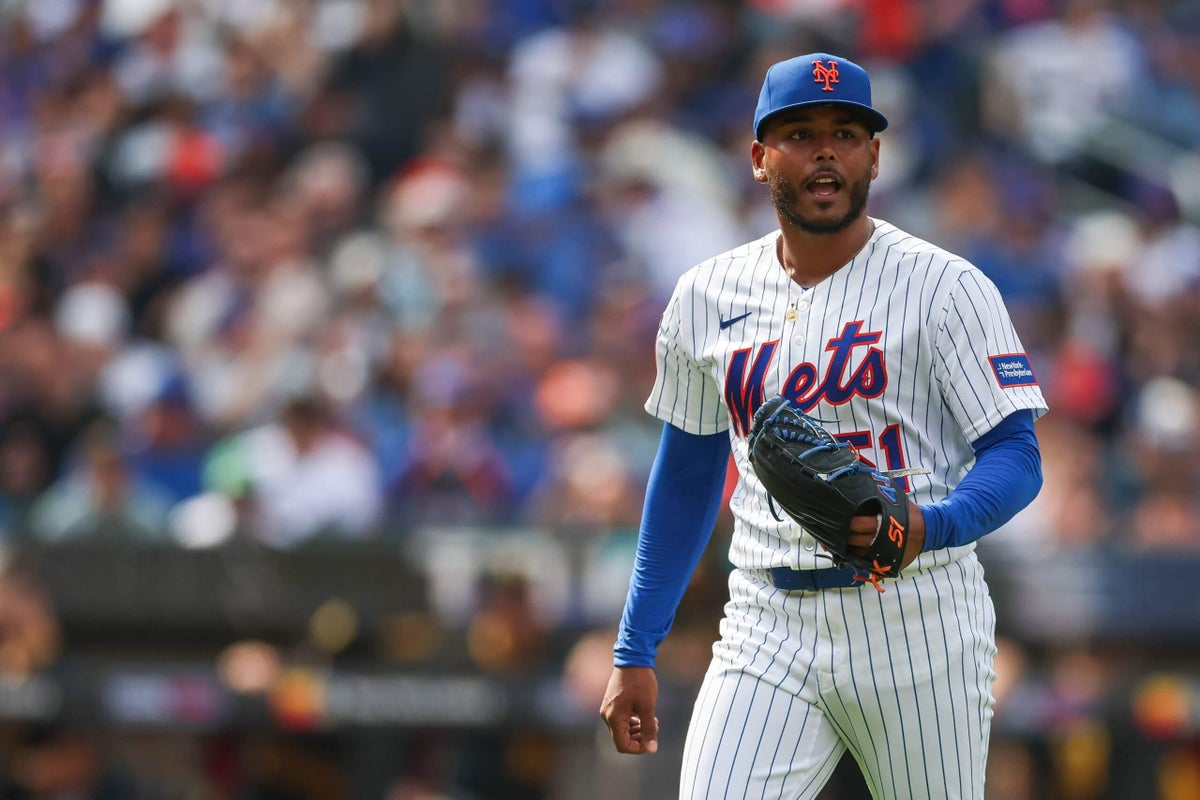
NEW YORK — Before taking a seat behind a microphone for a news conference Wednesday, the day before starting on Opening Day for the New York Mets, Freddy Peralta loudly told reporters in the room, “Hello, everybody!” Then he started smiling. He is seemingly always smiling. For the next dozen minutes, he answered every question in detail with one exception.
Asked directly about his extension negotiations and if he expects to be a free agent at the end of the season, Peralta said, “No comments about that.”
While Opening Day served as the starting line for Peralta with the Mets, it may have also represented the finish line for extension talks.
Initially hopeful for an extension, Peralta saying “No comments” on the eve of pitching five innings in the Mets’ 11-7 victory against the Pittsburgh Pirates on Thursday almost certainly was meant to signal it was time to eliminate the distraction of his contract situation.
It’s reasonable to conclude at this point that any contract negotiations between the sides have been tabled, likely until free agency after the season.
Peralta, 29, is lauded by players, coaches and club executives for his leadership. Manager Carlos Mendoza recently singled out Peralta’s positive presence as an important early development out of camp for a new-look group. Peralta likely prefers all the focus on the team.
It is hardly unheard of for a player to get extended midseason — starter Joe Musgrove and the San Diego Padres in August 2022 is one example — though many such deals get done before or around Opening Day. Extensions completed shortly after Opening Day are often the product of serious momentum built during spring training. It is believed that the Mets and Peralta had no such progress (the New York Post also reported Thursday that the two sides weren’t close).
Peralta’s agency, ACES, typically has not executed midseason extensions. The lone exception is Dustin Pedroia’s deal with the Boston Red Sox in July 2013.
On March 2, Peralta told The Athletic’s Ken Rosenthal that he preferred a long-term deal. Such a desire may not necessarily jibe with the Mets’ inclination under president of baseball operations David Stearns. After three offseasons with the Mets, Stearns has yet to sign a pitcher for more than three years.
Stearns has not embraced contract extensions with the Mets; he allowed Pete Alonso to reach free agency twice, as well as Edwin Díaz last winter, without substantive negotiations beforehand. Stearns wasn’t especially active on extensions in Milwaukee, where running a team in a smaller market makes them more pivotal to retaining talent over the long term.
The acquisition of Peralta in January figured to test Stearns and the Mets’ resolve when it comes to extensions. New York had surrendered two top-100 prospects in Jett Williams and Brandon Sproat to put Peralta at the top of their rotation. At the time of the trade, Peralta held interest in an extension; he enjoys New York City (where several family members live) and liked the idea of getting his contract situation ironed out ahead of a potential walk year.
If things are headed toward the Mets and Peralta revisiting talks in the offseason, then the likelihood of a resolution at that juncture also looks tricky.
Based on history, security matters to Peralta. In February 2020 (and while with a different agency), he agreed to an extension with the Brewers, who were under Stearns’ leadership. At the time, Peralta called it a “somewhat” easy decision; he wasn’t yet a full-time starter. Plenty has changed since, including Peralta making two All-Star teams, and yet he is making $8 million in 2026, a bargain salary relative to his production and peers.
After Dylan Cease received seven years from the Toronto Blue Jays in free agency over the winter, would it be crazy for Peralta to eye something similar? The idea of Peralta taking fewer years if it means securing a higher annual average value should not be ruled out. Either way, he is on track to present a fascinating test case for the Mets’ philosophies.
Peralta profiles as a pitcher worth banking on, a top executive from a different National League team said. He cares about winning. He takes care of his body. And, in a worst-case scenario down the road, a team could shorten him back up as a reliever, the NL official said, because it’s not as if he hasn’t worked effectively in such a role before.
Peralta’s season got off to a solid yet unexceptional start. Against the Pirates, he allowed four runs, including two home runs. He recorded seven strikeouts without issuing a walk. He threw 80 pitches. After a shaky first inning in which he surrendered a two-run home run and threw 19 pitches, Peralta settled in.
“Overall, I thought he was very good,” Mendoza said.
Peralta is capable of plenty more. As the Mets’ new ace, Peralta’s performance in 2026 was always going to play a huge role in the team’s success during a season in which New York is under significant pressure to win. Without an extension, his showing in 2026 would potentially carry serious weight for his career, too — whether he remains in New York or not.