
It’s been a crappy week for the largest warship ever built.
A raging fire in its laundry facilities and persistently clogged toilets have taken the $13 billion USS Ford aircraft carrier out of the Iran fight — and it could remain out of service for a year.
The massive, 1,106-foot-long vessel left the Red Sea last week and has been docked in Crete for repairs since Monday, far from the air and sea attack on Iran it had joined two weeks earlier.
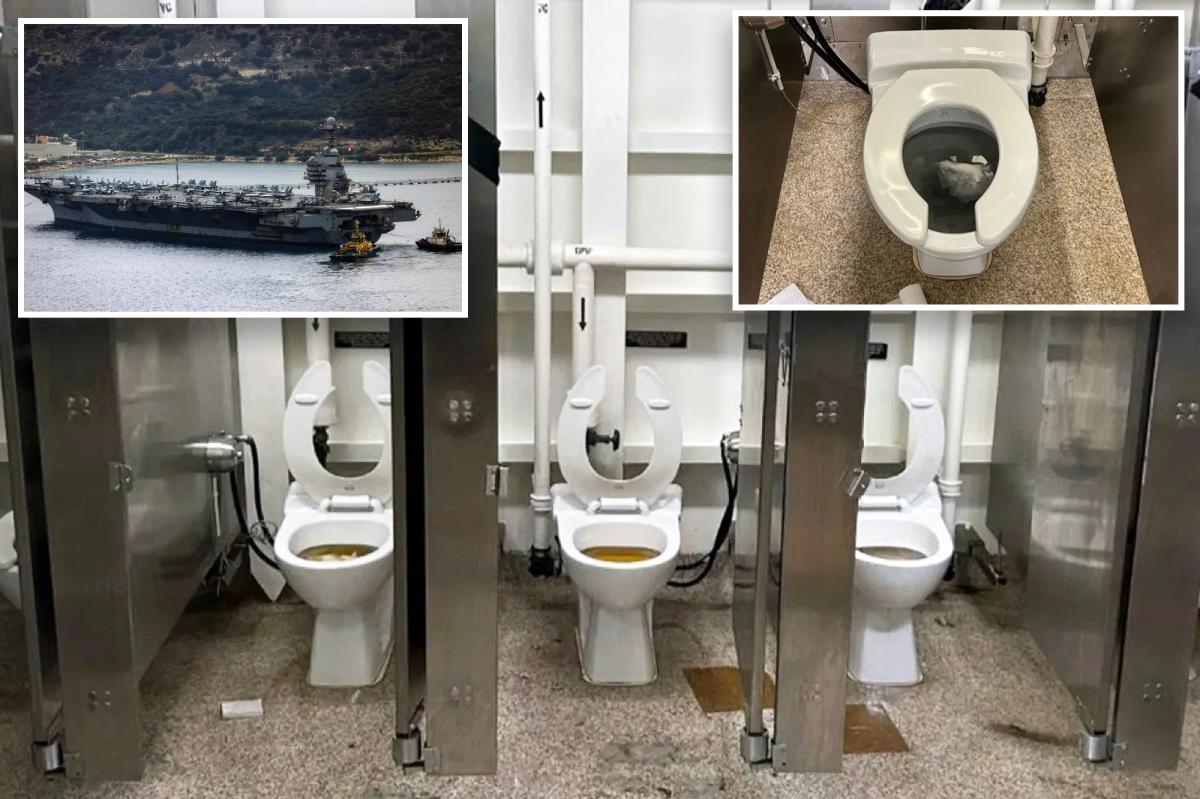
The USS Gerald R. Ford is getting repairs in Crete after sustaining damage during a fire. It has experienced a series of issues with its sanitation system. Anadolu via Getty Images
Damage to laundry facilities — essential on a floating city of nearly 4,500 sailors — is severe, lawmakers told The Post.
It got so bad that they were “taking helicopters to move their laundry to other ships so that it could be washed,” said Sen. Jack Reed (D-RI), the top Democrat on the Armed Services Committee.
Lawmakers said the March 12 fire impacted multiple berthing areas, an indication smoke may have coursed through the ship’s massive air circulation system, fouling linens and mattresses, and making areas virtually unusable.
“I’m told that there are 400 sailors that spent many days sleeping on the floor. It’s been at sea now for almost a year, so that is an incredible stress on the whole crew,” added Reed, a retired Army officer.
Fire isn’t the only element at issue — so is water.
The ship’s high-tech sanitation system has had problems since at least 2020, with routine clogs, pricey fixes, and a green design that has caused repeat maintenance problems costing at least $4 million.
The Navy has acknowledged clogs in the ship have caused difficulties. Obtained by the NY Post
“Those eco-friendly toilets are not pressurized in the same way — they don’t flush through,” naval expert Steve Wills told The Post.
The issues stem from its vacuum collection, holding and transfer (VCHT) system, borrowed from the cruise ship industry.
A General Accountability Office report from 2020 found it required “onerous” extra day-to-day maintenance to clean its narrow pipes, with each “acid flush” costing $400,000.
Poop deck: A system of eco-toilets on the first-in-class vessel have proved problematic. A 2020 Government Accountability Office report said it costs $400,000 to conduct each “acid flush” of the system. Obtained by the NY Post
“The Navy used a brand new toilet and sewage system . . . similar to what is on a commercial aircraft, but increased in scale for a crew of over 4,000 people,” the report said.
“Prioritizing environmentally-friendly systems over combat effectiveness is a big mistake,” said Bill Roggio, a senior fellow for the Foundation for Defense of Democracies.
Virginia Sen. Tim Kaine (D-Va.) wrote Navy Secretary John Phelan March 19 about the ship’s “persistent sewage system failures and inoperable laundry facilities,” saying he was “deeply concerned about the compounding mental and physical toll this long deployment and uncertainty is taking on our sailors.”
The vessel’s commanding officer, Capt. David Skarosi, said in February that some clogs “are the result of items being flushed that should not be introduced into the system” — raising the prospect that the crew’s action are partly to blame.
“It only takes one pissed off, angry sailor to potentially cause trouble,” he added, without accusing anyone of outright sabotage.
Aircraft carriers are powerful extensions of US force, and have been likened to floating cities and floating airports. Getty Images
The Navy’s 6th Fleet said the Ford will “undergo efficient assessment, repairs, and resupply,” and remains “fully mission capable,” but provided no timeline.
A probe into the fire is underway and lawmakers said investigators should also look at the impact posed by the ship’s extended nine-month deployment.
Sen. Mike Rounds (R-SD) said the repair stop would “give these guys a little bit of a break.”
The ship carries more than 75 aircraft and has seen plenty of action. It set sail from Norfolk in June, returned from the Mediterranean to take part in operations in the Caribbean, then was ordered back to the Middle East in February before the outbreak of the war with Iran.
“I’ve spent over seven months on an aircraft carrier. You get over six months and it’s a pretty stressful situation,” said Sen. Mark Kelly (D-Ariz.), a retired Navy captain and astronaut who flew dozens of missions during Operation Desert Storm. He said repairs could take a year.
“The aircraft carrier remains fully mission capable,” the Navy’s 6th Fleet said in a statement. Getty Images
“The Ford is the first of the class, so it’s a new design. . . . the fantail of the carrier looks like some significant damage,” he said of part of the ship’s stern. “It’s going to take some time to repair.”
Help is on the way. The USS George H.W. Bush Carrier Strike Group is heading toward the Mediterranean. There’s only one problem: it shares the same new toilet and sewage system as the Ford.