
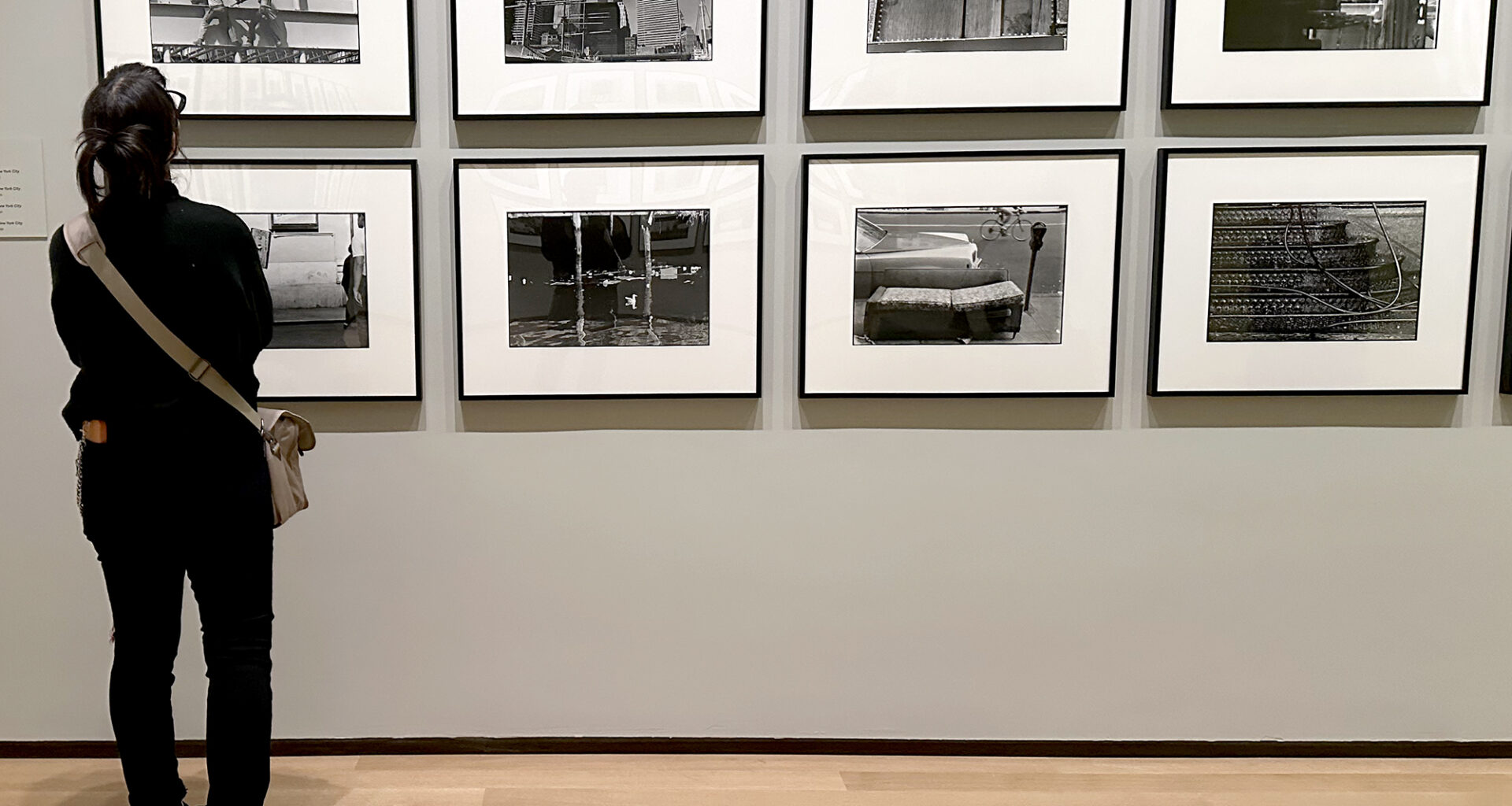
Photographs by Port Arthur artist are on display in the Museum of the City of New York exhibition “Rauschenberg’s New York: Pictures from the Real World.”
Photo by Andy Coughlan
A gallery shot from the Museum of the City of New York exhibition “Rauschenberg’s New York: Pictures from the Real World.”
Photo by Andy Coughlan
NEW YORK — Port Arthur native Robert Rauschenberg is a giant of American art in the 20th century. The artist, who died in 2008, would have turned 100 last October. Major galleries have been finding ways to honor his legacy.

Two major New York Museums are currently hosting exhibitions that examine his creative process. The Museum of the City of New York presents “Rauschenberg’s New York: Pictures from the Real World” through April 19.
Article continues below this ad
Rauschenberg was a keen photographer throughout his career and the show has collected New York-specific images from his early years in the city, and from his “In + Out City Limits” series taken between 1979 and 1981. The show also includes works that show how Rauschenberg incorporated the photos into his art.
RELATED: Dishman Art Museum exhibit draws on immigrant voices
The early works include portraits of his friends and collaborators, including the artist Jasper Johns and choreographer Merce Cunningham.They also included examples of Rauschenberg playing with composition.
In “Ceiling + Light Bulb” from 1951, Rauschenberg gives us an austere image of an unlit bare bulb and string against a dark ceiling. We see subtle marks in the dark shadows but it requires careful looking to see them. The bulb does not illuminate what is in the shadows so what is its purpose other than to be a piece of art? Rauschenberg saw the artistic in the mundane. It asks us to question what we see.
Article continues below this ad
“Untitled (Bathroom Window, Broadway Studio)” is another example of seeing the abstracted composition that most of us ignore. The glass is frosted or steamed up; drips of paint punctuate the flatness. There is a shadowy blurred figure in the other room. As in many of his works, Rauschenberg finds the natural frame to hold the image.
When his trusty Rolleicord camera was stolen, Rauschenberg abandoned photography for a while. At one point, he had thought that might be his creative outlet but he moved on although he build a career on found images that he would transfer to his work. He never abandoned the photograph in his art.
In 1979, Rauschenberg returned to an idea he had from his days at Black Mountain College to photograph the country inch by inch. Realizing that would be too time consuming, he developed the “In + Out City Limits” project which included photographs of Baltimore, Boston, Charleston, Fort Myers, Los Angeles and New York.
His New York photos stand out as they capture the city on a transitional moment as it began to move from the near-bankrupt squalor of the 1970s. Rauschenberg photographed the trash and discarded objects that littered the sidewalks, as well as the decay found in building facades. Once again, in the hands of an artist, the images reveal a beauty among the grime.
Article continues below this ad
Rauschenberg incorporates repeated images in his work. The image of the workers on a scaffold show up in at least two of the screen-printed works in the exhibition. WE see hydrants and windows and contrasting buildings.
It is interesting to see the choices Rauschenberg makes in his choice of photo. Remember, he was taking these photos in a pre-digital age. Whereas now one can whip out a phone and take hundreds of photos, he was using film and so the subject needed to be a more considered choice. Looking at his choices allows us to glimpse the artist’s creative process.
The exhibit features a short film where Rauschenberg talks about his work. We also see a glimpse of “Revolver II,” which features five rotating silkscreened plexiglass discs and a control pane. In the film, we see a moment where the transparent panels rotate for the first time and the look on Rauschenberg’s face is almost childlike with excitement. He pretends to faint and says to his assistant, Bryce Marden, simply, “My god. It’s getting better.” Here is a seasoned, critically acclaimed artist still finding joy in creation.
Just over a mile down Fifth Avenue, The Solomon R. Guggenheim museum is hosting its own show centered around its permanent holdings, “Robert Rauschenberg: Life Can’t Be Stopped.” It is a chance to see how Rauschenberg incorporates his own photos with magazine pages and other works to create his works.
Article continues below this ad
The show features the aforementioned “Revolver II” although we do not get to share in Rauschenberg’s pleasure in seeing it revolve. The central focus is “Barge,” from 1962-63, a 32-feet long silkscreen. The piece was created over 24 hours and is a monochromatic mélange of images that capture the spirit of the age.
Across the exhibition that spans Rauschenberg’s career, we see how he uses photos — both his own and from printed materials — to comment on the world. The Rauschenberg Foundation is embarking on a mission to identify all the images in the artist’s works — photos, texts, etc. It is a daunting task but also offers a fascinating glimpse into his vision.
Each new exhibition amplifies the creative influence that Port Arthur’s own casts over modern art. In another century, Rauschenberg will still be seen as defining artist.
Article continues below this ad
For more, visit mcny.org and guggenheim.org.