
Told by one of the 50 people in the courtroom.
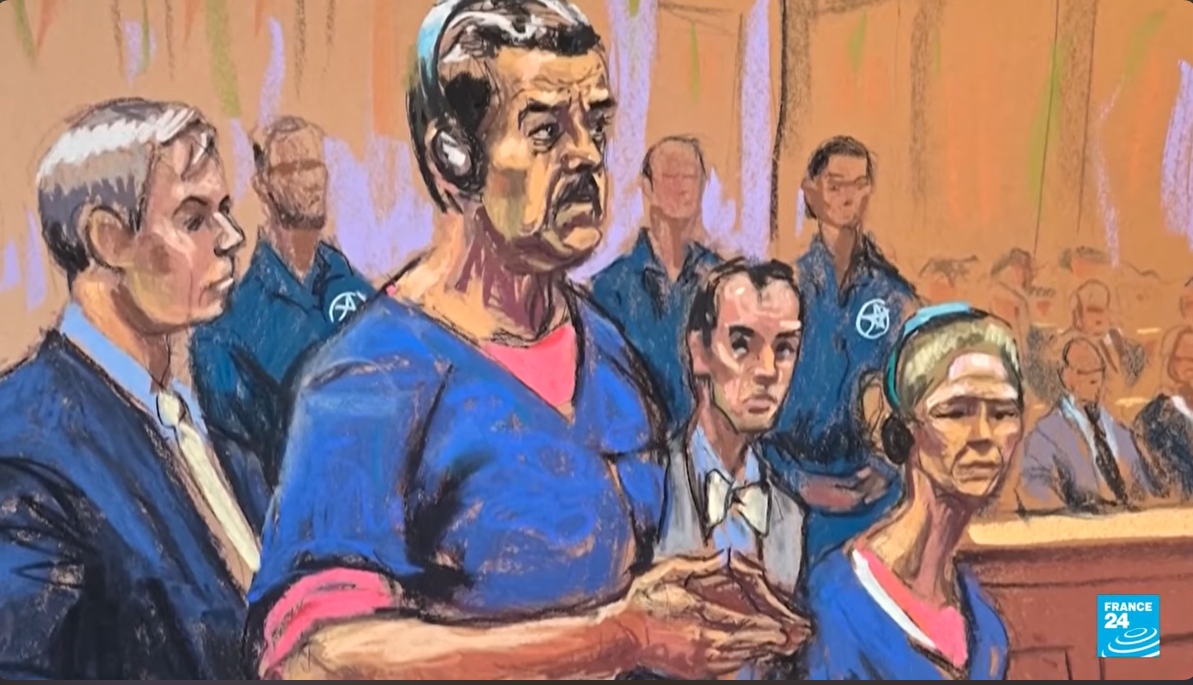
 Nicolas Maduro, Cilia Flores y sus abogados tuvieron su segundo audiencia el 26 de marzo de 2026. Screenshot: France 24
With shackles on her feet, Flores entered first without looking at the audience; then a silent Maduro who did search the room for a familiar face.
By Laura Weffer / Special correspondent (Efecto Cocuyo)
HAVANA TIMES – The moment Cilia Flores walked through the heavy wooden door on the left wing of courtroom A26 in the Southern District Court of New York, time seemed to stop for a fraction of a second. In unison, the audience waiting for the appearance of Nicolas Maduro and his wife held their breath. Surprise, tension, disbelief—a mix of everything.
As if in slow motion, Flores entered first at 11:42 a.m. With a weary gait, her feet shackled; she looked fragile, thinner than before. With a touch of makeup that influencers of eyeshadow, lipstick, and blush would likely describe as a “natural look.” Her hair was perfectly dyed blonde, straight, with no visible roots, and tied back in a ponytail with a brown scrunchie.
Once inside the courtroom, where her lawyers were waiting, she did not turn to look at the audience. She focused on the table set for the hearing that would mark a new chapter in this part of her life, which began on January 3, when she and her husband, Nicolas Maduro, were abducted by an elite US military group and brought to the United States, where they now face legal proceedings.
He is charged with narco-terrorism; she with conspiracy to traffic cocaine.
Both have pleaded not guilty.
Flores was dressed in a beige outfit, like those worn by nurses, and under the shirt she wore a long-sleeved, almost white gray undershirt. She barely managed a few sad smiles during the hour and eight minutes she was present at the hearing. As soon as she sat down, escorted by her defense attorney Mark E. Donnelly, she put on her simultaneous translation headphones. Everything was in English.
Maduro also had his feet shackled, but since his hands were free, he took the time to shake hands with each of his defense attorneys, led by Barry Pollack, as well as with the prosecutor handling the case against him.
From the podium to the defendant’s bench: the silence of a powerful man
Those who attended the first hearing described Maduro’s attitude as “confrontational” and “defiant.” When asked his name on that occasion, he immediately said, “Nicolas Maduro, president of Venezuela.”
But this Thursday, March 26, it was not like that.
Maduro has now spent more than two months at the Brooklyn Correctional Center. A person who was held there and spoke with Efecto Cocuyo says it is “bad, very bad,” that conditions are deplorable and the food is anything but appetizing.
That may explain Maduro’s evident weight loss. The orange T-shirt he wore under the beige uniform looked two sizes too big. His once chubby cheekbones were now sharply defined with a brownish shadow. His black hair showed some gray but kept the same style he has worn for years. The unmistakable mustache remained.
Although those distinctive features were still there, and anyone could recognize him as Nicolas Maduro Moros, something was missing.
He is no longer the man who danced on stage, nor the one who made a show of speaking broken English, much less the one who shouted at the top of his lungs against Donald Trump’s government. It is as if he has come to grasp the gravity of his situation.
A man stripped of noise.
The persona was of no use; what remained was an austere and grave presence, the expression of someone who understands that in these circumstances, time is measured in years, not applause.
During the hearing, Maduro sat with his back to the audience. Less than three meters from the journalists sat one of Venezuela’s most powerful men, showing the back of his neck as his gaze remained fixed on Judge Alvin Hellerstein, in whose hands his fate now lies.
He did not say a single word out loud. Nor was he asked to. He put on and took off his glasses to read, jotting down notes on what was being said in court. During a brief pause, he removed his headphones and ran his hands over his temples. Upon entering, he did scan the audience for a familiar face, someone he recognized—but found none. The row supposedly reserved for people close to Maduro and Flores was empty.
Maduro, are you going to pay my bill?
On several occasions during the hearing, both the defense, the prosecution, and the judge referred to how “unique” this case is. A head of state and his wife sanctioned by the US Treasury Department who claim they have no money to pay their lawyers’ hefty fees, while they fight to finally open the flow of funds that would cover the cost of this legal case.
In the end, three quarters of the entire hearing were devoted to this issue.
It was as if, on the bench, there was not a man accused of one of the most serious crimes under the US justice system; rather, what was really at stake was a discussion about settling a debt.
It was a transactional debate that ultimately boiled down to the most pragmatic question:
Maduro, are you going to pay me or not?
The fact that they are sanctioned makes the flow of money difficult and, therefore, the Venezuelan government’s payment to the lawyers as well. Judge Hellerstein cannot quite understand why the sanctions persist if relations between Venezuela and the United States are supposedly already normalized, while defense attorneys question why US taxpayers should have to cover the cost of the defense.
However, they must tread carefully here, because the argument for releasing the funds and lifting sanctions is that the defendants supposedly do not have enough personal funds to pay for their defense.
One curious detail is that prosecutor Kyle Wirshba—a young man with a beard and glasses—insisted on referring to the funds used for this purpose as “tainted money,” meaning money that is stained or has an illegitimate origin.
But there is nothing to worry about, he said, because since the trial began, Venezuela has received 18 billion dollars in “untainted money”—that is, money without such issues.
So far, the official figure from Delcy Rodríguez’s government is 300 million dollars.
The judge asked Pollack what he suggested to resolve this problem. Pollack replied with what was meant to be a joke: dismiss the case. But Hellerstein did not find it amusing and immediately ruled it out.
Another point of discord between the defense and the prosecution was how they referred to Maduro and Flores. While their defense attorneys addressed them as president and first lady, the prosecution identified them simply as “individuals.” In the end, the judge admonished the defense attorneys, stating that no titles of any kind are accepted in that court.
In the other two parts of the hearing, the issue of protecting case files was discussed so that certain involved individuals would not have access, for fear that doing so could reveal the identities of informants who contributed to the reports, putting their safety at risk.
On these two points, the judge said he needed to review them and would not make a decision yet.
No date set for the next hearing
The third issue concerned Cilia Flores’s health. According to her attorney, she suffers from a heart condition that requires a medical examination.
With that request, the hearing was adjourned.
The judge left first, and then Maduro and Cilia exited through the same door they had entered, but not before personally saying goodbye to their legal team.
At 12:50 p.m., the second legal session against Nicolas Maduro and Cilia Flores concluded.
A few minutes later, in the brightly lit courtroom, only the chairs, desks, and—through the windows—the typical New York skyline remained, with its skyscrapers defying gravity.
The couple had their farewell in a waiting room without an audience. No date has been set for the next hearing.
In the meantime, they will remain in jail.
By the way, before entering the hearing, attorney Pollack was approached by a few journalists asking him to confirm whether it was true that Maduro shouted at night from his cell. He neither confirmed nor denied it, limiting himself to saying: “I’m not there at night, but I wouldn’t spend much time thinking about it either.”
First published in Spanish by Efecto Cocuyo and translated and posted in English by Havana Times.