
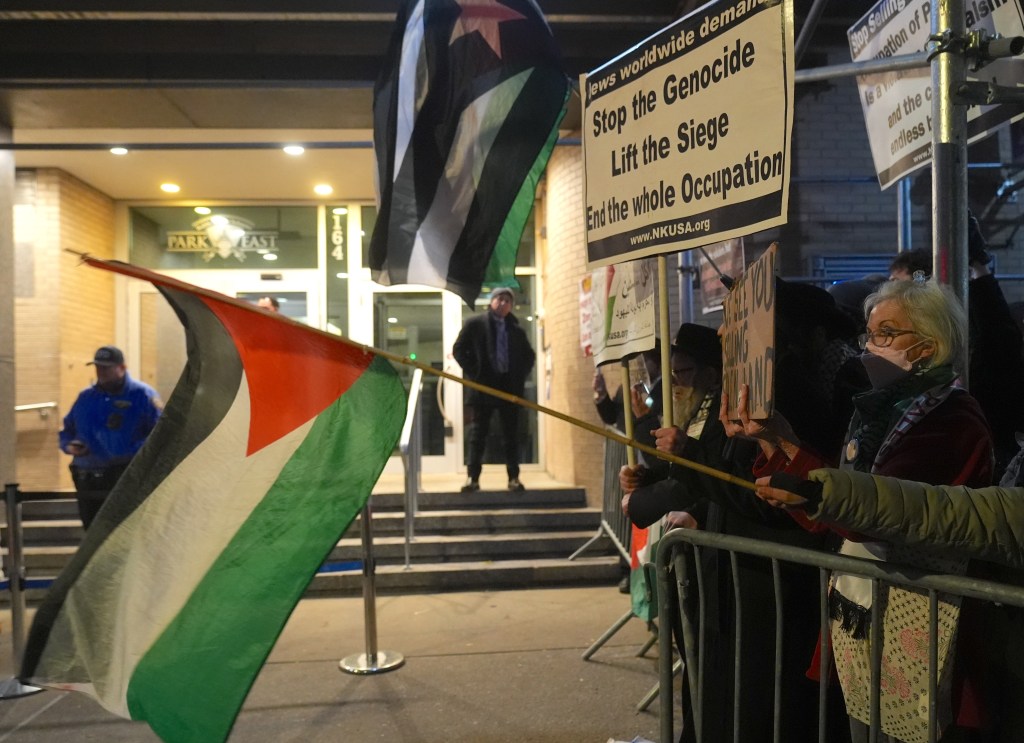
“Globalize the intifada!” “Resistance, you make us proud, take another settler out!” “We need to make them scared!”
These were the chants I heard as I made my way through a crowd of hundreds of protesters outside Manhattan’s Park East Synagogue on Nov. 19, 2025.
I had come to attend an information session about moving to Israel because my fiancé is Israeli and I wanted to better understand what that future might look like. Instead, I pushed through a volatile crowd of protesters. Only a handful of police officers attempted to control the scene.
Last week, the New York City Council passed a “buffer zone” bill designed to protect houses of worship from aggressive protests. It is a meaningful and necessary step. But legislation alone cannot address the deeper reality confronting many Jewish Americans: antisemitism is reshaping how we live, where we feel safe, and whether we see a future for themselves in this country.
When I finally got to the front of the crowd, I told an officer I was trying to attend the event.
“Let me see your ID,” he said, overwhelmed. He glanced quickly at my New York State ID — he didn’t check it against a list — and waved me through.
I hurried into the synagogue and realized I hadn’t gone through a metal detector. If someone with dangerous intentions had wanted to enter, they could have done so easily.
I went into the bathroom and, unnerved, started to cry. The chants and drumbeats echoed through the walls. I called my fiancé, shaking.
Downstairs, about 150 attendees had gathered in the basement to learn about moving to Israel. Sitting in the dark basement, I couldn’t help but think of the ships that carried Jewish immigrants to America.
My Eastern European great-grandparents met in Palestine in the 1920s but chose New York, believing America offered a safer future. What would they think of their great-granddaughter considering moving to Israel? Had my family’s American dream failed?
As I left that night, I watched an elderly Jewish couple ahead of me. The wife quietly told her husband to hide his kippah under his hat.
That moment has stayed with me because it represents a broader shift among American Jews — a move towards fear and hiding.
In my work at the Jewish Community Relations Council of New York, I see Jews struggling with antisemitism daily. I’ve met a business owner forced to partially shut down her restaurant due to antisemitic harassment, and a teacher chased by students for supporting Israel. These are not isolated incidents, but part of a larger pattern.
Data reflects this shift. According to the FBI, Jews account for nearly 70% of religion-based hate crime victims in the United States, despite making up about 2% of the population. In New York City, antisemitic incidents made up more than half of all reported hate crimes in 2025, according to NYPD data.
A recent survey by the American Jewish Committee found that 91% of American Jews say they feel less safe in the United States because of rising antisemitism. More than half reported hiding or downplaying their identity.
In 2025, Jewish organizations received more than $100 million in federal funding to address rising security threats. Many American Jews hide our identities in order to feel safe. Most synagogues now have security guards or are looking to hire one.
My great-grandparents came to America believing Jews could live openly and safely. I never wanted to consider moving to Israel out of fear.
Yet here we are.
Kaden, a former Fulbright journalism scholar, is manager of social media and communications at the Jewish Community Relations Council of New York.