
A New York appeals court rejected Yeshiva University’s second attempt to dismiss a sexual abuse lawsuit being brought by former students of Yeshiva University High School for Boys (YUHSB) on Jan. 15. The ruling affirmed an April 8, 2024, decision by Justice Alexander M. Tisch of State Supreme Court in Manhattan.
The lawsuit, filed under New York’s Child Victims Act (CVA), was brought by former students of YUHSB, also known as Marsha Stern Talmudical Academy (MTA). The plaintiffs say they were sexually and physically abused over decades, from the 1950s through 1986, by school employees including the former principal George Finkelstein, faculty member Macy Gordon and dorm counselor Richard Andron, and that school officials knew of allegations of abuse and failed to stop it.
“We respectfully disagree with the ruling and intend to appeal it to the New York State Court of Appeals,” a YU spokesman told The Commentator. “At the same time, we will continue to seek resolutions with the few remaining plaintiffs.”
In September 2024, nine former students reached confidential settlements with YU. The suit had at one point included more than 40 former students. Menachem Twersky, the lead plaintiff in the case, told The Commentator he did not know the exact number of remaining plaintiffs but estimated that about a dozen survivors are still involved.
Justice Tisch’s 2024 ruling allowed the case to continue against YU, MTA, the estate of Rabbi Norman Lamm, YU’s former president and Rabbi Robert Hirt, a former senior administrator. He dismissed claims against individual board members, finding that they were protected from personal liability under New York law.
On appeal, YU, MTA, the Lamm estate and Hirt argued that the case should be dismissed on constitutional and procedural grounds, including a claim that earlier federal rulings in the university’s favor created “vested rights” that could not be undone by later legislation. The Appellate Division, First Department, rejected that argument and upheld the lower court’s decision.
Twersky told The Commentator that the ruling makes clear that prior dismissals based on statutes of limitations do not create a constitutionally protected vested right that would prevent claims from later being revived under the Child Victims Act.
“The decision is significant because it squarely rejects the argument that defendants can rely on earlier time-bar dismissals to permanently avoid litigation,” he said.
“It also adds to the developing body of precedent interpreting the CVA, and is likely to be cited in other cases in New York, and potentially beyond, where similar arguments are raised,” he added.
The allegations first surfaced in federal court more than a decade ago. Earlier lawsuits filed by former students were dismissed after judges found that the claims were barred by the statute of limitations then in effect. In 2019, New York enacted the Child Victims Act, which created a revival window for older claims that had previously expired and extended the age limit for many civil claims involving childhood sexual abuse to 55.
The current state-court action was filed after that law took effect. Discovery—the part of a civil lawsuit in which parties are permitted to demand relevant evidence from each other before going to trial—in the case has already been underway for some time, according to Twersky. He said depositions of witnesses began in 2024, and depositions of plaintiffs followed in 2025.
A major dispute now centers on materials related to Sullivan & Cromwell, the law firm YU commissioned in 2013 to conduct an internal investigation into abuse allegations at YU and prepare a report. The report concluded that multiple incidents of sexual and physical abuse had been carried out by several people in positions of authority at MTA, including after members of the administration had been made aware of it.
On Aug. 1, 2025, Tisch ordered that materials from the Sullivan & Cromwell investigation be produced as part of discovery. The order required certain records, including interview notes and memoranda, to be submitted to the judge for private review to determine whether they are protected by privilege. It also ordered YU to turn over a database of collected digital documents and scanned records that had been provided to the law firm for its investigation.
In a Dec. 23, 2025 amended order, Tisch denied YU’s effort to revisit that ruling and refused to stay the process pending appeal. He also kept in place production of the database, which the court said contained an estimated 3.5 million documents.
Twersky said the court has established two separate processes: one for the production and review of a large database of records, and another for materials generated as part of the Sullivan & Cromwell investigation, including interview notes, memoranda and related records.
Those Sullivan & Cromwell materials are being submitted for “in camera review,” meaning the judge will decide privately whether they are protected by privilege, Twersky said.
The December order also appointed Special Referee Molly Sanghee Lundberg as Special Master to oversee the database review process. Twersky said she is working with the parties to establish protocols for searching, reviewing and producing materials from the database.
According to Twersky, YU is appealing both the vested-rights ruling and the order requiring it to turn over those records. He said the appointment of a Special Master did not begin discovery, but instead governs “a significant phase of it—specifically, the production and review of a large volume of documents.”
The next meeting with the Special Referee is expected this week, he told The Commentator..
“Perhaps we will soon know if we’ve been granted access to YU documents, and how many,” he said.
Twersky also told The Commentator that two senior YU officials were subpoenaed and are expected to testify in the coming weeks. He declined to identify them, but said that, “as with prior depositions of YU officials,” they would likely be asked what they knew about the alleged abuse, when they knew it and what, if anything, they did in response.
The Commentator reached out to Kevin T. Mulhearn, who is listed as counsel for respondents in the Jan. 15 appellate decision and had previously spoken with The Commentator about efforts to obtain internal university records related to the Sullivan & Cromwell materials. The Commentator was told that Mulhearn is no longer operating in New York State.
In the appeal, YU, MTA and the Lamm estate were represented by lawyers from Pillsbury Winthrop Shaw Pittman LLP, while Hirt was represented separately by lawyers from Seyfarth Shaw.
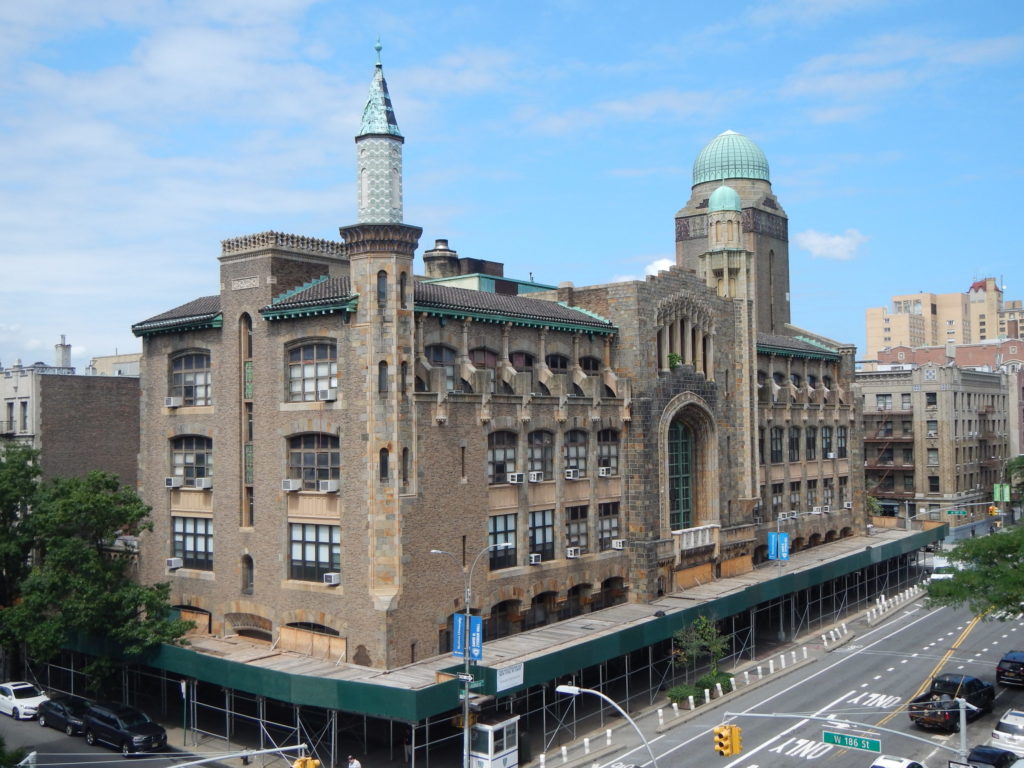
Photo Caption: Yeshiva University Zysman Hall
Photo Credit: Wikimedia Commons