

Destination marketing organisation New York City Tourism + Conventions has released its 2025 Annual Report regarding tourism in New York City. Data show that both tourist numbers and spending went up compared with 2024, proving the city’s resilience in a difficult market.
In 2025, the U.S. tourism sector went through some hard times. Industry stakeholders blamed President Donald Trump’s policies – including trade tariffs and tourist detentions at the U.S. border – for a decline in foreign tourism arrivals, causing many to adapt their growth projections. European and Canadian tourists in particular, were less likely to visit the U.S.
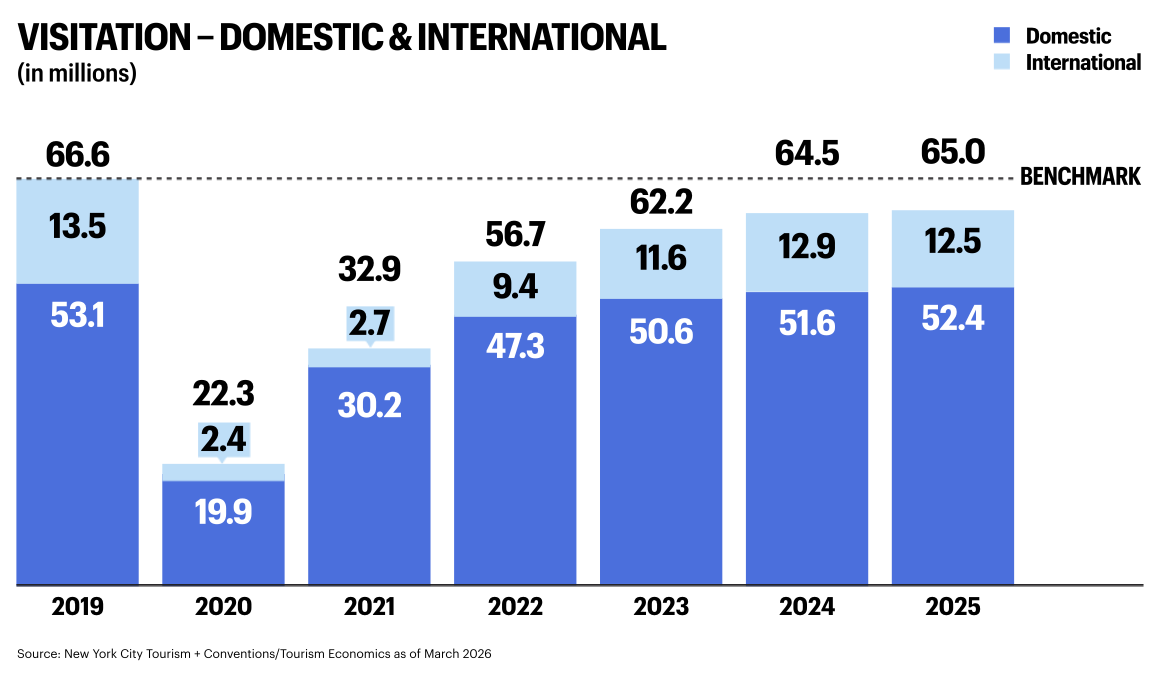
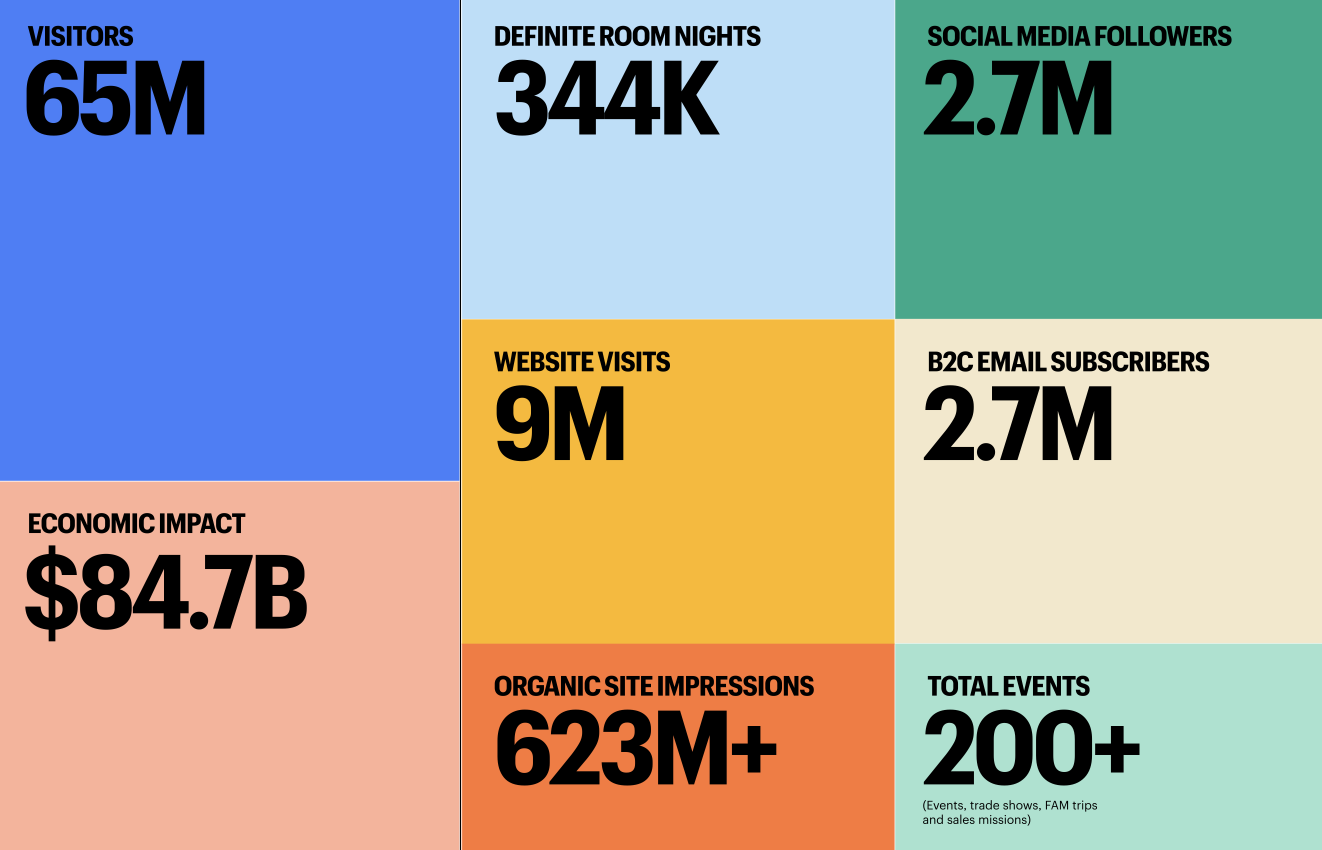
However, the New York City Tourism + Conventions 2025 Annual Report shows how New York City has proven remarkably resilient in such a difficult tourism market. The city’s total visitation grew modestly to 65 million visitors (up 0.7% over 2024) and generated $84.7 billion in total economic impact.
“In 2025, New York City’s tourism economy proved resilient despite global challenges, underscoring the enduring appeal of the five boroughs. The international visitor market is crucial to our economy, accounting for 50% of tourism spending. Despite international declines, we saw growth across all our economic impact metrics: total direct visitor spending was more than $55 billion, which generated nearly $85 billion in economic impact for our city, flowing into hotels, restaurants, cultural institutions, retail and small businesses across all five boroughs. The impact of the tourism industry remains critical to the entire city,” said Julie Coker, President and CEO of New York City Tourism + Conventions.
 Julie Cooker © Matthew Papa | New York City Tourism + Conventions
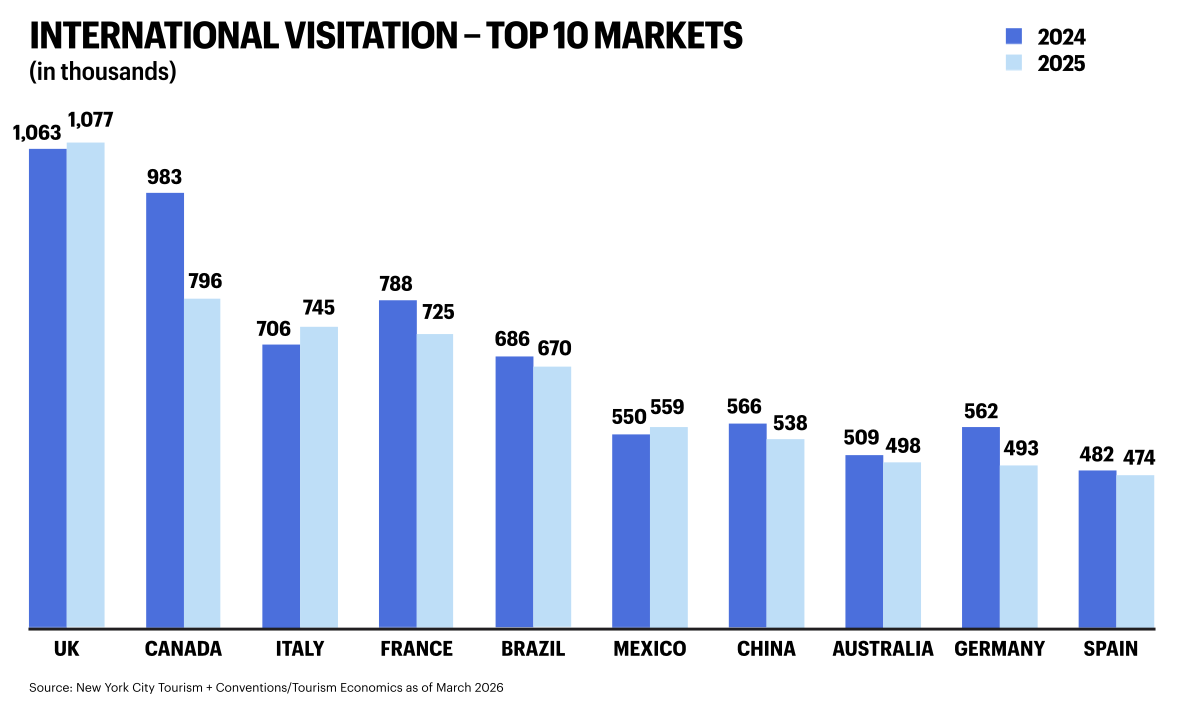
Overall, total visitation grew to 65 million visitors, up 0.7% over 2024. As was to be expected given the nationwide trend, the number of international tourists in NYC declined slightly in 2025, although the decline was smaller than previously forecasted. The city welcomed 12.5 million international visitors, down 3.2% from 2024. Moreover, visitation increased year over year from the UK (1.3%), Italy (5.5%), and Mexico (1.8%).
 © New York City Tourism + Conventions
Domestic travel, however, remained strong. 52.4 million U.S. visitors went to New York City, up 1.7% over 2024. The top five feeder markets included the New York City tristate area, Philadelphia, Washington DC, Los Angeles, and Boston. Overnight trips were up 2.3% over 2024.
While leisure travel accounted for 52.4 million visitors (99% of New York City’s peak levels in 2019), business travel amounted to 12.6 million visitors, which is still slightly behind record 2019 levels.
 © New York City Tourism + Conventions
“New York City’s domestic visitor market saw accelerated growth in 2025, as domestic travel remains the backbone of the tourism industry nationwide. Next year, we expect domestic travel to surpass record 2019 levels, signalling a major milestone and emphasizing the strength of our regional drive markets. The domestic market accounts for 80% of our visitation, and overnight trips now account for 51% of this segment, contributing to New York City’s position as first in hotel occupancy in the US market,” said Charles Flateman, Board Chair of New York City Tourism + Conventions and Executive Vice President of The Shubert Organization.
All in all, leisure and business travel combined generated $84.7 billion in total economic impact in New York City in 2025. This includes $55.6 billion in direct spending and $7.5 billion in local and state taxes. According to New York City Tourism + Conventions, the sector accounts for 397,000 jobs.
 © New York City Tourism + Conventions
What will the future bring?
As for 2026, New York City is projecting to receive 66.3 million visitors, which would mean a 2% increase compared to 2025. Domestic travel should increase to 53.4 million visitors, thus surpassing the record 2019 levels. Moreover, international travel is expected to rebound, hitting 12.9 million yearly visitors. Growth is projected from all of New York City’s top 20 international markets. The FIFA World Cup 26™ games are expected to attract some 1.2 million visitors to the region, which would generate $3.3 billion in economic impact, including $1.8 billion in direct spending.