
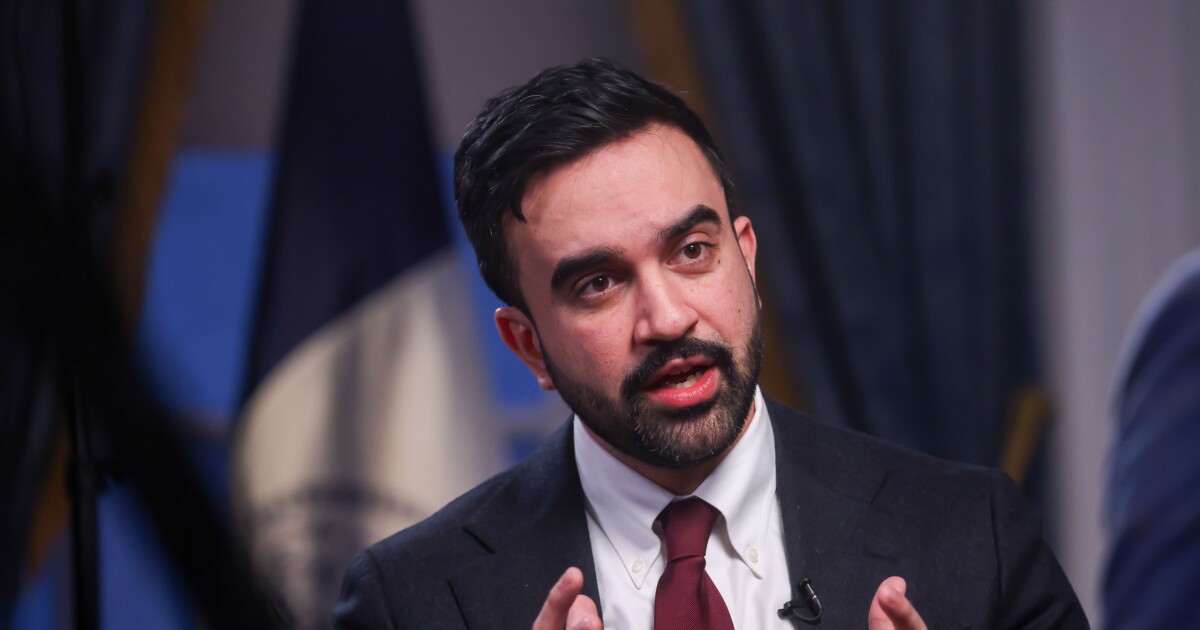
 New York Mayor Zohran Mamdani is trying to address a budget gap left by his predecessors.
Bloomberg News
Last week’s $2.3 billion New York City bond sale — the first big deal since Mayor Zohran Mamdani took office — could be viewed as a test of the market’s confidence in the mayor.
Processing Content
But the week was so busy that it’s hard to tell what led to the final result, downsized a bit from initial plans.
Investors had to consider the city’s multibillion-dollar budget gap, Mamdani’s approach to fixing the budget, and the negative outlooks three out of the city’s four rating agencies assigned to the city in the weeks leading up to the deal. On top of all that, the muni market had a selloff.
The general obligation bond deal was downsized by $300 million. But the outcome was overall a sign of strength, according to city Comptroller Mark Levine.
Wednesday’s “sale and the steady demand for the city’s municipal bonds in the face of market volatility is a clear signal of confidence from investors who know that our credit is strong,” Levine said in a statement to Bloomberg News.
John Hallacy, of John Hallacy Consulting, said the negative outlooks and the budget gap itself likely had little impact on the deal because the factors that led to the budget gap are long-standing and well-known. He attributed most of the deal’s performance to movements in the broader market.
“A the margins, the outlooks may have had some effect too, but it’s not really pronounced,” Hallacy said.
“I would say this is a good result,” Hallacy said. “I don’t think it’s indicating any particular clear pattern here, in terms of reflecting concerns” about the budget.
The first tranche, Series 2026 F-1, included $911.02 million of tax-exempts; the city originally planned to sell $1.27 billion of the series. The rates for the bonds ranged from 5s of 8/2029 at 2.78% to 5s of 2036 at 3.59%, callable 8/1/2036.
Series 2026 F-2, $419.56 million of taxables, saw all bonds priced at par: 4.124s of 8/2026 and 4.324s of 2028. Series 2026 G, $900 million of tax-exempts, saw rates ranging from 5s of 2/2028 at 2.63% to 5.25s of 2053 at 4.83%, callable 8/1/2036.
BofA Securities was the bookrunning lead manager of the deal, with Jefferies and Ramirez as co-senior managers and 22 co-managers. The bond counsels were Bryant Rabbino and Norton Rose Fulbright, with Orrick as co-disclosure counsel. Frasca & Associates and PRAG served as co-financial advisors.
The deal was rated Aa2 with a negative outlook by Moody’s Ratings, AA with a stable outlook by S&P Global Ratings, AA with a negative outlook by Fitch Ratings, and AA-plus with a negative outlook by KBRA.
According to Bloomberg News, the city’s borrowing penalty was higher than a similar sale last year, but some yields came in tighter than initial pricing.
The deal priced as the market continued to react to the war in the Middle East. On Tuesday, the retail order period, there was a selloff in the muni market. On Wednesday, munis were mixed as the institutional pricing took place.
Moody’s was the first agency to assign a negative outlook to the city, on March 11, and Fitch and KBRA added theirs the week before the deal priced. Each of the agencies attributed the outlook to the city’s sizable budget gap and Mamdani’s plans to address it.
KBRA analyst Linda Vanderperre agreed that New York’s reputation likely impacted the reaction to the negative outlooks.
“New York City is a credit that I think is very well known, very well understood, and very strongly in the double-A category,” Vanderperre said. “People are not as immediately concerned as perhaps they might have been with Chicago, when rating actions were taken on that credit.”
Chicago GO bonds are rated in the triple-B tier.
New York’s budget dilemma grew out of the city’s decades-long habit of underbudgeting for certain expenses, said Ana Champeny of the Citizens Budget Commission. Over the last four years, though, more and more of the budget was unaccounted for, and certain expenses, like housing voucher program CityFHEPS, grew at a rapid pace.
When Mamdani and Levine took office, they were faced with a more than $10 billion budget gap for fiscal 2026 and 2027. Mamdani ended the underbudgeting in his executive budget and has proposed tax hikes to fill the gap, along with includes cost-saving measures, some one-time sources of revenue, and spending the city’s reserves.
The budget gap and Mamdani’s proposed solution were cause for concern, according to Fitch’s Kevin Dolan.
“The fiscal ’27 budget shows a widening imbalance by several billion dollars compared to the prior November ’25 plan, and relies on a large property tax increase,” Dolan said.
The mayor advocated to raise taxes on corporations and high earners, presenting a property tax hike as a last resort; but raising those taxes would require state approval. That level of reliance on the state government increases uncertainty, KBRA’s Douglas Kilcommons said.
Mamdani’s plan also employs an optimistic revenue forecast, Vanderperre said.
KBRA’s outlook change was partly influenced by governance factors, Vanderperre said; although she commended Mamdani’s transparency, it’s a very different approach from his predecessor, Eric Adams.
“We were comfortable with the city’s historic method of budgeting,” Vanderperre said.
Hallacy said investors are likely waiting until farther along in the budgeting process to factor any concerns into their investments — although a tax hike that damages investor confidence in the city could still have an upside.
“The irony in muniland is always, if you get a tax increase, chances are there’s even more demand for the municipal.”
“It seems to me like the deal went really well,” AllianceBernstein analyst Richard Schwam told Bloomberg News. He added that the downsizing helped the city’s rates. “It seemed like it was business as usual for them, which was impressive given the size of the deal and given the negative rating revisions that they just had from Moody’s, Fitch and Kroll.”