
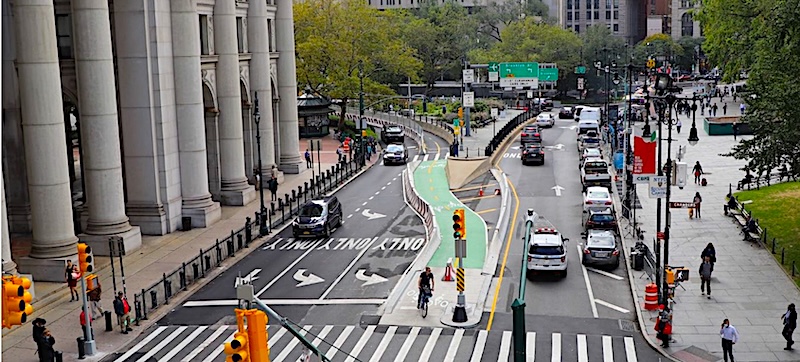
Streamlined Approach to Brooklyn Bridge Promised to Cyclists
Mayor Zohran Mamdani announced on Friday that long-stalled plans for an improved bicycle approach to the Manhattan end of Brooklyn Bridge will be completed before the start of the World Cup soccer match, which comes to the New York area on June 13 and continues through mid-July.
Nearly 30,000 pedestrians and more than 5,600 cyclists use the Brooklyn Bridge on an average day, according to the City’s Department of Transportation. While the existing path to the bridge from Centre Street is largely seamless, the approach from Park Row (just south of Chambers Street) is a virtual obstacle course, forcing cyclists to make a near u-turn onto the pedestrian plaza, briefly mix with walkers, and then exit the plaza for access to the bike lane.
The plan to improve this situation consists of eliminating one lane from the southbound side of Centre Street, south of Chambers. This left lane will be turned into a protected, two-way bike path serving cyclists leaving the bridge and heading south, as well as those approaching the span from Downtown, who will have a more direct connection to the ramp. While the sharp switchback turn will remain, the route will be simplified and cyclists will no longer compete for space with pedestrians.
That block of Centre Street will be left with a single, southbound traffic lane serving drivers who plan to turn left onto the bridge, along with those continuing further into Lower Manhattan. As part of the project, DOT plans to double the width of the crosswalk between the Brooklyn Bridge and City Hall Park, creating additional space for pedestrians.
“This new design will better protect cyclists and pedestrians as we prepare to welcome the world for the FIFA World Cup,” Mayor Mamdani said, “and show that our streets truly reflect the best of New York City.”
“I cycle in this area almost daily, so I know firsthand how crowded and chaotic the Manhattan entrance can be,” City Council member Chris Marte said. “For too long, pedestrians and cyclists have been forced into the same congested space at one of the busiest points in Lower Manhattan. This redesign is a commonsense step that will finally create safer, clearer access to the bridge and make it easier for the thousands of people who rely on it every day.”
DOT first announced this plan in 2024, and originally scheduled it for completion by the end of last year. In September 2024, Community Board 1 enacted a resolution supporting the plan, while also asking for additional elements that were not included in the DOT proposal, such police traffic enforcement to ease backups during the first months of the new configuration, along with pedestrian managers to guide both cyclists and walkers out of each other’s way. None of these additional elements were included in City Hall’s announcement.
The Mamdani administration added that the upgraded Brooklyn Bridge approach will be accompanied by improvements that will better connect Lower Manhattan to Union Square, including upgrading cycling infrastructure along Lafayette Street and widening sidewalks near Union Square. The announcement added that, “most upgrades are expected to be announced and installed this spring.”