
Black Music Sunday is a weekly series highlighting all things Black music, with over 300 stories covering performers, genres, history, and more, each featuring its own vibrant soundtrack. I hope you’ll find some familiar tunes and perhaps an introduction to something new.
As Women’s History Month draws to a close I thought I’d feature Pearl Bailey, a star of both stage and screen. I covered her along with other early Black queens of stage and screen back in 2022 to kick off Women’s History Month, but she deserves her flowers in a standalone story.
Bailey’s Musician Guide biography written by Anne Janette Johnson starts her story:
Pearl Mae Bailey was born in the small town of Newport News, Virginia, in 1918. Her father was an evangelical minister, and from her earliest years she sang and danced during his church services. When she was only four her parents divorced, and she moved with her two sisters and brother, first to Washington, D.C. and then to Philadelphia, Pennsylvania.
It was in Philadelphia, during her teens, that Bailey was introduced to show business. Her brother was a professional tap dancer who often worked at the city’s Pearl Theatre. One night when he was late returning home for dinner, she went down to get him and wound up entered in an amateur-night contest. She sang “Poor Butterfly” and won first prize–five dollars and a two-week engagement at the theater. Unfortunately, the theater had hit hard times, and it closed before Bailey could be paid for her services. She was undaunted, however; the brief experience on stage convinced her that it was the only career for her.
Bailey entered and won another amateur contest, this time at the renowned Apollo Theatre in New York City. Soon thereafter she set out on a club circuit that took her through the rough-and-tumble coal mining towns of central Pennsylvania. For 15 dollars a week she sang in Scranton, Wilkes-Barre, and Pottsville before graduating to larger venues in Washington, D.C. and Baltimore. The onset of World War II found her touring the country with a U.S.O. (United Service Organizations) troupe, entertaining stateside U.S. servicemen.
Cassandra Waggoner continues her story at Black Past:
After the war ended Bailey moved to New York. She continued to perform in nightclubs but she also garnered a recording contract and now went on tour to promote her music. Her 1952 recording, “Takes Two to Tango,” was one of the top songs of the year. In 1946 Bailey made her Broadway debut in St. Louis Woman where she played the role of Hagar in a cast that also included Mahalia Jackson, Eartha Kitt and Nat King Cole. Although Bailey performed on stage she still performed in concert tours. On November 9, 1952, Bailey married jazz drummer Louie Bellson in London.
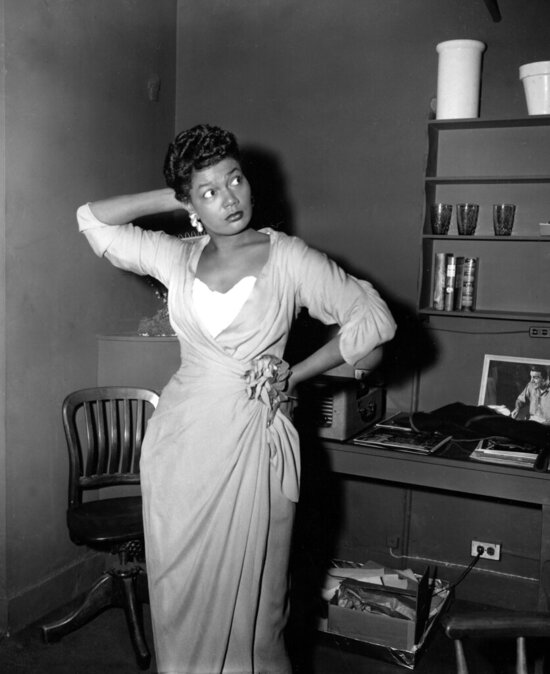
Actress-singer Pearl Bailey is shown in her dressing room at New York City’s Alvin Theatre where she starred in the musical “House of Flowers” on Feb. 3, 1955.
In 1954 Bailey made her film debut as a supporting actress in Carmen Jones. Playing the character, Frankie, she was most remembered for her rendition of “Beat Out That Rhythm on the Drum. Bailey also starred in the Broadway musical House of Flowers in 1954. By 1959 she was considered a leading African American actor and starred in films such as Porgy and Bess with Sidney Poitier and Dorothy Dandridge.
[…]
After the war Bailey became a headliner in her own right. She was working at the Village Vanguard in New York City in 1944, when the owner suggested she loosen up and be herself onstage. That advice helped her to create a signature style–easy and personal, with throwaway lines and jokes added between and during songs. McLellan wrote: “The public image projected through Bailey’s songs was less earth mother than earthy. Her voice had a pleasant tone, an impressive clarity and a way of projecting words with exquisite care. She had a special way of styling a song, with a flavor of jazz and often some worldly wise aside on the music’s sentiment.” The critic added: “Bailey inherited a special tradition of earthy, sexually aware singing from such pioneers as [American blues singers] Ma Rainey and Billie Holiday, tidied it up a bit for general consumption and won an enthusiastic following in nightclubs.”
Here’s a 30-minute YouTube biography from Shakeera about Bailey’s life, politics and career:
Mentioned in the bio is her album, “The Intoxicating Pearl Bailey.” Here’s one track from the album:
The Onyx Queen Channel celebrates the lives of Black women. Here’s their take:
You can read about Bailey in her own words in several autobiographies. She wrote “The Raw Pearl,” “Talking to Myself,” and “Between You and Me: A Heartfelt Memoir on Learning, Loving, and Living.”
“Hurry Up America and Spit” expresses her message to the American people.
Here are a few of her famous duets:, starting with Dinah Shore:
Here is Bailey with the amazing Ethel Waters:
Here she is with Nat King Cole:
And finally, with Carol Channing:
Here are three greats performing together: Pearl Bailey, Sarah Vaughan, and Ella Fitzgerald.
Bailey was captured in an abstract portrait by Black artist Alma Thomas:
x
By African-American artist Alma Thomas (1891-1978), Hello Dolly, 1967, oil on canvas board, 24 x 18 in. (60.9 x 45.7 cm.), photo: Christie’s New York, 14 Dec 2023. Very different from her well known abstract works. #arthistory #art #blackart #womanartist #blackartist #BlackHistoryMonth
— Laura JG (@laurajg.bsky.social) February 19, 2026 at 3:29 PM
Let’s close this tribute with a full album:
Please join me in the comments section below for more Pearl Bailey!