

If you have visited Sunset Zoo in the mornings during our recent switch to spring/summer hours (9:30 a.m. to 5 p.m.), you may have seen a new fluffy face in Expedition Asia! Kartick, a male sloth bear, arrived on December 10, 2025 from San Diego Zoo as a new mate for Sunset Zoo’s resident female, Tess. Kartick’s pairing with Tess was a recommendation of the Sloth Bear Species Survival Plan (SSP). The SSP, in cooperation with the Association of Zoos and Aquariums (AZA), evaluates the populations of a particular species in human care at select institutions and makes breeding recommendations based on genetic variability. This is especially critical for vulnerable species like the sloth bear, whose population has decreased by nearly 50% in the last 30 years.
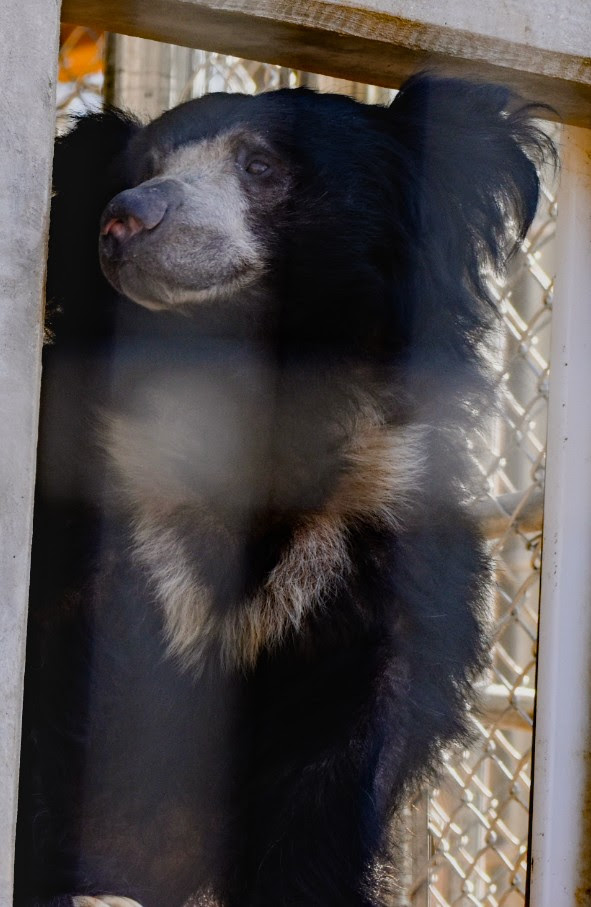
Kartick was born at the Woodland Park Zoo in Seattle, Washington on December 27, 2017 and is currently eight years old. He was transferred to the San Diego Zoo in 2019 before coming to Kansas last December. All animals who arrive at Sunset Zoo have to go through a period of quarantine in case they carry any potentially contagious ailments. During this time, they are separated from all other animals until they pass a rigorous veterinary exam.
After Kartick cleared quarantine, keepers began slowly introducing him to Tess. This started with something simple like swapping the bedding between the bears so they could get used to each other’s smell. Then they let the bears smell each other through the shift doors. Currently, they are letting one bear into the other’s vacant den, so they can become even more familiar with each other. Introducing two animals is an intentionally slow process to maximize safety. Taking the process slowly is especially important for potentially dangerous animals, who have a greater possibility of injuring each other if an introduction goes poorly. Our keepers are doing everything they can to ensure the process goes as well as possible.
The hope is that Kartick and Tess will breed and produce cubs, like Tess’ sister Molly did at the Smithsonian Zoo last December. Sloth bears have a defined breeding season, which usually occurs from about May to July, with cubs born around December or January. Sloth bear cubs are very small when they are born, weighing only about a pound. They don’t open their eyes until about two to three weeks old and only start moving around at four weeks. Cubs will nurse for about a year and stay with their mothers for about two to three years. Mothers carry their cubs on their backs and the cubs hold on to mom’s shaggy fur.
In the wild, sloth bears range across south Asia and are found in India, Sri Lanka, Bangladesh, Nepal, and Bhutan. They are most likely to be found in forests and grasslands and gravitate toward rocky outcrops. While technically omnivores, sloth bears are highly adapted to eat their preferred diet – insects. They have long claws they use to dig open rotting logs, long snouts they can stick into termite nests and long tongues to seek out prey. However, the bears’ ability to huff and puff puts the big bad wolf to shame. They are able to powerfully blow away the earth around a termite mound, voluntarily closing their nostrils in the process, and then vacuum up the insects into their mouth. Adults also have no upper front teeth to block the way of sucking up food.
At the moment, Kartick is given access to the outdoor habitat in the mornings, then swaps with Tess for the afternoons. Kartick is distinguishable from Tess by his large, round, very fuzzy ears and keepers say he looks like a teddy bear or Teddy Graham.
The next time you are planning on visiting Sunset Zoo, consider coming in the morning so you can say hello to Kartick!